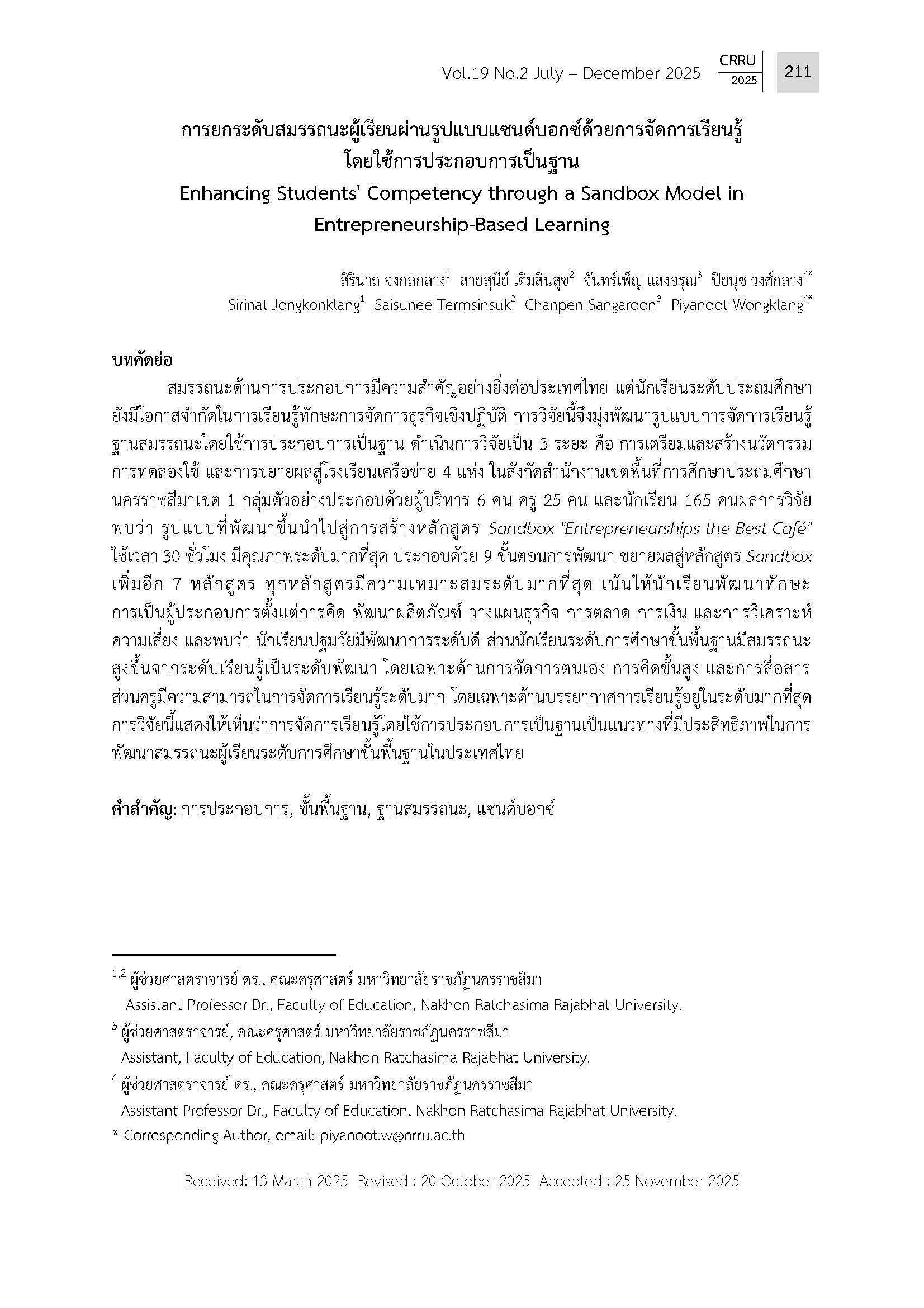
การยกระดับสมรรถนะผู้เรียนผ่านรูปแบบแซนด์บอกซ์ด้วยการจัดการเรียนรู้ โดยใช้การประกอบการเป็นฐาน
คำสำคัญ:
การประกอบการ, ขั้นพื้นฐาน, ฐานสมรรถนะ, แซนด์บอกซ์บทคัดย่อ
สมรรถนะด้านการประกอบการมีความสำคัญอย่างยิ่งต่อประเทศไทย แต่นักเรียนระดับประถมศึกษายังมีโอกาสจำกัดในการเรียนรู้ทักษะการจัดการธุรกิจเชิงปฏิบัติ การวิจัยนี้จึงมุ่งพัฒนารูปแบบการจัดการเรียนรู้ฐานสมรรถนะโดยใช้การประกอบการเป็นฐาน ดำเนินการวิจัยเป็น 3 ระยะ คือ การเตรียมและสร้างนวัตกรรม การทดลองใช้ และการขยายผลสู่โรงเรียนเครือข่าย 4 แห่ง ในสังกัดสำนักงานเขตพื้นที่การศึกษาประถมศึกษานครราชสีมาเขต 1 กลุ่มตัวอย่างประกอบด้วยผู้บริหาร 6 คน ครู 25 คน และนักเรียน 165 คนผลการวิจัยพบว่า รูปแบบที่พัฒนาขึ้นนำไปสู่การสร้างหลักสูตร Sandbox "Entrepreneurships the Best Café" ใช้เวลา 30 ชั่วโมง มีคุณภาพระดับมากที่สุด ประกอบด้วย 9 ขั้นตอนการพัฒนา ขยายผลสู่หลักสูตร Sandbox เพิ่มอีก 7 หลักสูตร ทุกหลักสูตรมีความเหมาะสมระดับมากที่สุด เน้นให้นักเรียนพัฒนาทักษะ
การเป็นผู้ประกอบการตั้งแต่การคิด พัฒนาผลิตภัณฑ์ วางแผนธุรกิจ การตลาด การเงิน และการวิเคราะห์ความเสี่ยง และพบว่า นักเรียนปฐมวัยมีพัฒนาการระดับดี ส่วนนักเรียนระดับการศึกษาขั้นพื้นฐานมีสมรรถนะสูงขึ้นจากระดับเรียนรู้เป็นระดับพัฒนา โดยเฉพาะด้านการจัดการตนเอง การคิดขั้นสูง และการสื่อสาร ส่วนครูมีความสามารถในการจัดการเรียนรู้ระดับมาก โดยเฉพาะด้านบรรยากาศการเรียนรู้อยู่ในระดับมากที่สุด การวิจัยนี้แสดงให้เห็นว่าการจัดการเรียนรู้โดยใช้การประกอบการเป็นฐานเป็นแนวทางที่มีประสิทธิภาพในการพัฒนาสมรรถนะผู้เรียนระดับการศึกษาขั้นพื้นฐานในประเทศไทย
เอกสารอ้างอิง
Chaicharoen, S. (2014). Instructional design: Principles and theories to practices (1st ed.). Educational Technology Section, Faculty of Education, Khon Kaen University.
Cheng, C. C. J., Yang, C.-l., & Sheu, C. (2014). The link between eco-innovation and business performance: A Taiwanese industry context. Journal of Cleaner Production, 64, 81–90.
Eurydice. (2012). Entrepreneurship education at school in Europe: National strategies, curricula and learning outcomes. Education, Audiovisual and Culture Executive Agency.
Jones, C., & Iredale, N. (2010). Enterprise education as pedagogy. Education + Training, 52(1), 7-19.
Jongkonklang, S. (2021). Learning management science. Nakhon Ratchasima: Nakhon Ratchasima Rajabhat University.
Kalugina, O. (2020). Does distribution of energy innovation impact distribution of income: A quantile-based SDG modeling approach. Technological Forecasting and Social Change, 160, Article 120224. https://doi.org/10.1016/j.techfore.2020.120224
Kolb, D. A. (1984). Experiential learning: Experience as the source of learning and development. Prentice-Hall.
Lytras, M. D., Daniela, L., & Visvizi, A. (2018). Social networks research for sustainable smart education. Sustainability, 10(9), Article 2974. https://doi.org/10.3390/su10092974
Marsh, D., Mehisto, P., Wolff, D., & Frigols Martin, M. J. (2010). European Framework for CLIL Teacher Education: A framework for the professional development of CLIL teachers. European Centre for Modern Languages.
McGill, I., & Brockbank, A. (2004). The action learning handbook: Powerful techniques for education, professional development, and training. Routledge.
Ministry of Education. (2021). Educational management policy of the Ministry of Education, fiscal year 2021-2022. Office of Policy and Strategy.
Nakhon Ratchasima Provincial Education Office. (2021). Report on the results of the Ordinary National Educational Test (O-NET) for academic year 2021. http://nmapeo.go.th/info.php?id=313
Nakhon Ratchasima Provincial Office. (2021). Annual performance report 2021. Nakhon Ratchasima Provincial Office.
Neelakandan, N. (2020). What are the key concepts of competency-based learning? eLearning Industry.
https://elearningindustry.com/determine-employee-skill-development-through-competency-based-learning
OECD. (2019). An OECD learning framework 2030. In The Future of Education and Labor (pp. 23-35). Cham: Springer International Publishing.
Office of the Basic Education Commission. (2021). Guidelines for competency-based learning management. Bangkok: Agricultural Cooperative Federation of Thailand Printing House.
Office of the Education Council. (2019). Guidelines for developing student competencies in basic education. Bangkok: 21 Century.
Office of the Education Council. (2020). Active competency-based learning management. Bangkok: 21 Century.
Office of the Education Council. (2021). Guidelines for developing core competencies of basic education students. Bangkok: Prigwhan Graphic.
Office of the Education Council. (2022). Thai education report 2022. Bangkok: Prigwhan Graphic.
Office of Educational Testing. (2021). National educational testing report 2021. Office of Educational Testing.
Sudchakaj, S. (2020). A study on learning patterns for entrepreneurial skill development among teachers in the Office of Non-Formal and Informal Education in Thailand in the context of non-formal education [Unpublished master's thesis]. Mahidol University.
Suksomwat, C. (2020). Guidelines for teaching and learning management to promote student entrepreneurship: Crowdsourcing and text analytics [Unpublished master's thesis]. Chulalongkorn University.
Tomlinson, C. A. (2017). How to differentiate instruction in academically diverse classrooms (3rd ed.). ASCD.
Wongwanich, W., & Phathphol, M. (2021). Creative learning. Retrieved February 15, 2024, from Chiang Mai University Digital Collections.
ดาวน์โหลด
เผยแพร่แล้ว
รูปแบบการอ้างอิง
ฉบับ
ประเภทบทความ
สัญญาอนุญาต
ลิขสิทธิ์ (c) 2025 วารสารการวิจัยกาสะลองคำ มหาวิทยาลัยราชภัฏเชียงราย

อนุญาตภายใต้เงื่อนไข Creative Commons Attribution-NonCommercial-NoDerivatives 4.0 International License.