The economic, social, and environmental returns of crop replacing rubber of farmers under the production volume control project in Kalasin Province
DOI:
https://doi.org/10.14456/rc-sdj.2025.06Keywords:
crop replacing rubber, knowledge accessment, benefit cost ratio, plant diversity indexAbstract
Background: As a result of the decline in rubber prices in Thailand, the government has controlled production from 2015 to 2022. Therefore, this research studies the socio-economic conditions, compares the production, marketing, and returns, and identifies the problems of farmers who plant rubber trees instead of rubber in Kalasin Province.
Methods: Qualitative research was conducted by studying farmers who had participated in the project for between 1-3 years, setting a quota target group of 14 people. A structured interview form was used, specifying questions and arranging content for data collection through field interviews. Analysis of data through thematic and cross-tab analysis, presenting data with percentages and averages.
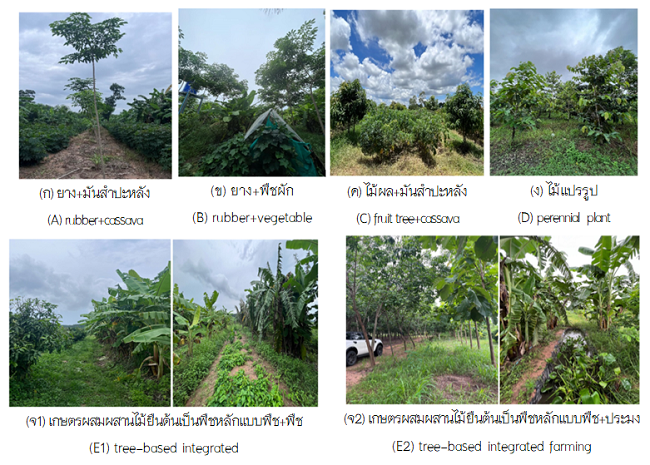
Results: Among the rubber replacement cropping systems, one approach involves maintaining rubber plantations but intercropping with other crops while waiting for rubber production. It was found that farmers who intercropped rubber with cassava achieved the highest average income and net profit, at 3,983 and 2,752 THB per rai per year, respectively. This method also had the highest benefit-cost ratio (BCR) of 3.23. Additionally, these farmers had continuous access to knowledge from the Rubber Authority of Thailand (RAOT). Conversely, farmers who entirely replaced rubber with new crops experienced the highest income and profit when intercropping fruit trees with cassava, generating 9,391 and 5,759 THB per rai per year, respectively, with a BCR of 2.61. However, this approach required the highest initial investment and maintenance costs, at 10,882 and 3,602 THB per rai per year, respectively. The cropping system with the highest plant diversity index was integrated farming with perennial trees as the primary crop (1.68), followed by rubber intercropped with cassava (0.49). Farmers who fully replaced rubber faced challenges such as a lack of technical support from RAOT, delays in compensation payments, and marketing difficulties.
Conclusions: Rubber–cassava intercropping yielded the highest returns, offering economic, social, and environmental benefits. Farmers gained knowledge from RAOT, and plant diversity was maintained. Strengthening networks with organizations is recommended to enhance support for production and marketing management among intercropping farmers.
References
Chambon, B., Promkhambut, A., Tongkaemkaew, U., Dao, X., & Bosc, P.M. (2016). Has the rubber boom weakened households in the new rubber producing areas? A case study in Northeast Thailand. In CRRI and IRRDB International Rubber Conference 2016 (pp. 1-13). Siem Reap (Cambodge).
Dawadi, S. (2020). Thematic Analysis Approach: A Step by Step Guide for ELT Research Practitioners. Journal of NELTA, 25(1-2), 62–71. https://doi.org/10.3126/nelta.v25i1-2.49731
Hougni, D.-G. J. M., Chambon, B., Penot, E., & Promkhambut, A. (2018). The household economics of rubber intercropping during the immature period in Northeast Thailand. Journal of Sustainable Forestry, 37(9), 1–17. https://doi.org/10.1080/10549811.2018.1486716
IPES-Food. (2016). From Uniformity to Diversity: A Paradigm Shift from Industrial Agriculture to Diversified Agroecological Systems. International Panel of Experts on Sustainable Food Systems. Full Report. https://www.ipes-food.org/_img/upload/files/UniformityToDiversity_FULL.pdf
Kalasin Provincial Agriculture and Cooperatives office. (2023). Basic information of Kalasin Province (May 2023). Publication documents. https://www.opsmoac.go.th/kalasin-dwl-preview-421191791812
Kremen, C., & Miles, A. (2012). Ecosystem Services in Biologically Diversified versus Conventional Farming Systems: Benefits, Externalities, and Trade-Offs. Ecology and Society, 17(4). http://www.jstor.org/stable/26269237
Kremen, C., Iles, A., & Bacon, C. (2012). Diversified farming systems: an agroecological, systems-based alternative to modern industrial agriculture. Ecology and Society, 17(4), 44. http://dx.doi.org/10.5751/ES-05103-170444
Kromkratok, W., Angthong, S., Phonlacharoen, S., Thirachai, S., Phongsuphat, K., & Daengnim, P. (2022). Rubber situation in the second quarter of 2023. Rubber Journal, 44(3), 34-43.
Kullawong, S., Aditto S., Chambon, B., & Promkhambut, A. (2020). Farmer fertilization practices ofmature rubber plantations in NortheastThailand during a period of low rubber prices. Forest and Society, 4(1), 162-180. https://doi.org/10.24259/fs.v4i1.8980
Kullawong, S., Aditto, S., Chambon, B., & Promkhambut, A. (2018). Dynamic of rubber production in Northeast Thailand: A case study at Subsomboon village, Doonsard sub-district, Kranuan district, Khon Kaen province. Khon Kaen Agriculture Journal, 46(Suppl. 1), 239-248. https://agritrop.cirad.fr/588402/
Land Development Department. (2021). Guidelines for promoting suitable agriculture based on the Agri-Map data in Kalasin. https://www.ldd.go.th/Agri-Map/Data/NE/ksn.pdf
Lekbangpong, S., Mongkaew, T., Poonnual, N., & Sriplod, S. (2022). The Model of the Career Development in the Integrated Farming System for Lifestyle of New Model Farmers in Nakhon Si Thammarat Province. Rajabhat Rambhai Barni Research Journal, 16(3), 133-142. https://so05.tci-thaijo.org/index.php/RRBR/article/view/262306/176321
Mensah, J. (2019). Sustainable development: Meaning, history, principles, pillars, and implications for human action: Literature review. Cogent Social Sciences, 5(1). https://doi.org/10.1080/23311886.2019.1653531
Neadkhun, P., Borisutdhi, Y., Simarak, S., & Panpakdee, C. (2023). Coping strategies of rubber farmers in Bueng Kan, Thailand durinf a period of price fluctuations. Humanities, Arts and Social Sciences Studies, 23(2), 273-283. https://doi.org/10.14456/hasss.2023.25
Office of the Senate Secretariat. (2016). Regulations of the Rubber Authority of Thailand 2015. Printing Office.
Polthanee, A., Promkhambut, A., & Khamla, N. (2016). Seeking security through rubber intercropping: A case study from northeastern Thailand. Asia-Pacific Journal of Science and Technology, 21(3), 1–11. https://doi.org/10.14456/apst.2016.1
Purvis, B., Mao, Y., & Robinson, D. (2019). Three pillars of sustainability: in search of conceptual origins. Sustainability Science, 14(3), 681-695. https://doi.org/10.1007/s11625-018-0627-5
Ratanasongtham, W., Jitmun, S., Duangtanoi, W., Jankawee, T., Thammasarangkoon, K., Homphian, N., & Sookbumroong, W. (2021). Cost and return of economic crops in agroforestry garden of Eastern Phi Pan Nam mountain range in Uttaradit province. Lampang Rajabhat University Journal, 11(1), 100–111. https://so04.tci-thaijo.org/index.php/JLPRU/article/view/251394
Rockström, J., Williams, J., Daily, G., Noble, A., Matthews, N., Gordon, L., Wetterstrand, H., DeClerck, F., Shah, M., Steduto, P., & de Fraiture, C. (2017). Sustainable intensification of agriculture for human prosperity and global sustainability. Ambio, 46, 4-17. https://doi.org/10.1007/s13280-016-0793-6
Rodriguez, C., Martensson, L., Zachrison, M., & Carlsson, G. (2021). Sustainability of Diversified Organic Cropping System-Challenges Identified by Farmer Interviews and Multicriterial Assessments. Frontiers in Agronomy, (3). https://doi.org/10.3389/fagro.2021.698968
Rubber Act of Thailand B.E. 2588 (2015, July 14). Government Gazette. No. 132 Section 36 A. Pages 1-18.
Rubber Research Institute. (2012). Rubber: A historical crop intertwined with the lives of Thai farmers. https://km.raot.co.th/magazine/ebook-11.pdf
Siripongtugksin, N. (2019). Impacts of government rubber policies on rubber planting in Thailand. Research and Development Journal, Suan Sunandha Rajabhat University, 11(2). https://doi.org/10.53848/irdssru.v11i2.233392
Sukkaewmanee, P., & Pranpravit, A. (2024). The diversity study of plant, ecology, palynology and anti-bacteria of Drosera burmanni Vahl in Mueang Surat Thani and Kanchanadit District, Surat Thani Province. Agriculture and Technology Journal, 5(1), 100-114. https://shorturl.asia/oSgvF
Suwannawimon, T. (2014). Report on conversion of rubber wood weight to wood volume. Copy of the book of the Forest Research and Development Office.
Tasankun, P. (2023). Thai rubber situation NOW NEW NEXT towards becoming the world's rubber center. Rubber Journal, 44(3), 25-33.
Thi, H. N., & Cramb, R. A. (2017). Economic Analysis of Improved Smallholder Paddy and Maize Production in Northern Viet Nam and Implications for Climate-Smart Agriculture. In Climate Smart Agriculture-Building Resilience to Climate Change (pp. 563-599). Springer.
Tongkaemkaew, U. (2018). Impact of Rubber Plantation on Daily Time Spent of Small Holders in Northeast Thailand. Thaksin University Journal, 17(4), 48-61.
Tongpan, S., & Neungjamnong, N. (2019). From rice paddies to rubber plantations: The transformation of livelihood and food security of farming households along the Mekong River in Bueng Kan province. Journal of Humanities and Social Sciences, Ubon Ratchathani University, 10(1), 25-45. https://so02.tci-thaijo.org/index.php/human _ubu/article/view/182694/148180
Wongsuwat, P., Rattanawong, W., & Chantraprakaekun, W. (2021). Sustainability of rubber farmers in Thailand. Suthiparitat Journal, 35(3), 174-193.
Zhu, X., Liu, W., Chen, J., Bruijnzeel, L. A., Mao, Z., Yang, X., Cardinael, R., Meng, F. R., Sidle, R. C., Seitz, S., & Nair, V. D. (2020). Reductions in water, soil and nutrient losses and pesticides pollution in agroforestry practices: a review of evidence and processes. Plant and soil, 453, 45-86. https://doi.org/10.1007/s11104-019-04377-3