ผลตอบแทนทางเศรษฐกิจ สังคม และสิ่งแวดล้อมของระบบปลูกพืชแทนยางพาราภายใต้โครงการควบคุมปริมาณการผลิตในจังหวัดกาฬสินธุ์
DOI:
https://doi.org/10.14456/rc-sdj.2025.06คำสำคัญ:
การปลูกแทนยางพารา, การเข้าถึงความรู้, อัตราผลประโยชน์ต่อต้นทุน, ดัชนีความหลากหลายพืชบทคัดย่อ
ที่มา(ภูมิหลัง): ผลจากราคายางพาราในประเทศไทยลดลง ทำให้รัฐบาลจึงควบคุมการผลิตในปี พ.ศ. 2558 ถึงปี พ.ศ. 2565 ดังนั้นงานวิจัยนี้จึงทำการศึกษาสภาพสังคมเศรษฐกิจ เปรียบเทียบผลผลิต การตลาด และผลตอบแทน และระบุปัญหาของเกษตรกรผู้ปลูกพืชแทนยางพาราในจังหวัดกาฬสินธุ์
วิธีการ: การวิจัยเชิงคุณภาพ โดยศึกษาเกษตรกรที่เข้าร่วมโครงการระหว่าง 1-3 ปี กำหนดกลุ่มเป้าหมายแบบโควตา จำนวน 14 ราย ใช้แบบสัมภาษณ์ชนิดมีโครงสร้างที่กำหนดคำถามเรียงลำดับเนื้อหาสำหรับเก็บรวบรวมข้อมูลด้วยการลงพื้นที่ทำการสัมภาษณ์ ส่วนการวิเคราะห์ข้อมูลใช้วิธีการวิเคราะห์แก่นสาระ และวิเคราะห์โดยใช้ตารางไขว้ นำเสนอข้อมูลด้วยค่าร้อยละ และค่าเฉลี่ย
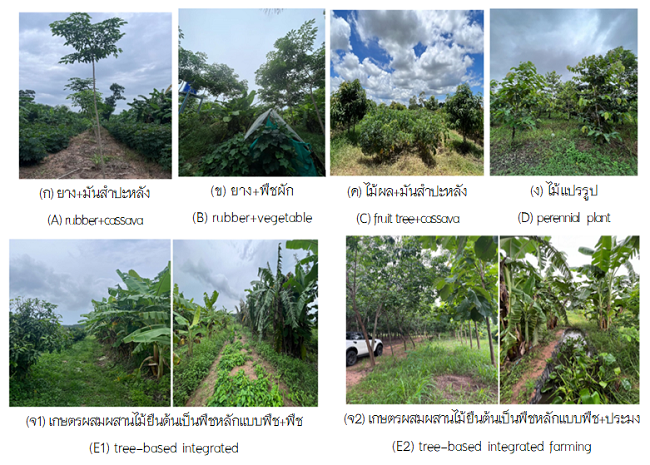
ผลลัพธ์: ระบบปลูกพืชทดแทนยางพาราที่ยังคงปลูกแทนด้วยยางพาราเหมือนเดิม แต่ปลูกพืชแซมในระหว่างรอผลผลิตจากยางพารา พบว่าเกษตรกรที่ปลูกยางพาราแซมด้วยมันสำปะหลังสามารถทำรายได้เฉลี่ย และกำไรสุทธิสูงสุด คือ 3,983 และ 2,752 บาทต่อไร่ต่อปี ตามลำดับ และมีค่าอัตราผลประโยชน์ต่อต้นทุนสูงที่สุดคือ 3.23 นอกจากนี้ ยังเข้าถึงความรู้จากการยางแห่งประเทศไทย (กยท.) อย่างต่อเนื่อง ขณะที่เกษตรกรผู้ปลูกแทนโดยเปลี่ยนพืชชนิดใหม่ทดแทนยางพารา พบว่า การปลูกไม้ผลแซมด้วยมันสำปะหลังมีรายได้ และกำไรสูงสุด คือ 9,391 และ 5,759 บาทต่อไร่ต่อปี ตามลำดับ และมีค่าอัตราผลประโยชน์ต่อต้นทุน 2.61 อย่างไรก็ตาม การปลูกแทนนี้มีเงินลงทุนเริ่มต้นสูงที่สุด และมีค่าใช้จ่ายในการดูแลพืชสูงสุดคือ 10,882 และ 3,602 บาทต่อไร่ต่อปี ตามลำดับ การปลูกแทนยางพาราที่มีค่าดัชนีความหลากหลายพืช ซึ่งเป็นดัชนีบ่งชี้ความมั่นคงของระบบนิเวศสูงสุด คือ การทำเกษตรผสมผสานที่มีไม้ยืนต้นเป็นพืชหลัก (1.68) รองลงมาคือ การปลูกยางพาราแซมด้วยมันสำปะหลัง (0.49) เกษตรกรที่เปลี่ยนพืชชนิดทดแทนยางพาราประสบปัญหาการไม่ได้รับความรู้ในการจัดการแปลงจากการยางแห่งประเทศไทย ความล่าช้าในการจ่ายเงินทดแทน และปัญหาทางด้านการตลาด
บทสรุป: การปลูกแทนแบบยางพาราแซมด้วยมันสำปะหลังเป็นรูปแบบที่ดีที่สุด เนื่องจากผลตอบแทนทางเศรษฐกิจสูงสุด ขณะที่ผลตอบแทนทางสังคม คือ การเข้าถึงความรู้และผลตอบแทนทางสิ่งแวดล้อมมีค่าดัชนีความหลากหลายพืชปานกลาง จึงควรมีการเชื่อมโยงเครือข่ายกับหน่วยงานเกี่ยวข้องที่สามารถให้ความรู้เกี่ยวกับการจัดการด้านการผลิต และการตลาดในทุกระบบการส่งเสริมเกษตรกร
เอกสารอ้างอิง
Chambon, B., Promkhambut, A., Tongkaemkaew, U., Dao, X., & Bosc, P.M. (2016). Has the rubber boom weakened households in the new rubber producing areas? A case study in Northeast Thailand. In CRRI and IRRDB International Rubber Conference 2016 (pp. 1-13). Siem Reap (Cambodge).
Dawadi, S. (2020). Thematic Analysis Approach: A Step by Step Guide for ELT Research Practitioners. Journal of NELTA, 25(1-2), 62–71. https://doi.org/10.3126/nelta.v25i1-2.49731
Hougni, D.-G. J. M., Chambon, B., Penot, E., & Promkhambut, A. (2018). The household economics of rubber intercropping during the immature period in Northeast Thailand. Journal of Sustainable Forestry, 37(9), 1–17. https://doi.org/10.1080/10549811.2018.1486716
IPES-Food. (2016). From Uniformity to Diversity: A Paradigm Shift from Industrial Agriculture to Diversified Agroecological Systems. International Panel of Experts on Sustainable Food Systems. Full Report. https://www.ipes-food.org/_img/upload/files/UniformityToDiversity_FULL.pdf
Kalasin Provincial Agriculture and Cooperatives office. (2023). Basic information of Kalasin Province (May 2023). Publication documents. https://www.opsmoac.go.th/kalasin-dwl-preview-421191791812
Kremen, C., & Miles, A. (2012). Ecosystem Services in Biologically Diversified versus Conventional Farming Systems: Benefits, Externalities, and Trade-Offs. Ecology and Society, 17(4). http://www.jstor.org/stable/26269237
Kremen, C., Iles, A., & Bacon, C. (2012). Diversified farming systems: an agroecological, systems-based alternative to modern industrial agriculture. Ecology and Society, 17(4), 44. http://dx.doi.org/10.5751/ES-05103-170444
Kromkratok, W., Angthong, S., Phonlacharoen, S., Thirachai, S., Phongsuphat, K., & Daengnim, P. (2022). Rubber situation in the second quarter of 2023. Rubber Journal, 44(3), 34-43.
Kullawong, S., Aditto S., Chambon, B., & Promkhambut, A. (2020). Farmer fertilization practices ofmature rubber plantations in NortheastThailand during a period of low rubber prices. Forest and Society, 4(1), 162-180. https://doi.org/10.24259/fs.v4i1.8980
Kullawong, S., Aditto, S., Chambon, B., & Promkhambut, A. (2018). Dynamic of rubber production in Northeast Thailand: A case study at Subsomboon village, Doonsard sub-district, Kranuan district, Khon Kaen province. Khon Kaen Agriculture Journal, 46(Suppl. 1), 239-248. https://agritrop.cirad.fr/588402/
Land Development Department. (2021). Guidelines for promoting suitable agriculture based on the Agri-Map data in Kalasin. https://www.ldd.go.th/Agri-Map/Data/NE/ksn.pdf
Lekbangpong, S., Mongkaew, T., Poonnual, N., & Sriplod, S. (2022). The Model of the Career Development in the Integrated Farming System for Lifestyle of New Model Farmers in Nakhon Si Thammarat Province. Rajabhat Rambhai Barni Research Journal, 16(3), 133-142. https://so05.tci-thaijo.org/index.php/RRBR/article/view/262306/176321
Mensah, J. (2019). Sustainable development: Meaning, history, principles, pillars, and implications for human action: Literature review. Cogent Social Sciences, 5(1). https://doi.org/10.1080/23311886.2019.1653531
Neadkhun, P., Borisutdhi, Y., Simarak, S., & Panpakdee, C. (2023). Coping strategies of rubber farmers in Bueng Kan, Thailand durinf a period of price fluctuations. Humanities, Arts and Social Sciences Studies, 23(2), 273-283. https://doi.org/10.14456/hasss.2023.25
Office of the Senate Secretariat. (2016). Regulations of the Rubber Authority of Thailand 2015. Printing Office.
Polthanee, A., Promkhambut, A., & Khamla, N. (2016). Seeking security through rubber intercropping: A case study from northeastern Thailand. Asia-Pacific Journal of Science and Technology, 21(3), 1–11. https://doi.org/10.14456/apst.2016.1
Purvis, B., Mao, Y., & Robinson, D. (2019). Three pillars of sustainability: in search of conceptual origins. Sustainability Science, 14(3), 681-695. https://doi.org/10.1007/s11625-018-0627-5
Ratanasongtham, W., Jitmun, S., Duangtanoi, W., Jankawee, T., Thammasarangkoon, K., Homphian, N., & Sookbumroong, W. (2021). Cost and return of economic crops in agroforestry garden of Eastern Phi Pan Nam mountain range in Uttaradit province. Lampang Rajabhat University Journal, 11(1), 100–111. https://so04.tci-thaijo.org/index.php/JLPRU/article/view/251394
Rockström, J., Williams, J., Daily, G., Noble, A., Matthews, N., Gordon, L., Wetterstrand, H., DeClerck, F., Shah, M., Steduto, P., & de Fraiture, C. (2017). Sustainable intensification of agriculture for human prosperity and global sustainability. Ambio, 46, 4-17. https://doi.org/10.1007/s13280-016-0793-6
Rodriguez, C., Martensson, L., Zachrison, M., & Carlsson, G. (2021). Sustainability of Diversified Organic Cropping System-Challenges Identified by Farmer Interviews and Multicriterial Assessments. Frontiers in Agronomy, (3). https://doi.org/10.3389/fagro.2021.698968
Rubber Act of Thailand B.E. 2588 (2015, July 14). Government Gazette. No. 132 Section 36 A. Pages 1-18.
Rubber Research Institute. (2012). Rubber: A historical crop intertwined with the lives of Thai farmers. https://km.raot.co.th/magazine/ebook-11.pdf
Siripongtugksin, N. (2019). Impacts of government rubber policies on rubber planting in Thailand. Research and Development Journal, Suan Sunandha Rajabhat University, 11(2). https://doi.org/10.53848/irdssru.v11i2.233392
Sukkaewmanee, P., & Pranpravit, A. (2024). The diversity study of plant, ecology, palynology and anti-bacteria of Drosera burmanni Vahl in Mueang Surat Thani and Kanchanadit District, Surat Thani Province. Agriculture and Technology Journal, 5(1), 100-114. https://shorturl.asia/oSgvF
Suwannawimon, T. (2014). Report on conversion of rubber wood weight to wood volume. Copy of the book of the Forest Research and Development Office.
Tasankun, P. (2023). Thai rubber situation NOW NEW NEXT towards becoming the world's rubber center. Rubber Journal, 44(3), 25-33.
Thi, H. N., & Cramb, R. A. (2017). Economic Analysis of Improved Smallholder Paddy and Maize Production in Northern Viet Nam and Implications for Climate-Smart Agriculture. In Climate Smart Agriculture-Building Resilience to Climate Change (pp. 563-599). Springer.
Tongkaemkaew, U. (2018). Impact of Rubber Plantation on Daily Time Spent of Small Holders in Northeast Thailand. Thaksin University Journal, 17(4), 48-61.
Tongpan, S., & Neungjamnong, N. (2019). From rice paddies to rubber plantations: The transformation of livelihood and food security of farming households along the Mekong River in Bueng Kan province. Journal of Humanities and Social Sciences, Ubon Ratchathani University, 10(1), 25-45. https://so02.tci-thaijo.org/index.php/human _ubu/article/view/182694/148180
Wongsuwat, P., Rattanawong, W., & Chantraprakaekun, W. (2021). Sustainability of rubber farmers in Thailand. Suthiparitat Journal, 35(3), 174-193.
Zhu, X., Liu, W., Chen, J., Bruijnzeel, L. A., Mao, Z., Yang, X., Cardinael, R., Meng, F. R., Sidle, R. C., Seitz, S., & Nair, V. D. (2020). Reductions in water, soil and nutrient losses and pesticides pollution in agroforestry practices: a review of evidence and processes. Plant and soil, 453, 45-86. https://doi.org/10.1007/s11104-019-04377-3