
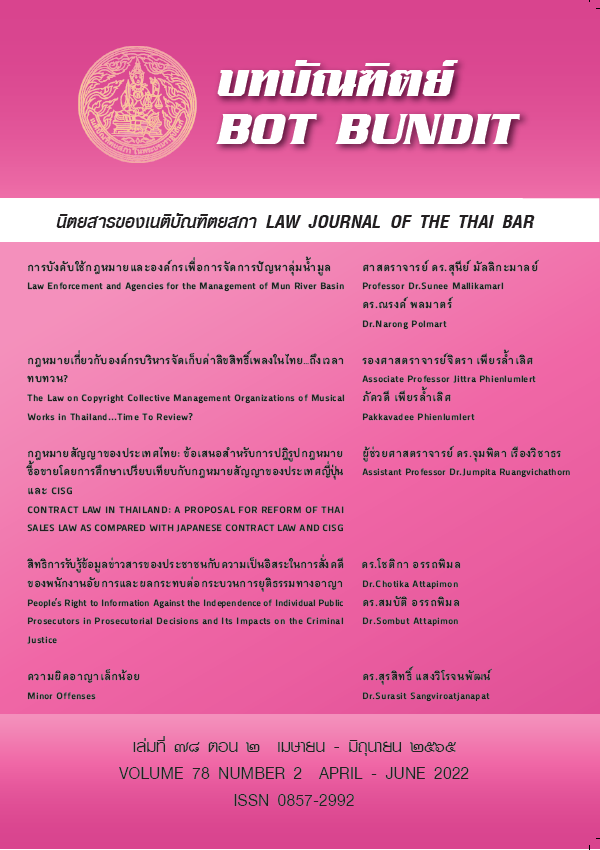
CONTRACT LAW IN THAILAND: A PROPOSAL FOR REFORM OF THAI SALES LAW AS COMPARED WITH JAPANESE CONTRACT LAW AND CISG
Article Sidebar
Main Article Content
Abstract
Currently, there are no specific laws governing domestic commercial sales and international sales in Thailand, which apparently cause legal obstacles. The sales provisions provided in the Thai Civil and Commercial Code (“TCC”) are the only set of Thai laws applying to all types of sales which are distinct in nature. As Thailand and Japan share similar legal histories and backgrounds in following the Civil Law legal system originated in Continental Europe, and the Japanese Civil Code (“JCC”) was also the forerunner of TCC when the time of its first drafting in 1905, any revision made in JCC is of significance to TCC.
Additionally, Japan, but not Thailand, is also a member state of the United Nations Convention on Contracts for the International Sale of Goods (“CISG”), or the 1980 Vienna Sales Convention, which was designed to apply only to international commercial sales and is now worldwide accepted and gaining more and more popularity as the growing number of member states has been increasing and currently reaching 94 states.
JCC has just been revised, after no significant intact during the last 120 years, in the part of the law of obligations including contract, known as ‘the 2017 Reform,’ which has become effective since 1st April 2020. This research is thus aimed to study (1) the significance of the revised JCC as a guideline in developing Thai contract law regarding sales, (2) the significance of CISG as a guideline in developing Thai sales law, and (3) the significance of developing Thai contract law regarding sales by using the revised JCC and CISG as guidelines. In doing so, some significant aspects of JCC, which have been revised, are selected to compare with CISG and TCC to evaluate their compatibilities to use as guidelines in developing Thai sales law in the area needed.
It is highly expected that the result of this research will be a piece of vital information that can be used to develop Thai sales law by using the selected revised JCC and CISG as guidelines, where appropriate, in any form of (1) separating domestic commercial sales from non-commercial sales, (2) enacting a new law applying to domestic commercial sales, and (3) acceding to CISG with the enactment of a new Thai sales law applying specifically to international sales.
Article Details

This work is licensed under a Creative Commons Attribution-NonCommercial-NoDerivatives 4.0 International License.
References
Abe, M., & Nottage, L. (2014). Japanese Law. In J. M. Smits (Ed.), Elgar Encyclopedia of Comparative Law, Second Edition ( pp 462-479). Edward Elgar Publishing Limited.
Alper, G. (2022, May 5). CISG: Table of Contracting States. Institute of International Commercial Law. https://iicl.law.pace.edu/cisg/page/cisg-table-contracting-states
Boonchalermvipas, S. (1997, November 6-7). Development of Legal Systems in Asia: Experiences of Japan and Thailand. In Chomchai, P. (Ed.), Proceedings of the International Symposium on the Development of Legal Systems in Asia: Experiences of Japan and Thailand, Bangkok, Thailand. Khyshu University & Thammasat University.
Chomchai, P. (Ed.). (1997, November 6-7). The History of Thai Legal System. In Proceedings of the International Symposium on the Development of Legal Systems in Asia: Experiences of Japan and Thailand, Bangkok, Thailand. Khyshu University & Thammasat University.
Ishikawa, H. (2013). Codification, Decodification, and Recodification of the Japanese Civil Code. In Ius Gentium: Comparative Perspectives on Law and Justice (IUSGENT ed., Vol. 32, pp. 267–285). Springer Publishing. https://doi.org/10.1007/978-94-007-7942-6_12
Isogawa, N. (1997, November 6-7). The Japanese Civil Code in the World of Legal Systems: Toward a Comparative Study on the Asian Civil Law. In Chomchai, P. (Ed.), Proceedings of the International Symposium on the Development of Legal Systems in Asia: Experiences of Japan and Thailand, Bangkok, Thailand. Khyshu University & Thammasat University.
Kraivixien, T. (1963). Thai Legal History. Women Lawyers Journal, 49(3), 6–24.
Mukai, K. & Toshitani, N. (1967). The Progress and Problems of Compiling the Civil Code in the Early Meiji Era. In Law in Japan: an Annual 1, 25-59.
Nottage, L. (2019). Comparative Law in and for Japan. In Reimann, M. & Zimmerman, R. (Eds.), The Oxford Handbook of Comparative Law (2nd ed.). Oxford University Press.
Otori, T. (1971). Shokanshuho [Commercial Customary Law]. In Commercial Law (General Provisions and Commercial Transactions) [Seminar].
Ruangvichathorn, J. (1996). English and Thai Approaches to Some Typical Remedy Clauses in International Sales Contracts Compared. University of Exeter.
Ruangvichathorn, J. (1996). The Japanese Civil Code: The forerunner of Thai Civil and Commercial Code. Sripatum University Press.
Ruangvichathorn, J. (2020). The Harmonisation of ASEAN Sales Law: A Comparative Study with Thai Sales Law and CISG. Thammasat Law Journal, 49(1), 131–147. https://so05.tci-thaijo.org/index.php/tulawjournal/article/download/225358/163933/
Sawaeng Bunchaloemwipat. (2009). The History of Thai Legal System ( 9th ed.). Winyuchon Publication House.
Schwenzer, I., Fountoulakis, C., & Dimsey, M. (2012). International Sales Law: A Guide to the CISG. Hart Publishing.
Schwenzer, I., & Hachem, P. (2009). The CISG - Successes and Pitfalls. American Journal of Comparative Law, 57(2).
Sono, H., Nottage, L., Saigusa, K., & Pardieck, A. (2019). Contract Law in Japan. Kluwer Law International.
Taylor, V. L. (1993). Continuing Transactions and Persistent Myths: Contracts in Contemporary Japan. Melbourne University Law Review, 19(2), 352–398. http://classic.austlii.edu.au/au/journals/MelbULawRw/1993/17.pdf
Zimmermann, R. (2010). Comparative Foundations of a European Law of Set-Off and Prescription. Cambridge University Press. https://assets.cambridge.org/97805218/14614/copyright/9780521814614_copyright.pdf
