The Development of a Mathematical Skills and Processes Test for Upper Secondary School Students under the Bangkok Secondary Educational Service Area Office 1
Keywords:
mathematical skills and processes, norm, test developmentAbstract
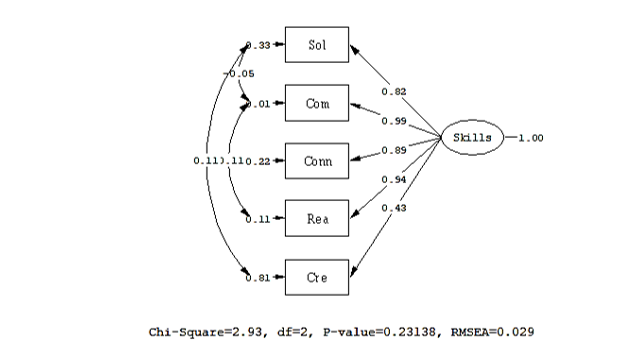
The objectives of this research were to 1) develop and examine the quality of a mathematics skills and processes test; and 2) develop a norm for interpreting scores. The sample group consisted of 564 upper secondary school students under the Bangkok Secondary Educational Service Area Office 1, Semester 2/2023, obtained through multi-stage random sampling. The research results indicated the following: 1) The developed test has five components, namely 1. problem-solving skills; 2.mathematical communication and interpretation skills; 3. connection skills; 4. reasoning skills; and creative thinking skills. The test is in the form of situational questions. Components 1-4 are 40 multiple-choice questions with five options, awarding 0 point for incorrect answers and 1 point for correct answers. Component 5 requires written answers and is scored using a rubric-based system, totaling 42 questions; 2) The test demonstrated content validity with the index of item objective congruence (IOC) ranging from 0.60 to 1.00. The level of difficulty and discriminating power were 0.37 to 0.74 and 0.30 to 0.82, respectively, while the overall reliability was 0.96. Confirmatory factor analysis showed consistency with the empirical data ( = 1.46, p = 0.23, GFI = 0.99, AGFI = 0.98, RMSEA = 0.03, RMR = 0.00). The norm for the test, in the form of standard T scores, ranged from T35 to T70. The sample students demonstrated a moderate level of ability in mathematical skills and processes.
Keywords: mathematical skills and processes, norm, test development
References
กระทรวงศึกษาธิการ. (2560). มาตรฐานการเรียนรู้และตัวชี้วัด (ฉบับปรับปรุง พ.ศ. 2560) ตามหลักสูตรแกนกลางการศึกษาขั้นพื้นฐาน พุทธศักราช 2551. โรงพิมพ์ชุมนุมสหกรณ์การเกษตรแห่งประเทศไทยจำกัด.
ฉวีวรรณ แก้วไทรฮะ. (2559). รายงานการวิจัย เรื่อง การพัฒนารูปแบบเครื่องมือการวัดทักษะกระบวนการทางคณิตศาสตร์ในระดับมัธยมศึกษาตอนต้น. วิทยาลัยนานาชาติ มหาวิทยาลัยราชภัฏสวนสุนันทา.
ฉัตรศิริ ปิยะพิมลสิทธิ์. (2548). การใช้ spss เพื่อการวิเคราะห์ข้อมูล. มหาวิทยาลัยทักษิณ.
ชวาล แพรัตนกุล. (2520). คู่มือการสร้างแบบทดสอบมาตรฐานความถนัดทางการเรียนชั้นมัธยมศึกษาปีที่ 3. โรงพิมพ์คุรุสภา.
พรทิพย์ ไชยโส. (2545). เอกสารคำสอน วิชา 153521 หลักการวัดและประเมินผลการศึกษาขั้นสูง. ภาควิชาการศึกษา คณะศึกษาศาสตร์มหาวิทยาลัย เกษตรศาสตร์.
พร้อมพรรณ อุดมสิน. (2544). การวัดและการประเมินผลการเรียนการสอนคณิตศาสตร์ (พิมพ์ครั้งที่ 3 ed.). จุฬาลงกรณ์มหาวิทยาลัย.
พิสณุ ฟองศรี. (2552). การสร้างและพัฒนาเครื่องมือวิจัย. ด่านสุทธาการพิมพ์จำกัด.
ไพศาล วรคำ. (2554). การวิจัยทางการศกษา. ตักสิลาการพิมพ์.
ศิริชัย กาญจนวาสี. (2556). การทดสอบแบบดั้งเดิม (พิมพ์ครั้งที่ 7 ed.). จุฬาลงกรณ์มหาวิทยาลัย.
สถาบันส่งเสริมการสอนวิทยาศาสตร์และเทคโนโลยี. (2560). คู่มือการใช้หลักสูตรกลุ่มสาระการเรียนรู้คณิตศาสตร์ ระดับมัธยมศึกษาตอนปลาย (ฉบับปรังปรุง พ.ศ. 2560). สถาบันส่งเสริมการสอนวิชาวิทยาศาสตร์และเทคโนโลยี.
อัมพร ม้าคนอง. (2559). ทักษะกระบวนการทางคณิตศาสตร์: การพัฒนาเพื่อพัฒนาการ (พิมพ์ครั้งที่ 3 ed.). โรงพิมพ์จุฬาลงกรณ์มหาวิทยาลัย.
OECD. (2019). PISA 2018 Results (Volume I): What Students Know and Can Do, PISA, OECD Publishing. https://doi.org/10.1787/5f07c754-en
Soper , D. S. (2022). Structural Equation Model Sample Size Calculator. https://www.analyticscalculators.com/calculator.aspx?id=89
Downloads
Published
Issue
Section
License
Copyright (c) 2024 Journal of Kasetsart Educational Review

This work is licensed under a Creative Commons Attribution-NonCommercial-NoDerivatives 4.0 International License.
บทความทุกบทความเป็นลิขสิทธิ์ของวารสารคณะศึกษาศาสตร์ มหาวิทยาลัยเกษตรศาสตร์ วิทยาเขตบางเขน
วารสารศึกษาศาสตร์ปริทัศน์ (Kasetsart Educational Review)



