
Factors Affecting Acceptance and Concerns Regarding Generative Artificial Intelligence Use for Learning Among Undergraduates
Keywords:
acceptance, concern, learning, generative artificial intelligence (GenAI)Abstract
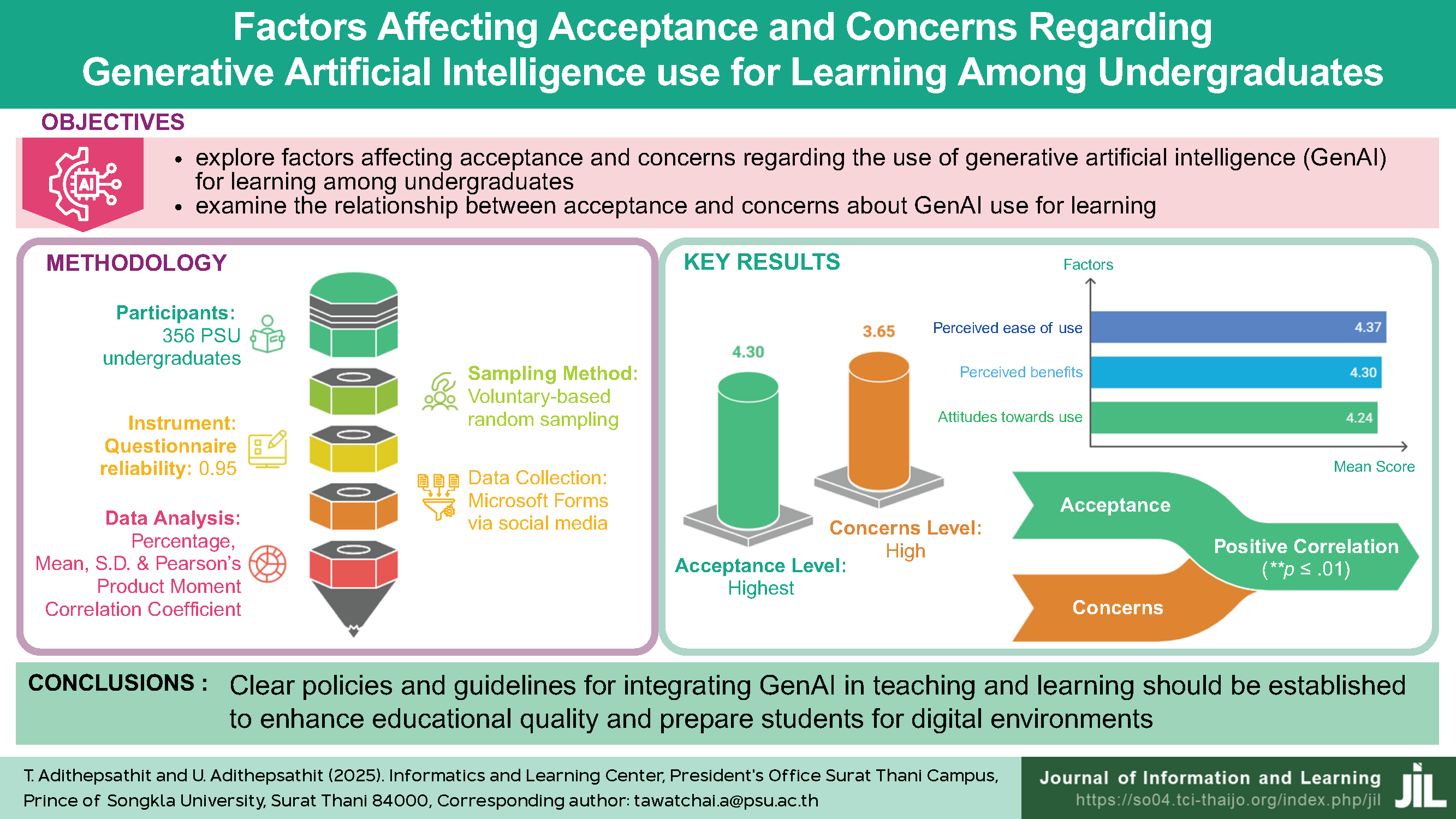
This research aims to study factors affecting acceptance and concerns regarding the use of Generative Artificial Intelligence (GenAI) for learning among undergraduates, and to examine the relationship between acceptance and concerns about GenAI use for learning. The participants of 356 undergraduate students at Prince of Songkla University, Surat Thani Campus, were selected by employing voluntary-based random sampling. The research instrument was a questionnaire assessing the participants' acceptance and concerns of GenAI use for learning, with a reliability coefficient of 0.95. Data were collected using a Microsoft Forms questionnaire distributed via social media channels during the second semester of the academic year 2024. The statistics employed for data analysis included percentage, mean, standard deviation, and Pearson’s Product Moment Correlation Coefficient to examine the relationship between factors affecting acceptance and concerns regarding GenAI use for learning. The findings revealed that the overall acceptance of GenAI use for learning among the participants was at the highest level (M = 4.30). The three aspects with the highest ratings included the acceptance in perceived ease of use (M = 4.37), acceptance in perceived benefits (M = 4.30), and attitudes towards use (M = 4.24) respectively. The overall level of concern about using GenAI for learning was at the high level (M = 3.65). The study also found a positive, statistically significant relationship between acceptance and concerns about using GenAI for learning at the .01 level. The findings from this study can be considered as a guideline for the development and enhancement of GenAI use to promote effective and responsible learning in the digital era.
References
Ahmed, K. (2024). A catalog of generative AI tools for faculty advancement [Conference presentation]. 21st International Conference on Information Technology Based Higher Education and Training (ITHET), Paris, France. https://doi.org/10.1109/ithet61869.2024.10837663
Akgun, S., & Greenhow, C. (2022). Artificial intelligence in education: Addressing ethical challenges in K-12 settings. AI and Ethics, 2, 431–440, https://doi.org/10.1007/s43681-021-00096-7
Bhat, M. A., Tiwari, C. K., Bhaskar, P., & Khan, S. T. (2024). Examining ChatGPT adoption among educators in higher educational institutions using extended UTAUT model. Journal of Information, Communication and Ethics in Society, 22(3), 331–353. https://doi.org/10.1108/JICES-03-2024-0033
Bura, C. (2025). Generative AI in learning: Empowering the next generation of education. Preprints. https://doi.org/10.20944/preprints202501.1986.v1
Francis, N. J., Jones, S., & Smith, D. P. (2025). Generative AI in higher education: Balancing innovation and integrity. British Journal of Biomedical Science, 81, Article 14048. https://doi.org/10.3389/bjbs.2024.14048
Gasaymeh, M. A., Beirat, M. A., & Abu Qbeita, A. A. (2024). University students’ insights of generative artificial intelligence (AI) writing tools. Education Sciences, 14(10), Article 1062. https://doi.org/10.3390/educsci14101062
Hersh, W. (2025). Generative artificial intelligence: Implications for biomedical and health professions education. ArXiv. https://doi.org/10.48550/arxiv.2501.10186
Huo, X., & Siau, K. L. (2024). Generative artificial intelligence in business higher education: A focus group study. Journal of Global Information Management, 32(1), 1–21. https://doi.org/10.4018/JGIM.364093
Jiang, P., Niu, W., Wang, Q., Yuan, R., & Chen, K. (2024). Understanding users' acceptance of artificial intelligence applications: A literature review. Behavioral Sciences, 14(8), Article 671. https://doi.org/10.3390/bs14080671
Jitimawannasri, C. (2021). Educational management in the digital era. Rattanasuwan Printing.
Kalmus, J., & Nikiforova, A. (2024). To accept or not to accept? An IRT-TOE framework to understand educators' resistance to generative AI in higher education. ArXiv. https://doi.org/10.48550/arxiv.2407.20130
Kanont, K., Pingmuang, P., Simasathien, T., Wisnuwong, S., Wiwatsiripong, B., Poonpirome, K., Songkram, N., & Khlaisang, J. (2024). Generative AI, a learning assistant? Factors influencing higher-ed students' technology acceptance. The Electronic Journal of e-Learning, 22(1), 18–33. https://doi.org/10.34190/ejel.22.6.3196
Li, C., Yang, J., Zhang, H., Tian, L., Guo, J., & Yu, G. (2024). Assessment of university students' behavioral intentions to use ChatGPT: A comprehensive application based on the innovation diffusion theory and the technology acceptance model. Preprints. https://doi.org/10.20944/preprints202406.1835.v1
Manodamrongsat, P., Intarachai, P., & Intarachai, C. (2022). The impact of artificial intelligence on education. Phranakhon Rajabhat Research Journal (Humanities and Social Sciences), 17(2), 318–328. https://so05.tci-thaijo.org/index.php/PNRU_JHSS/article/view/259625
Ministry of Higher Education, Science, Research, and Innovation. (2024). Thailand national AI strategy annual report 2024. National Science and Technology Development Agency & National Digital Economy and Society Commission. https://ai.in.th/wp-content/uploads/2025/02/AI-Thailand-Annual-Report-2024.pdf
Nemoto, T., & Beglar, D. (2014). Developing Likert-scale questionnaires. In N. Sonda & A. Krause (Eds.), JALT2013 Conference Proceedings. JALT Publications. https://jalt-publications.org/files/pdf-article/jalt2013_001.pdf
Office of the Education Council. (2020). AI for learning development. Prik Wan Graphic. https://doi.nrct.go.th/admin/doc/doc_660140.pdf
Office of the Higher Education Commission. (2023). Survey report on opinions regarding the use of artificial intelligence in Thai higher education institutions. Ministry of Higher Education, Science, Research, and Innovation. https://ai.in.th/about-ai-thailand
Oriakhi, V., Esegbona-Isikeh, O. M., Esseme, B., Claude, A., Emakporuena, D., Nwanakwaugwu, A. C., & Matthew, U. O. (2025). Generative artificial intelligence in education: ChatGPT-4 experiences to anticipated ChatGPT-5. Journal of Science, Management and Technology, 6(1), 149–169. https://doi.org/10.4314/hpjsmt.v6i1.13
Phongsanam, T. (2021). AI technology and turning points in Thai education. Bansomdejchaopraya Rajabhat University. https://eit.bsru.ac.th/wp-content/uploads/2021/09/ผศ.-ดร.-ธวัชชัย-พงษ์สนาม-เทคโนโลยี-AI-กับจุดเปลี่ยนทางการศึกษาไทย.pdf
Shahzad, M. F., Xu, S., & Javed, I. (2024). ChatGPT awareness, acceptance, and adoption in higher education: The role of trust as a cornerstone. International Journal of Educational Technology in Higher Education, 21, Article 46. https://doi.org/10.1186/s41239-024-00478-x
Sridam, I., Sangkharam, P., & Ittipongse, A. (2023). The impact of artificial intelligence on educational innovation. Journal of Educational Innovation and Leadership, 4(1), 145–159. https://so06.tci-thaijo.org/index.php/jeil/article/view/266447
Supianto, Widyaningrum, R., Wulandari, F., Zainudin, M., Athiyallah, A., & Rizqa, M. (2024). Exploring the factors affecting ChatGPT acceptance among university students. Multidisciplinary Science Journal, 6(12), Article 2024273. https://doi.org/10.31893/multiscience.2024273
Zapata-Rivera, D., Torre, I., Lee, C., Cabezuelo, A. S., Ghergulescu, I., & Libbrecht, P. (2024). Editorial: Generative AI in education. Frontiers in Artificial Intelligence, 7, Article 1532896. https://doi.org/10.3389/frai.2024.1532896
Downloads
Additional Files
Published
How to Cite
Issue
Section
Categories
License
Copyright (c) 2025 Journal of Information and Learning [JIL]

This work is licensed under a Creative Commons Attribution-NonCommercial-NoDerivatives 4.0 International License.
Free access to published articles. Current licensing policy: CC BY-NC 4.0 from Volume 37, Issue 2 (2026). For earlier articles, consult the rights information on the individual article page. See our Open Access, Copyright and Licensing policy.


