
ปัจจัยที่ส่งผลต่อการยอมรับและความกังวลในการใช้ปัญญาประดิษฐ์เชิงสร้างสรรค์ของนักศึกษาระดับปริญญาตรี
คำสำคัญ:
การยอมรับ, ความกังวล, การเรียนรู้, ปัญญาประดิษฐ์เชิงสร้างสรรค์บทคัดย่อ
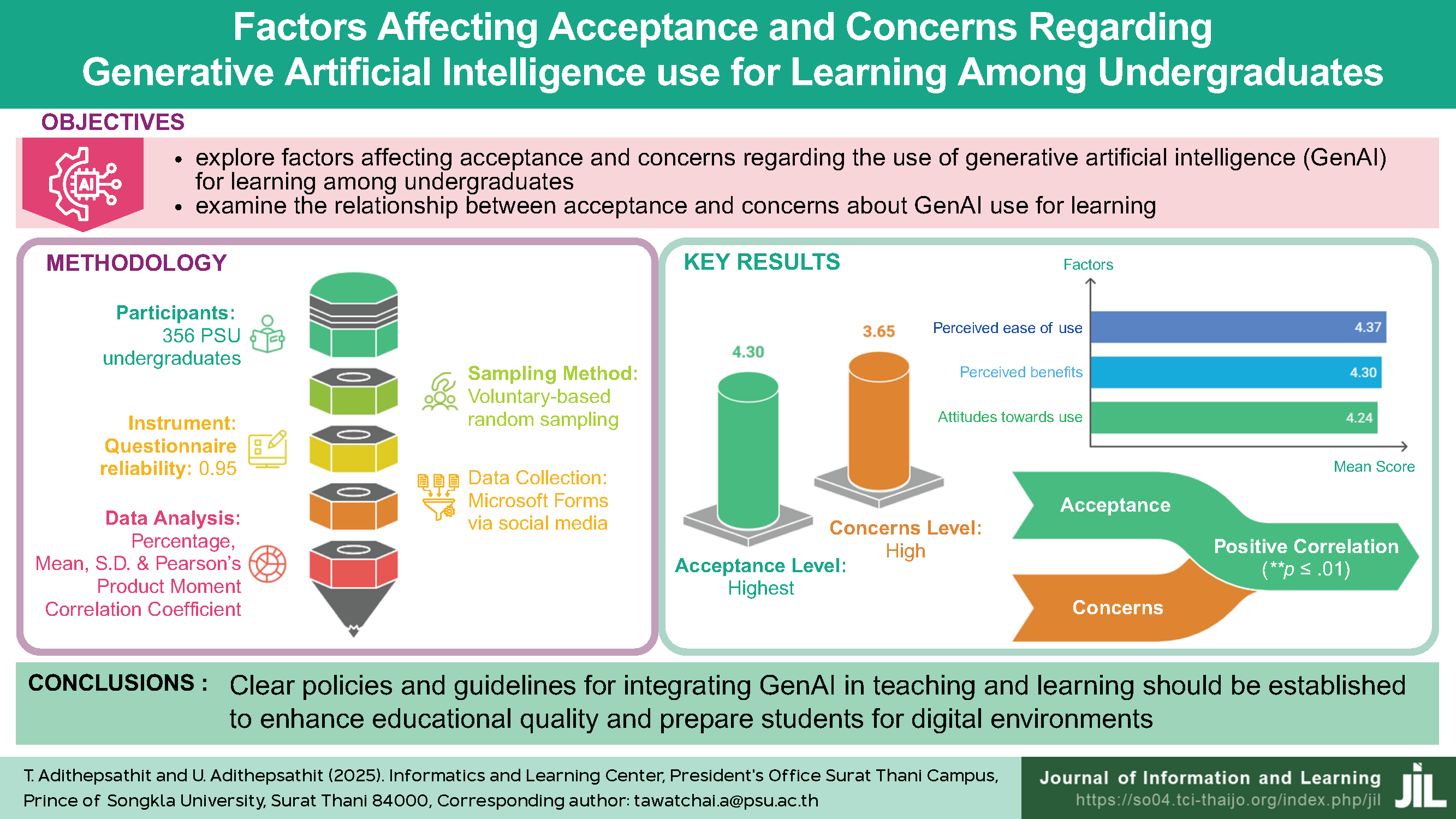
การวิจัยนี้มีวัตถุประสงค์ เพื่อศึกษาปัจจัยที่ส่งผลต่อการยอมรับและความกังวลในการใช้ปัญญาประดิษฐ์เชิงสร้างสรรค์ของนักศึกษาระดับปริญญาตรี และเพื่อศึกษาความสัมพันธ์ระหว่างการยอมรับและความกังวลในการใช้ปัญญาประดิษฐ์เชิงสร้างสรรค์ของนักศึกษาระดับปริญญาตรี กลุ่มตัวอย่าง คือ นักศึกษาระดับปริญญาตรี มหาวิทยาลัยสงขลานครินทร์ วิทยาเขตสุราษฎร์ธานี จำนวน 356 คน โดยใช้วิธีสุ่มตามความสมัครใจ เครื่องมือที่ใช้ในการวิจัย ได้แก่ แบบสอบถามการยอมรับการใช้ปัญญาประดิษฐ์เชิงสร้างสรรค์ของนักศึกษา โดยมีผลการทดสอบความเชื่อมั่นของแบบสอบถาม เท่ากับ 0.95 งานวิจัยนี้เก็บข้อมูลโดยใช้แบบสอบถามสร้างด้วย Microsoft Forms ส่งทางช่องทางเครือข่ายสังคมออนไลน์ในภาคการศึกษาที่ 2 ปีการศึกษา 2567 สถิติที่ใช้ในการวิเคราะห์ข้อมูล ได้แก่ ร้อยละ ค่าเฉลี่ย ส่วนเบี่ยงเบนมาตรฐานและการหาความสัมพันธ์ระหว่างปัจจัยที่ส่งผลต่อการยอมรับและความกังวลในการใช้ปัญญาประดิษฐ์เชิงสร้างสรรค์ของนักศึกษาระดับปริญญาตรี ใช้สัมประสิทธิ์สถิติสหสัมพันธ์ของเพียร์สัน ผลการวิจัยพบว่า การยอมรับในการใช้ปัญญาประดิษฐ์เชิงสร้างสรรค์ระดับปริญญาตรี ในภาพรวมอยู่ในระดับมากที่สุด (M = 4.30) ได้แก่ การยอมด้านการรับรู้ความง่ายในการใช้งาน (M = 4.36) ด้านการรับรู้ประโยชน์ (M = 4.30) และด้านทัศนคติต่อการใช้งาน (M = 4.24) ตามลำดับ ความกังวลในการใช้ปัญญาประดิษฐ์เชิงสร้างสรรค์อยู่ในระดับมาก (M = 3.65) ผลการศึกษาความสัมพันธ์ระหว่างการยอมรับและความกังวลในการใช้ปัญญาประดิษฐ์เชิงสร้างสรรค์ระดับปริญญาตรีทุกด้านมีความสัมพันธ์ทางบวกอย่างมีนัยสำคัญทางสถิติที่ระดับ .01 โดยผลการศึกษาที่ได้จะนำไปใช้เป็นแนวทางในการพัฒนาและยกระดับการใช้ปัญญาประดิษฐ์เชิงสร้างสรรค์ระดับปริญญาตรีเพื่อส่งเสริมการเรียนรู้อย่างมีประสิทธิภาพและรับผิดชอบในยุคดิจิทัล
เอกสารอ้างอิง
Ahmed, K. (2024). A catalog of generative AI tools for faculty advancement [Conference presentation]. 21st International Conference on Information Technology Based Higher Education and Training (ITHET), Paris, France. https://doi.org/10.1109/ithet61869.2024.10837663
Akgun, S., & Greenhow, C. (2022). Artificial intelligence in education: Addressing ethical challenges in K-12 settings. AI and Ethics, 2, 431–440, https://doi.org/10.1007/s43681-021-00096-7
Bhat, M. A., Tiwari, C. K., Bhaskar, P., & Khan, S. T. (2024). Examining ChatGPT adoption among educators in higher educational institutions using extended UTAUT model. Journal of Information, Communication and Ethics in Society, 22(3), 331–353. https://doi.org/10.1108/JICES-03-2024-0033
Bura, C. (2025). Generative AI in learning: Empowering the next generation of education. Preprints. https://doi.org/10.20944/preprints202501.1986.v1
Francis, N. J., Jones, S., & Smith, D. P. (2025). Generative AI in higher education: Balancing innovation and integrity. British Journal of Biomedical Science, 81, Article 14048. https://doi.org/10.3389/bjbs.2024.14048
Gasaymeh, M. A., Beirat, M. A., & Abu Qbeita, A. A. (2024). University students’ insights of generative artificial intelligence (AI) writing tools. Education Sciences, 14(10), Article 1062. https://doi.org/10.3390/educsci14101062
Hersh, W. (2025). Generative artificial intelligence: Implications for biomedical and health professions education. ArXiv. https://doi.org/10.48550/arxiv.2501.10186
Huo, X., & Siau, K. L. (2024). Generative artificial intelligence in business higher education: A focus group study. Journal of Global Information Management, 32(1), 1–21. https://doi.org/10.4018/JGIM.364093
Jiang, P., Niu, W., Wang, Q., Yuan, R., & Chen, K. (2024). Understanding users' acceptance of artificial intelligence applications: A literature review. Behavioral Sciences, 14(8), Article 671. https://doi.org/10.3390/bs14080671
Jitimawannasri, C. (2021). Educational management in the digital era. Rattanasuwan Printing.
Kalmus, J., & Nikiforova, A. (2024). To accept or not to accept? An IRT-TOE framework to understand educators' resistance to generative AI in higher education. ArXiv. https://doi.org/10.48550/arxiv.2407.20130
Kanont, K., Pingmuang, P., Simasathien, T., Wisnuwong, S., Wiwatsiripong, B., Poonpirome, K., Songkram, N., & Khlaisang, J. (2024). Generative AI, a learning assistant? Factors influencing higher-ed students' technology acceptance. The Electronic Journal of e-Learning, 22(1), 18–33. https://doi.org/10.34190/ejel.22.6.3196
Li, C., Yang, J., Zhang, H., Tian, L., Guo, J., & Yu, G. (2024). Assessment of university students' behavioral intentions to use ChatGPT: A comprehensive application based on the innovation diffusion theory and the technology acceptance model. Preprints. https://doi.org/10.20944/preprints202406.1835.v1
Manodamrongsat, P., Intarachai, P., & Intarachai, C. (2022). The impact of artificial intelligence on education. Phranakhon Rajabhat Research Journal (Humanities and Social Sciences), 17(2), 318–328. https://so05.tci-thaijo.org/index.php/PNRU_JHSS/article/view/259625
Ministry of Higher Education, Science, Research, and Innovation. (2024). Thailand national AI strategy annual report 2024. National Science and Technology Development Agency & National Digital Economy and Society Commission. https://ai.in.th/wp-content/uploads/2025/02/AI-Thailand-Annual-Report-2024.pdf
Nemoto, T., & Beglar, D. (2014). Developing Likert-scale questionnaires. In N. Sonda & A. Krause (Eds.), JALT2013 Conference Proceedings. JALT Publications. https://jalt-publications.org/files/pdf-article/jalt2013_001.pdf
Office of the Education Council. (2020). AI for learning development. Prik Wan Graphic. https://doi.nrct.go.th/admin/doc/doc_660140.pdf
Office of the Higher Education Commission. (2023). Survey report on opinions regarding the use of artificial intelligence in Thai higher education institutions. Ministry of Higher Education, Science, Research, and Innovation. https://ai.in.th/about-ai-thailand
Oriakhi, V., Esegbona-Isikeh, O. M., Esseme, B., Claude, A., Emakporuena, D., Nwanakwaugwu, A. C., & Matthew, U. O. (2025). Generative artificial intelligence in education: ChatGPT-4 experiences to anticipated ChatGPT-5. Journal of Science, Management and Technology, 6(1), 149–169. https://doi.org/10.4314/hpjsmt.v6i1.13
Phongsanam, T. (2021). AI technology and turning points in Thai education. Bansomdejchaopraya Rajabhat University. https://eit.bsru.ac.th/wp-content/uploads/2021/09/ผศ.-ดร.-ธวัชชัย-พงษ์สนาม-เทคโนโลยี-AI-กับจุดเปลี่ยนทางการศึกษาไทย.pdf
Shahzad, M. F., Xu, S., & Javed, I. (2024). ChatGPT awareness, acceptance, and adoption in higher education: The role of trust as a cornerstone. International Journal of Educational Technology in Higher Education, 21, Article 46. https://doi.org/10.1186/s41239-024-00478-x
Sridam, I., Sangkharam, P., & Ittipongse, A. (2023). The impact of artificial intelligence on educational innovation. Journal of Educational Innovation and Leadership, 4(1), 145–159. https://so06.tci-thaijo.org/index.php/jeil/article/view/266447
Supianto, Widyaningrum, R., Wulandari, F., Zainudin, M., Athiyallah, A., & Rizqa, M. (2024). Exploring the factors affecting ChatGPT acceptance among university students. Multidisciplinary Science Journal, 6(12), Article 2024273. https://doi.org/10.31893/multiscience.2024273
Zapata-Rivera, D., Torre, I., Lee, C., Cabezuelo, A. S., Ghergulescu, I., & Libbrecht, P. (2024). Editorial: Generative AI in education. Frontiers in Artificial Intelligence, 7, Article 1532896. https://doi.org/10.3389/frai.2024.1532896
ดาวน์โหลด
ไฟล์ประกอบ
เผยแพร่แล้ว
รูปแบบการอ้างอิง
ฉบับ
ประเภทบทความ
หมวดหมู่
สัญญาอนุญาต
ลิขสิทธิ์ (c) 2025 Journal of Information and Learning [JIL]

อนุญาตภายใต้เงื่อนไข Creative Commons Attribution-NonCommercial-NoDerivatives 4.0 International License.
Journal of Information and Learning ดำเนินการโดยสำนักวิทยบริการ มหาวิทยาลัยสงขลานครินทร์ วิทยาเขตปัตตานี บทความที่ได้รับการตีพิมพ์ในวารสารได้รับความคุ้มครองตามกฎหมายลิขสิทธิ์ โดยเจ้าของลิขสิทธิ์จะมีสิทธิในการทำซ้ำ ดัดแปลง และเผยแพร่งานบทความ ทั้งรูปแบบอิเล็กทรอนิกส์ การทำฉบับสำเนา การแปล และการผลิตซ้ำในรูปแบบต่างๆ ลิขสิทธิ์บทความเป็นของผู้เขียนและสำนักวิทยบริการ มหาวิทยาลัยสงขลานครินทร์ วิทยาเขตปัตตานี วารสารฯ ขอสงวนสิทธิ์ในการพิจารณาตีพิมพ์ตามความเหมาะสม รวมทั้งการตรวจทานแก้ไข การปรับข้อความ หรือขัดเกลาภาษาให้ถูกต้องตามเกณฑ์ที่กำหนด สำหรับผลการวิจัยและความคิดเห็นที่ปรากฏในบทความถือเป็นความคิดเห็นและอยู่ในความรับผิดชอบของผู้เขียน


