
Instructional Guidelines for Promoting Computational Thinking of Lower Secondary Students
Keywords:
instructional guidelines, computational thinking, lower secondary studentsAbstract
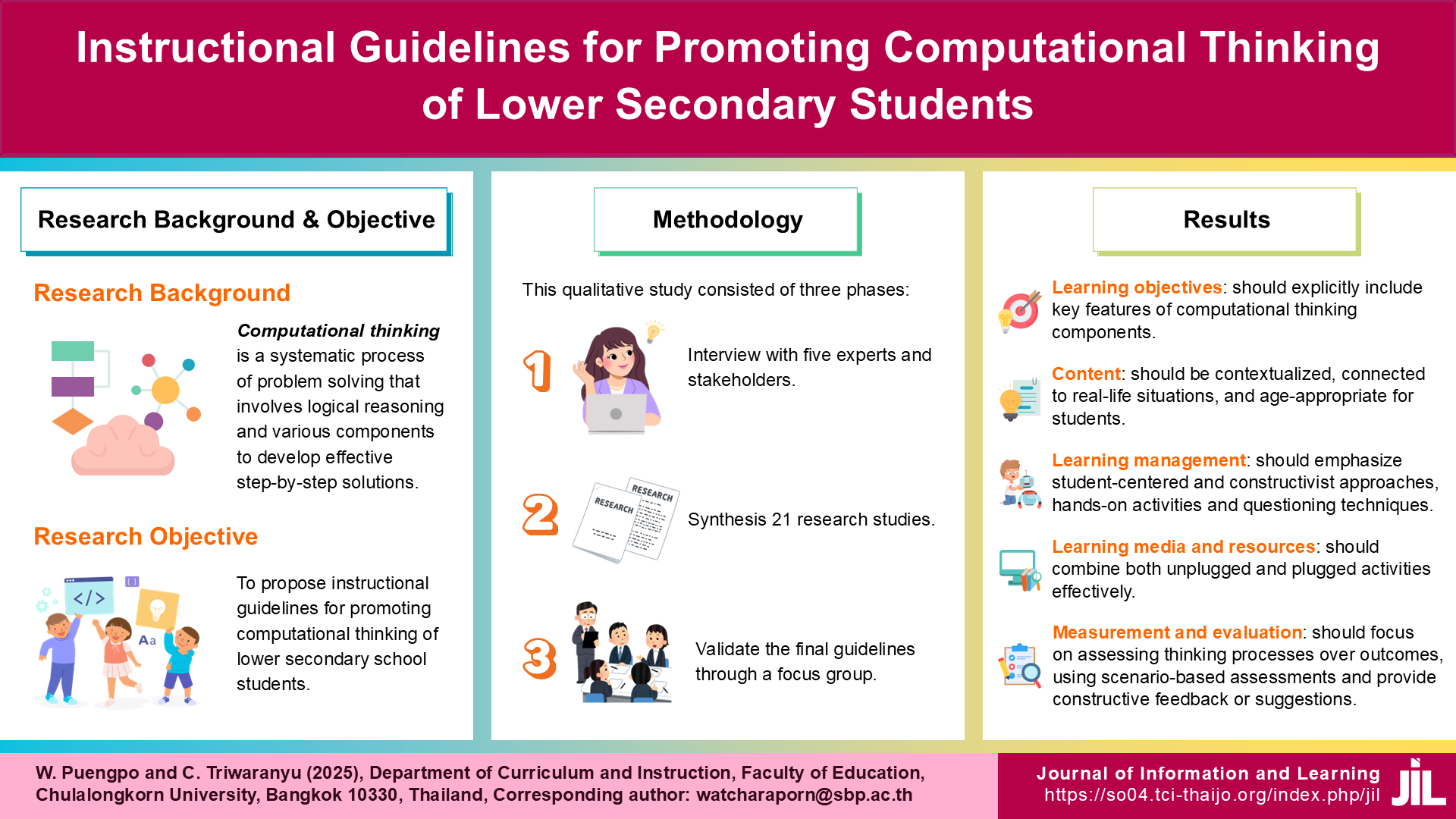
This study aimed to propose instructional guidelines for promoting computational thinking of lower secondary school students. The research was conducted in three phases: 1) investigating instructional guidelines through structured interviews with five experts and stakeholders, 2) synthesizing relevant instructional guidelines from 21 research studies using a structured research data extraction form; and 3) presenting a complete set of instructional guidelines validated through a focus group discussion involving five experts and stakeholders, using a standardized focus group protocol. Data from all three phases were analyzed using content analysis. The findings indicated five key areas for instructional guidelines: 1) Learning objectives should explicitly include key features of computational thinking components. 2) Contents should be contextualized, connected to real-life situations, and age-appropriate for students. 3) Learning management should emphasize student-centered and constructivist approaches through instructional methods that promote hands-on activities and the use of effective questioning techniques. 4) Learning media and resources should include both unplugged and plugged activities to achieve positive effects. 5) Measurement and evaluation should focus on competency-based assessment, emphasizing the evaluation of thinking processes rather than solely outcomes and utilizing scenario-based assessments that provide constructive feedback or suggestions to students.
References
Angeli, C., & Giannakos, M. (2020). Computational thinking education: Issues and challenges. Computers in Human Behavior, 105. https://doi.org/10.1016/j.chb.2019.106185
Brennan, K., & Resnick, M. (2012). New frameworks for studying and assessing the development of computational thinking [Paper presentation]. Annual American Educational Research Association meeting. https://scratched.gse.harvard.edu/ct/files/AERA2012.pdf
Chen, Y., Wang, Y., & Li, Y. (2022, October). The effectiveness of teaching approaches in computational thinking education: A meta-analysis. Proceedings of the 14th International Conference on Education Technology and Computers, Spain, 386–392. https://doi.org/10.1145/3572549.3572611
Code.org. (2023, June 20). PISA’s new focus on computational thinking and coding. Medium. https://codeorg.medium.com/pisas-new-focus-on-computational-thinking-and-coding-fbe90e456c5f
Csizmadia, A., Curzon, P., Dorling, M., Humphreys, S., Ng, T., Selby, C., & Woollard, J. (2015). Computational thinking: A guide for teachers. https://eprints.soton.ac.uk/424545/1/150818_Computational_Thinking_1_.pdf
Denning, P. J. (2017). Remaining trouble spots with computational thinking. Communications of the ACM, 60(6), 33–39. https://doi.org/10.1145/2998438
Falloon, G. (2016). An analysis of young students' thinking when completing basic coding tasks using Scratch Jnr. on the ipad. Journal of Computer Assisted Learning, 32(6), 576–593. https://doi.org/10.1111/jcal.12155
Grover, S., & Pea, R. (2013). Computational thinking in K–12: A review of the state of the field. Educational Researcher, 42(1), 38–43. https://doi.org/10.3102/0013189X12463051
Jaiteang, A. (2010). Lak kānsō̜n [Teaching principles] (5th ed.). Odean Store.
Korkmaz, Ö., Çakir, R., & Özden, M. Y. (2017). A validity and reliability study of the computational thinking scales (CTS). Computers in Human Behavior, 72, 558–569. https://doi.org/10.1016/j.chb.2017.01.005
Ling, U. L., Saibin, T. C., Naharu, N., Labadin, J., & Aziz, N. A. (2018). An evaluation tool to measure computational thinking skills: Pilot investigation. National Academy of Managerial Staff of Culture and Arts Herald, 1, 606–614. https://www.researchgate.net/publication/327882359
Lye, S. Y., & Koh, J. H. L. (2014). Review on teaching and learning of computational thinking through programming: What is next for K-12?. Computers in Human Behavior, 41, 51–61. https://doi.org/10.1016/j.chb.2014.09.012
Mumcu, F., Kidiman, E., & Özdinç, F. (2023). Integrating computational thinking into mathematics education through an unplugged computer science activity. Journal of Pedagogical Research, 7(2), 72–92. https://doi.org/10.33902/JPR.202318528
Ornstein, A. C., & Hunkins, F. P. (2009). Curriculum: Foundations, principles, and issues (5th ed). Pearson Education.
Porzak, R., & Psomos, P. (2023). Computational thinking for teachers and classes. Innovatio Press. https://wydawnictwo.wsei.eu/wp-content/uploads/2024/02/COMPUTATIONAL-THINKING.pdf
Sentance, S., & Csizmadia, A. (2017). Computing in the curriculum: Challenges and strategies from a teacher’s perspective. Education and Information Technologies, 22, 469–495. https://doi.org/10.1007/s10639-016-9482-0
Shute, V. J., Sun, C., & Asbell-Clarke, J. (2017). Demystifying computational thinking. Educational Research Review, 22, 142–158. https://doi.org/10.1016/j.edurev.2017.09.003
Smith, M. (2016, January 30). Computer science for all. The White House president Barack Obama. https://obamawhitehouse.archives.gov/blog/2016/01/30/computer-science-all
Tekdal, M. (2021). Trends and development in research on computational thinking. Education and Information Technologies, 26(5), 6499–6529. https://doi.org/10.1007/s10639-021-10617-w
Wing, J. M. (2006). Computational thinking. Communications of the ACM, 49(3), 33–35. https://dl.acm.org/doi/pdf/10.1145/1118178.1118215
Yadav, A., Stephenson, C., & Hong, H. (2017). Computational thinking for teacher education. Communications of the ACM, 60(4), 55–62. https://dl.acm.org/doi/pdf/10.1145/2994591
Downloads
Additional Files
Published
How to Cite
Issue
Section
Categories
License
Copyright (c) 2025 Journal of Information and Learning [JIL]

This work is licensed under a Creative Commons Attribution-NonCommercial-NoDerivatives 4.0 International License.
The Journal of Information and Learning is operated by the Office of Academic Resources, Prince of Songkla University. All articles published in the journal are protected by Thailand copyright law. This copyright covers the exclusive rights to share, reproduce and distribute the article, including in electronic forms, reprints, translations, photographic reproductions, or similar. Authors own copyrights in the works they have created as well as the Office of Academic Resources. The Journal reserves the right to edit the language of papers accepted for publication for clarity and correctness, as well as to make formal changes to ensure compliance with the journal's guidelines. All authors must take public responsibility for the content of their paper.


