
The Development of an English Language Teaching Model Based on Contextual Teaching and Learning Approach to Enhance English Communication Skills for Grade 10 Students
Keywords:
Contextual Teaching and Learning, CTL Approach, English communication skills, English language teaching modelAbstract
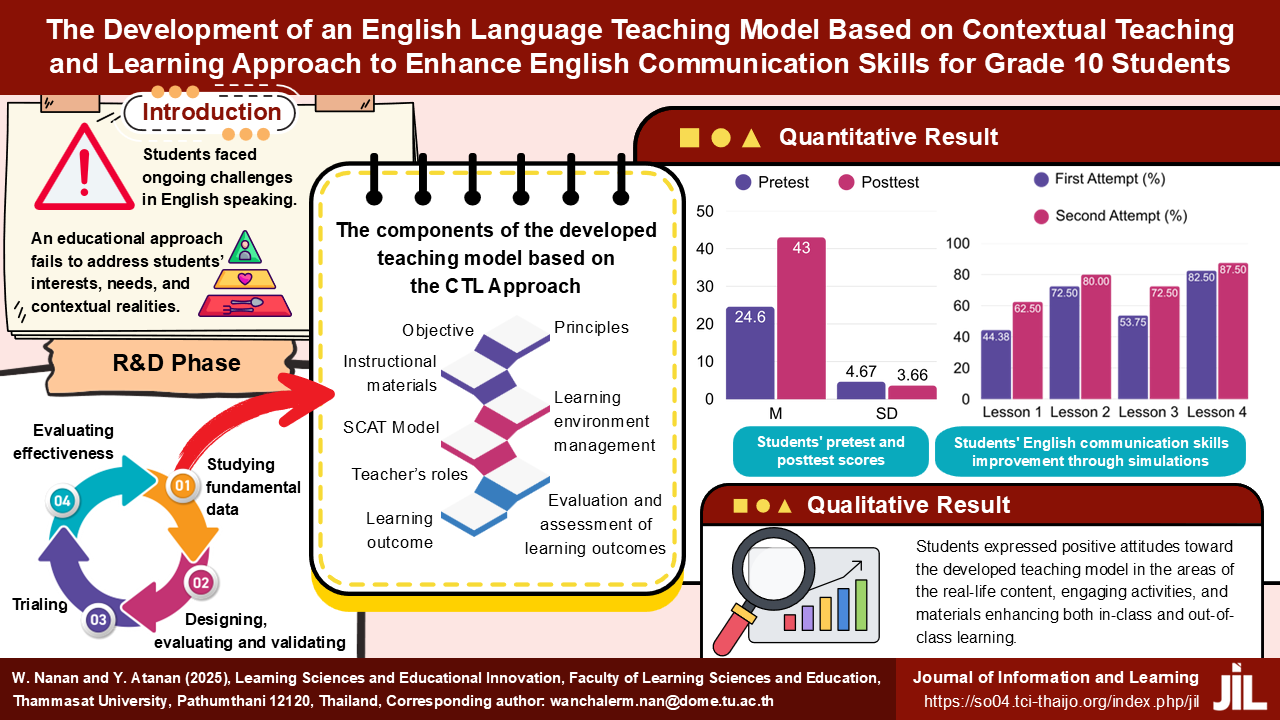
To develop a teaching model is a crucial factor which upholds and enhances students’ leaning outcomes, especially developing a teaching model for resolving the issues faced in an English classroom. Therefore, this research aims 1) to develop the teaching model based on the Contextual Teaching and Learning approach (CTL) to enhance students’ English communication skills, 2) to compare students’ English communication skills before and after utilizing the developed teaching model, and 3) to investigate students’ opinions toward the developed teaching model. A research and development (R&D) strategy was employed. The sample group consisted of 20 grade-10 students at Muangdongwittaya School, Sukhothai, Thailand chosen by volunteer sampling. The research instruments comprised a survey, questionnaires, group discussion questions, lesson plans, English communication skills tests, and an in-depth interview. Both qualitative data (analyzed through content analysis) and quantitative data (analyzed using means, standard deviations, paired t-tests, and percentages) were collected. The findings revealed that 1) the developed teaching model comprised eight components including principles, objective, four instructional stages (studying contexts, creating real-life contexts, applying in new contexts, and transferring contexts: SCAT model), classroom learning environment management, instructional materials, teacher’s roles, assessment and evaluation of learning outcomes, and learning outcome, 2) students' post-test scores (M = 43.0, SD = 3.66) were significantly higher than their pre-test scores (M = 24.60, SD = 4.67) at the .01 level, and students’ higher English communication skills improved through simulations, and 3) students expressed positive attitudes toward the developed teaching model regarding the real-life content, engaging activities, and materials enhancing both in-class and out-of-class learning.
References
AL-Garni, S. A., & Almuhammadi, A. H. (2019). The effect of using communicative language teaching activities on EFL students' speaking skills at the University of Jeddah. English Language Teaching, 12(6), 72–86. https://doi.org/10.5539/elt.v12n6p72
Annisa, S. (2015). Teaching speaking in English using contextual teaching and learning. English Education Journal, 6(4), 497–510. https://jurnal.usk.ac.id/EEJ/article/view/2858
Anukunwathaka, N., Mangkhang, C., Phuwanatwichit, T., & Wannapaisan, C. (2020). Area-based action curriculum: Innovation in education for sustainable development of Tai Lue cultural community, Thailand. Journal of Multidisciplinary in Social Sciences, 16(2), 19–30. https://so03.tci-thaijo.org/index.php/sduhs/article/view/268114
Behar-Horenstein, L. S., & Seabert, D. M. (2005). Teachers’ use of models of teaching. Educational Practice and Theory, 27(1), 49–66. https://doi.org/10.7459/ept/27.1.04
Changpueng, P., & Pattanapichet, F. (2024). The development of a full online flipped classroom instructional model for enhancement of engineering students’ English meeting skills and learning engagement. PASAA, 68(1), 337–374. https://doi.org/10.58837/CHULA.PASAA.68.1.10
Chongkham, R., & Pimvichai, J. (2023). The development of context-based learning model emphasizing the special economic zone and Thailand 4.0 context to improve grade 4 students’ English communication skills. Proceedings of the International Conference on English Language and Teaching (ICOELT 2022) (pp. 254–262). Atlantis Press. https://doi.org/10.2991/978-2-38476-166-1_37
Crawford, M. L. (2001). Teaching contextually: Research, rationale, and techniques for improving student motivation and achievement in mathematics and science. CCI Publishing.
Daqiq, B., Akramy, S. A., & Barati, A. M. (2024). The impacts of English language proficiency on employment opportunities. American Journal of Science Education Research, Article AJSER-183. https://www.researchgate.net/publication/380513993_The_Impacts_of_English_Language_Proficiency_on_Employment_Opportunities
Davies, M. J. (2025, April 13). Global Englishes in the ELT classroom: From theory to practice. RITSUMEI. https://www.ritsumei.ac.jp/acd/cg/lt/rb/683/683PDF/davies.pdf
De Jong, O. (2008). Context-based chemical education: How to improve it?. Chemical Education International, 8(1), 1–7. https://dspace.library.uu.nl/handle/1874/31675
EF EPI. (2024). EF English proficiency index 2024: A ranking of 116 countries and regions by English skills. https://www.ef.com/assetscdn/WIBIwq6RdJvcD9bc8RMd/cefcom-epi-site/reports/2024/ef-epi-2024-english.pdf
Faridi, A. (2010). The development of context-based English learning resources for elementary schools in Central Java. Excellence in Higher Education, 1(1&2), 23–30. https://doi.org/10.5195/ehe.2010.13
Farrelly, M. J., & Sinwongsuwat, K. (2021). Strategies used and challenges faced by Thai EFL teachers when eliciting talk during classroom interactions in high school contexts. Sage Open, 11(4), 1–19. https://journals.sagepub.com/doi/full/10.1177/21582440211050385
Gilbert, J. K. (2006). On the nature of context in chemical education. International Journal of Science Education, 28(9), 957–976. https://doi.org/10.1080/09500690600702470
Howey, K. R. (1998). Introduction to the commissioned papers. In S. J. Sears & S. B. Hersh (Eds.), Contextual teaching and learning: Preparing teachers to enhance student success in the workplace and beyond (pp.19–34). ERIC Clearinghouse on Adult, Career, and Vocational Education.
Hu, G. (2021). Language assessment in global Englishes. In A. F. Selvi & B. Yazan (Eds.), Language teacher education for global Englishes: A practical resource book (pp. 199–206). Routledge. https://doi.org/10.4324/9781003082712-33
Jiang, Y., Wu, Y., & Liang, Y. (2024). Affective filter hypothesis and second language acquisition: A study on anxiety levels in the dictation part of TEM-4. Arts Culture and Language, 1(5). https://doi.org/10.61173/8y785633
Joyce, B., & Calhoun, E. (2024). Models of teaching (10th ed.). Routledge.
Kaewlai, J. (2022). The use of communicative language teaching to enhance the willingness to speak and the English presentation skills of undergraduates at Rajamangala University of Technology Phra Nakhon. Rajapark Journal, 16(45), 184–196. https://so05.tci-thaijo.org/index.php/RJPJ/article/view/254641
Kaur, A., Young, D., & Kirkpatrick, R. (2016). English education policy in Thailand: Why the poor results? In R. Kirkpatrick (Ed.), English language education policy in Asia (pp. 345–361). Springer International Publishing. https://doi.org/10.1007/978-3-319-22464-0_16
Kaur, S. (2019). Role of a teacher in student learning process. International Journal of Business and Management Invention, 8(12), 41–45. https://ijbmi.org/papers/Vol(8)12/Series-1/G0812014145.pdf
Khaemmani, T. (2018). The art of teaching: Knowledge for effective learning process management (22nd ed.). Chulalongkorn University Press.
Krashen, S. D. (1982). Principles and practice in second language acquisition. Pergamon Press. https://www.sdkrashen.com/content/books/principles_and_practice.pdf
Li, Y. (2023). Study on the significance of the input hypothesis to English teaching. Journal of Education and Educational Research, 3(2), 5–7. https://doi.org/10.54097/jeer.v3i2.9002
Lu, Y., & Zhou, X. (2023). The application of multicluster structural model in English teaching model innovation and effect analysis. Applied Mathematics and Nonlinear Sciences, 9(1), 1–15. https://doi.org/10.2478/amns.2023.2.00986
Lukman, L. (2024). Development of contextual learning models to improve student's speaking skills. Journal of Languages and Language Teaching, 12(1), 198–211. https://doi.org/10.33394/jollt.v12i1.9128
Ministry of Education. (2017). Laksūt kǣn klāng kānsưksā naphư̄n thān Phutthasakkarāt 2551 læ māttrathān kānrīanrū læ tūa chī wat ... (Chabap prapprung B.E. 2560) [The basic education core curriculum A.D. 2008 (Revised Edition A.D. 2017). Express Transport Organization of Thailand Printing House. http://academic.obec.go.th/web/news/view/75
Mourchid, M., Bouaissane, M., Brigui, H., & Sawalmeh, M. H. (2023). World Englishes today: Towards a pluricentric approach of proficiency testing. International Journal of Linguistics, Literature and Translation, 6(8), 231–235. https://doi.org/10.32996/ijllt.2023.6.8.23
Munir, M. (2018). The development of English learning model based on contextual teaching and learning (CTL) in junior high schools. International Journal of Language Education, 2(1), 31–39. https://files.eric.ed.gov/fulltext/EJ1249885.pdf
Nongkawee, S., & Ngamnin, S. (2024). The effects of communicative language teaching on enhancing English speaking and writing abilities of mattayomsuksa 3 students. Education journal Faculty of Education, Nakhon Sawan Rajabhat University, 7(1), 366–377. https://so02.tci-thaijo.org/index.php/edunsrujo/article/view/264879
Plengkham, B., & Wasanasomsithi, P. (2023). Effects of integrated performance assessment modules on English speaking ability of Thai EFL undergraduate students. LEARN Journal: Language Education and Acquisition Research Network, 16(1), 448–472. https://so04.tci-thaijo.org/index.php/LEARN/article/view/263451
Raha, T., & Wongsapan, M. (2024). Development of an instructional model to enhance competency in the Thai language for grade 6 students. Journal of Education and Learning, 13(2), 119–129. https://doi.org/10.5539/jel.v13n2p119
Rahal, A. (2022). World Englishes in the linguistic landscape of Tunisia—Critical perspectives and pedagogical implications. In C. Smaoui (Ed.), World Englishes and language assessment (pp. 12–29). Cambridge Scholars Publishing. https://www.cambridgescholars.com/resources/pdfs/978-1-5275-7772-5-sample.pdf
Rahimi, M. (2024). Exploring the role of teachers’ cognitions and practices of teaching English speaking skills in students’ learning (dis)engagement. The Language Learning Journal, 1-15. https://doi.org/10.1080/09571736.2024.2438868
Sitthitikul, P. (2021). The roles of output in English language learning: A theoretical review. Journal of English Language and Linguistics, 2(2), 33–45. https://doi.org/10.62819/jel.2021.116
Su, F. (2023). An application of the input hypothesis to the teaching design of English reading class in senior high school. Journal of Education, Teaching and Social Studies, 5(3), 38–49. https://doi.org/10.22158/jetss.v5n3p38
Swain, M. (1985). Communicative competence: Some roles of comprehensible input and comprehensible output in its development. In S. Gass & C. Madden (Eds.), Input in second language acquisition (pp. 235–253). Newbury House.
Wang, S. (2024). Application of Krashen's input hypothesis in college English: Empirical findings and curriculum implications. Region-Educational Research and Reviews, 6(8), 116–119. https://doi.org/10.32629/rerr.v6i8.2504
Wang, T. (2024). Analysis of the affective factors of high school struggling students’ English learning based on affective filter hypothesis. Journal of Education and Educational Research, 8(2), 178–180. https://doi.org/10.54097/vep4rp21
Watson Todd, R. (2018). Analyzing and interpreting rating scale data from questionnaires. rEFLections, 14, 69–77. https://doi.org/10.61508/refl.v14i0.114230
Xue, Q., & Noels, K. A. (2025). Assessing accent anxiety: A measure of foreign English speakers’ concerns about their accents. Studies in Second Language Acquisition, 1–27. https://doi.org/10.1017/S0272263124000767
Yan, W., Lowell, V. L., & Yang, L. (2024). Developing English language learners’ speaking skills through applying a situated learning approach in VR-enhanced learning experiences. Virtual Reality, 28, Article 167. https://doi.org/10.1007/s10055-024-01061-5
Yuh, A. H., & Kaewurai, W. (2021). An investigation of Thai students’ English-speaking problems and needs and the implementation of collaborative and communicative approaches to enhance students’ English-speaking skills. The Golden Teak: Humanity and Social Science Journal, 27(2), 91–107. https://so05.tci-thaijo.org/index.php/tgt/article/view/252425
Yusyac, R., Muslem, A., & Yasin, B. (2021). Using contextual teaching and learning (CTL) approach to improve students' speaking ability. English Education Journal, 12(3), 459–475. https://doi.org/10.24815/eej.v12i3.19189
Downloads
Additional Files
Published
How to Cite
Issue
Section
Categories
License
Copyright (c) 2025 Journal of Information and Learning [JIL]

This work is licensed under a Creative Commons Attribution-NonCommercial-NoDerivatives 4.0 International License.
The Journal of Information and Learning is operated by the Office of Academic Resources, Prince of Songkla University. All articles published in the journal are protected by Thailand copyright law. This copyright covers the exclusive rights to share, reproduce and distribute the article, including in electronic forms, reprints, translations, photographic reproductions, or similar. Authors own copyrights in the works they have created as well as the Office of Academic Resources. The Journal reserves the right to edit the language of papers accepted for publication for clarity and correctness, as well as to make formal changes to ensure compliance with the journal's guidelines. All authors must take public responsibility for the content of their paper.


