
The Needs Assessment for the Development of Mobile Application Based on Scaffolded Reading Experiences and Gamification for Enhancing Digital Reading Literacy of Lower Secondary School Students
Keywords:
mobile application, scaffolded reading experiences, gamification, digital reading literacyAbstract
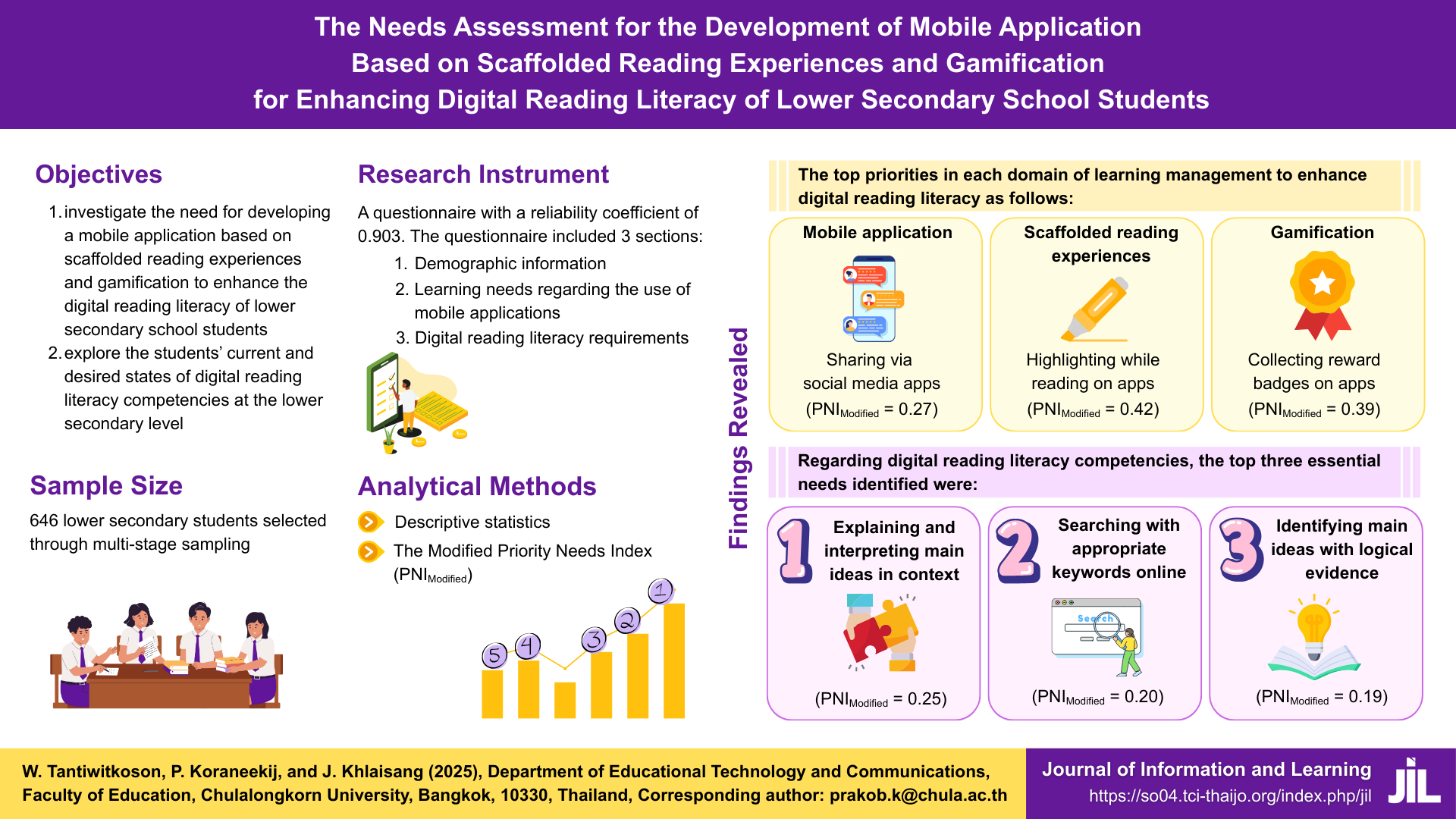
This study aimed 1) to investigate the need for developing a mobile application based on scaffolded reading experiences and gamification to enhance the digital reading literacy of lower secondary school students and 2) to explore the students’ current and desired states of digital reading literacy competencies at the lower secondary level. The sample consisted of 646 lower secondary students selected through multi-stage sampling. The research instrument was a questionnaire (reliability coefficient of 0.903), which included sections on demographic information, learning needs concerning mobile applications use, and digital reading literacy requirements. Data were analyzed using descriptive statistics and the Modified Priority Needs Index (PNIModified). The findings revealed the top priorities in each domain of learning management to enhance digital reading literacy: 1) mobile application-based learning—sharing opinions or work with teachers and peers via social media on mobile applications (PNIModified = 0.27), 2) scaffolded reading experiences—reading articles on mobile applications while highlighting key information during reading (PNIModified = 0.42), and 3) gamification—collecting reward badges from participating in article-reading activities on mobile applications (PNIModified = 0.39). Regarding digital reading literacy competencies, the top three essential needs were: (1) the ability to explain the meaning of words, sentences, and main ideas in sequence and interpret the main concept by connecting
it with real-life situations (PNIModified = 0.25), (2) the ability to search for information on the internet using appropriate keywords aligned with specific objectives (PNIModified = 0.20), (3) the ability to identify the main idea of a text and support it with clearly connected and logically consistent evidence (PNIModified = 0.19).
References
Abu Sa’aleek, R. A., & Baniabdelrahman, A. A. (2020). The effect of gamification on Jordanian EFL sixth grade students' reading comprehension. International Journal of Education and Training, 6(1), 1–11. http://injet.upm.edu.my/images/volume/isunov2_2020/The%20Effect%20of%20Gamification%20on%20Jordanian%20EFL%20Sixth%20Grade%20Students%20Reading%20Comprehension.pdf
Azir, I. D. A., & Sriyanto, W. (2021). Improving English reading digital text skills for multimedia students through the scaffolding method. Ethical Lingua: Journal of Language Teaching and Literature, 8(2), 369–377. https://ethicallingua.org/25409190/article/view/298
Clark, K. F., & Graves, M. F. (2005). Scaffolding students' comprehension of text. The Reading Teacher, 58(6), 570–580. https://www.jstor.org/stable/20205522
Coiro, J. (2020). Toward a multifaceted heuristic of digital reading to inform assessment, research, practice, and policy. Reading Research Quarterly, 56(1), 9–31. https://doi.org/10.1002/rrq.302
Fitzgerald, J., & Graves, M. F. (2004). Reading supports for all scaffolded reading experiences help English language learners master both reading and content. Educational Leadership, 62(4), 68–71. https://lesn.appstate.edu/fryeem/RE5710/ELL/fitzgerald05.pdf
Hendriwanto, H., & Kurniati, U. (2019). Building reading fluency with mobile-assisted extensive reading. International Journal of Interactive Mobile Technologies, 13(6), 84-92. https://doi.org/10.3991/ijim.v13i06.9799
Herawati, C., Gani, S. A., & Muslim, A. (2020). The implementation of scaffolding reading experience strategy in increasing students’ comprehension. Journal of English Teaching and Linguistics, 1(2), 102–113. https://doi.org/10.55616/jetli.v1i2.20
Hsu, C.-L., & Chen, M.-C. (2018). How does gamification improve user experience? An empirical investigation on the antecedents and consequences of user experience and its mediating role. Technological Forecasting and Social Change, 132, 118–129. https://doi.org/10.1016/j.techfore.2018.01.023
Kemp, S. (2025, March 3). Digital 2025: Thailand. Datareportal. https://datareportal.com/reports/digital-2025-thailand
Keezhatta, M. S., & Omar, A. (2019). Enhancing reading skills for Saudi secondary school students through mobile-assisted language learning (MALL): An experimental study. International Journal of English Linguistics, 9(1), 437–447. https://doi.org/10.5539/ijel.v9n1p437
Kennedy, U., & Chinokul, S. (2020). Effect of the scaffolded reading experience using a graphic novel on the English reading comprehension and reading motivation of Thai EFL students. LEARN Journal: Language Education and Acquisition Research Network, 13(2), 158–175. https://so04.tci-thaijo.org/index.php/LEARN/article/view/243701
Krejcie, R. V., & Morgan, D. W. (1970). Determining sample size for research activities. Educational and Psychological Measurement, 30(3), 607–610. https://doi.org/10.1177/001316447003000308
Lam, C. N. C., Habil, H., & Hui, S. M. (2022). A mobile application developed for scaffolding ESL learners in providing peer feedback. Journal of Nusantara Studies, 7(2), 291–313. https://doi.org/10.24200/jonus.vol7iss2pp291-313
Lunrasri, Y., Tangdhanakanond, K., & Pasiphol, S. (2022). Effects of prompting type and learning achievement on reading literacy of ninth graders. Kasetsart Journal of Social Sciences, 43(2), 369–378. https://so04.tci-thaijo.org/index.php/kjss/article/view/258495
Matyakhan, R., Chaowanakritsanakul, T., & Santos, J. A. L. (2024). Implementing gamification to enhance reading engagement and comprehension among Thai EFL university students. LEARN Journal: Language Education and Acquisition Research Network Journal, 17(1), 212–239. https://files.eric.ed.gov/fulltext/EJ1415575.pdf
Mingsiritham, K. (2023). Kānrīanrū Thī Yàngyư̄n Nai Yuk Dījithan [Sustainability learning in the digital age]. Sukhothai Thammathirat Open University Press.
Mullis, I. V. S., Martin, M. O., & Foy, P. (2021). PIRLS 2021 reading assessment framework. Boston College, TIMSS & PIRLS International Study Center. https://pirls2021.org/frameworks/home/reading-assessment-framework/overview/index.html
Nakhonsongkhla, J. (2018). Kānsū̄angsan kānrīanrū bæb dījithan [Designing digital-based learning]. Chulalongkorn University Press.
National Assessment Governing Board. (2023, June 3). Reading framework for the 2019 national assessment of educational progress. https://www.nagb.gov/naep-subject-areas/reading/framework-archive/2019-reading-framework.html
National Statistical Office. (2024). The 2022 ICT indicators. https://www.nso.go.th/public/e-book/Indicators-ICT/The_2022_ICT_Indicators/162-163
OECD. (2019, May 7). Upgrading the ICT questionnaire items in PISA 2021. OECD. Publishing. https://www.oecd.org/en/publications/upgrading-the-ict-questionnaire-items-in-pisa-2021_d0f94dc7-en.html
OECD. (2021, May 4). 21st-Century readers: Developing literacy skills in a digital world. OECD Publishing. https://doi.org/10.1787/a83d84cb-en
Peng, C. (2022). An application of English reading mobile teaching model based on K-means algorithm. Mobile Information Systems, 2022, Article 153845. https://doi.org/10.1155/2022/3153845
Phulthawitham, S. (2023, June 3). Mobile application khư̄ ārai čhampen yāngrai kap thurakit khun [Mobile applications: What they are and why they’re essential for your business]. Criclabs. https://www.criclabs.co/post/what-is-mobile-application
Qushoy, M. (2022). The use of scaffolding reading experience in improving students’ literacy development. FLIP: Foreign Language Instruction Probe, 1(1), 1–8. https://doi.org/10.54213/flip.v1i1.117
Rattanamanee, N. (2019). The development of questionnaires for educational research (3rd ed.). Chulalongkorn University Press.
Shao, J., Abdul Rabu, S., & Chen, C. (2025). The impact of gamified interactive e-books incorporating metacognitive reading strategies on Chinese elementary students’ mathematical reading comprehension, word problem-solving performance, and general reading motivation. Education and Information Technologies. https://doi.org/10.1007/s10639-025-13660-z
Sheldon, L. (2020). The multiplayer classroom: Designing coursework as a game. CRC Press.
Shofi, A. T., & Jannah, W. (2022). Developing mobile learning application as instructional media for reading comprehension. Al-Lisan: Jurnal Bahasa (e-Journal), 7(2), 198–224. https://doi.org/10.30603/al.v7i2.2739
Singsuk, N. (2022). Designing a virtual science laboratory using mobile technology combined with blended learning to enhance scientific process skills of lower secondary school students [Unpublished doctoral dissertation]. Srinakharinwirot University.
Sitthichaiworabutr, K., Prapinpongsakorn, S., & Techataweewan, W. (2020). Digital reading behavior of undergraduate students in public Universities. RSU library Journal, 27(2), 117–138. https://rilj.rsu.ac.th/journal/56/article/270
Toimah, T. F., Maulana, Y. I., & Fajar, I. (2021). Gamification model framework and its use in e-learning in higher education. IAIC Transactions on Sustainable Digital Innovation, 3(1), 28–35. https://doi.org/10.34306/itsdi.v3i1.520
Vallerand, R. J. (2000). Deci and Ryan's self-determination theory: A view from the hierarchical model of intrinsic and extrinsic motivation. Psychological Inquiry, 11(4), 312–318. https://www.jstor.org/stable/1449629
Witkin, B. R. (1984). Assessing needs in educational and social programs: Using information to make decisions, set priorities, and allocate resources. Jossey-Bass.
Wongwanich, S. (2007). Kān wičhai pramœ̄n khwām tǭngkān čam pen [Needs assessment research]. Chulalongkorn University Press.
World Bank, EEF (Thailand) & Thammasat University. (2024, February 20). Fostering foundational skills in Thailand from a skills crisis to a learning society. Equitable Education Fund. https://en.eef.or.th/2025/06/27/fostering-foundational-skills-in-thailand-from-a-skills-crisis-to-a-learning-society
Yawiloeng, R. (2022). Using instructional scaffolding and multimodal texts to enhance reading comprehension: Perceptions and attitudes of EFL students. Journal of Language and Linguistic Studies, 18(2), 877–894. https://files.eric.ed.gov/fulltext/EJ1347869.pdf
Yu, Y. L., Othman, M. F. B., Abd Wahab, M. H., & Idrus, S. Z. S. (2020). Unique English: An English learning application for remedial program using gamification approach. Journal of Physics: Conference Series, 1529(3), Article 032084. https://doi.org/10.1088/1742-6596/1529/3/032084
Zhu, J., Li, X., Zhang, Y., Zainuddin, Z., Lee, S. Y. C., & Chu, S. K. (2019, December). Can gamification bring long-term effects for elementary students’ learning? [Paper presented]. ASIS&T Asia-Pacific Regional Conference, Phnom Penh, Cambodia. https://web.edu.hku.hk/f/staff/447/Zhu%202018%20Can%20Gamification%20Bring%20Long-term%20Effects%20for%20Elementary%20Students%E2%80%99%20Learning.pdf
Downloads
Additional Files
Published
How to Cite
Issue
Section
Categories
License
Copyright (c) 2025 Journal of Information and Learning [JIL]

This work is licensed under a Creative Commons Attribution-NonCommercial-NoDerivatives 4.0 International License.
Free access to published articles. Current licensing policy: CC BY-NC 4.0 from Volume 37, Issue 2 (2026). For earlier articles, consult the rights information on the individual article page. See our Open Access, Copyright and Licensing policy.


