
A Synthesis of Teaching Methods Affecting Mathematics Achievement: Meta-Analysis and Network Meta-Analysis
Keywords:
meta-analysis, network meta-analysis, mathematics teaching methods, mathematics achievementAbstract
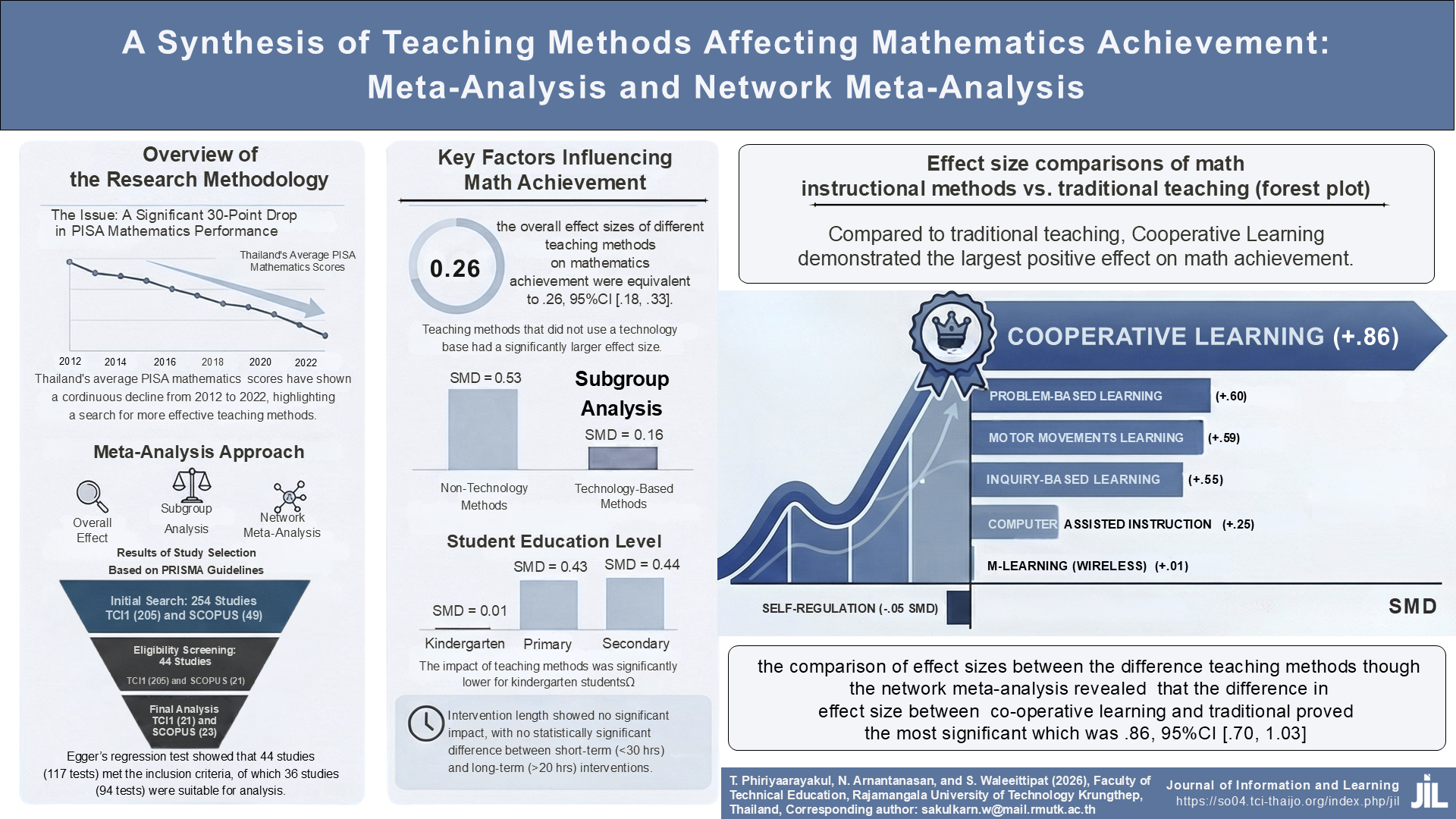
The study aimed to analyze the overall effect size of the teaching methods on mathematics achievement and to compare the effect sizes of different teaching methods on mathematics achievement. The meta-analysis included 44 research studies: 23 studies retrieved from the TCI 1 database and 21 studies from the SCOPUS database, all meeting the inclusion criteria. Data were analyzed using of the effect size, homogeneity analysis, meta-analysis, subgroup analysis, and network meta-analysis. The results revealed that the overall effect size of teaching methods on mathematics achievement was 0.26 (95% CI [0.18, 0.33]). The effect sizes of the teaching methods differed significantly (Q(93) = 364.473, p < .001, I² = 76.69%). Besides, the subgroup analysis indicated that technology-based research was a significant moderator of the effect sizes of teaching methods. It is also found that, the network meta-analysis comparing effect sizes across different teaching methods revealed that cooperative learning had the largest overall difference in effect size compared with traditional instruction (0.86, 95% CI [0.70, 1.03]).
References
Ali, A., Ahmad, N., & Hussain, S. (2021). An experimental study of collaborative instructional strategy (CIS) for teaching mathematics at primary level in Pakistan. Mathematics Teaching Research Journal, 13(1), 94–105. https://files.eric.ed.gov/fulltext/EJ1384864.pdf
Aragón-Mendizábal, E., Aguilar-Villagrán, M., Navarro-Guzmán, J. I., & Howell, R. (2017). Improving number sensein kindergarten children with low achievement in mathematics. Anales de Psicologia, 33(2), 311–318. http://dx.doi.org/10.6018/analesps.33.2.239391
Borenstein, M., Hedges, L. V., Higgins, J. P. T., & Rothstein, H. R. (2011). Introduction to meta-analysis. John Wiley & Sons.
Byun, J. H., & Joung, E. (2018). Digital game-based learning for K–12 mathematics education: A meta-analysis. School Science and Mathematics, 118(3–4), 113–126. https://doi.org/10.1111/ssm.12271
Caviola, S., Toffalini, E., Giofrè, D., Ruiz, J. M., Szucs, D., & Mammarella, I. C. (2021). Math performance and academic anxiety forms, from sociodemographic to cognitive aspects: A meta-analysis on 906,311 participants. Educational Psychology Review, 34, 363–399. https://doi.org/10.1007/s10648-021-09618-5
Chayaban, W., Tippayakulpairoj, D., Siripila, S., Noklang, S., Anantanasan, N., Chaiboonma, S., & Piromsombat, C. (2021). A network meta-analysis of teaching method influencing mathematics achievement of students. Journal of Educational Measurement, Mahasarakham University, 27(1), 244–260. https://so02.tci-thaijo.org/index.php/jemmsu/article/view/240457
Cheung, A. C. K., & Slavin, R. E. (2011). The effectiveness of educational technology applications for enhancing mathematics achievement in K-12 classrooms: A meta-analysis. Center for Research and Reform in Education, Johns Hopkins University.
Cheung, A. C. K., & Slavin, R. E. (2013). The effectiveness of educational technology applications for enhancing mathematics achievement in K-12 classrooms: A meta-analysis. Educational Research Review, 9, 88–113. http://dx.doi.org/10.1016/j.edurev.2013.01.001
Cohen J. (1988). Statistical power analysis for the behavioral sciences (2nd ed.). Lawrence Erlbaum Associates.
Cooper, H., & Hedges, L. V. (2009). Research synthesis as a scientific process. In H. Cooper, L. V. Hedges, J. C. Valentine, (Eds.), The handbook of research synthesis and meta-analysis (2nd ed.) (pp. 3–19). Russell Sage Foundation Publications.
Dias, S., Welton, N. J., Sutton, A. J., Caldwell, D. M., Lu, G., & Ades, A. E. (2013). Evidence synthesis for decision making 4: Inconsistency in networks of evidence based on randomized controlled trials. Medical Decision Making, 33(5), 641–656. https://doi.org/10.1177/0272989X12455847
Donoghue, G. M., & Hattie, J. A. C. (2021). A meta-analysis of ten learning techniques. Frontiers in Education, 6, Article 581216. https://doi.org/10.3389/feduc.2021.581216
Fadda, D., Pellegrini, M., Vivanet, G., & Callegher, C. Z. (2022). Effects of digital games on student motivation in mathematics: A meta-analysis in K-12. Journal of Computer Assisted Learning, 38(1), 304–325. https://doi.org/10.1111/jcal.12618
Harrer, M., Cuijpers, P., Furukawa, T. A., & Ebert, D. D. (2021). Doing meta-analysis with R: A hands-on guide. Chapmann & Hall/CRC Press.
Higgins, K., Huscroft-D’Angelo, J., & Crawford, L. (2019). Effects of technology in mathematics on achievement, motivation, and attitude: A meta-analysis. Journal of Educational Computing Research, 57(2), 283–319. https://doi.org/10.1177/0735633117748416
Holzberger, D., Reinhold, S., Lüdtke, O., & Seidel, T. (2020). A meta-analysis on the relationship between school characteristics and student outcomes in science and maths: Evidence from large-scale studies. Studies in Science Education, 56(1), 1–34. https://doi.org/10.1080/03057267.2020.1735758
Jacobse, A. E., & Harskamp, E. G. (2011). A meta-analysis of the effects of instructional interventions on students' mathematics achievement. GION, Gronings Instituut voor Onderzoek van Onderwijs, Opvoeding en Ontwikkeling, Rijksuniversiteit Groningen. https://research.rug.nl/en/publications/a-meta-analysis-of-the-effects-of-instructional-interventions-on-/
Kim, J., Gilbert, J., Yu, Q., & Gale, C. (2021). Measures matter: A meta-analysis of the effects of educational apps on preschool to grade 3 children’s literacy and math skills. AERA Open, 7(1), 1–19. https://doi.org/10.1177/23328584211004183
Lee, Y., Capraro, M. M., Capraro, R. M., & Bicer, A. (2018). A meta-analysis: Improvement of students' algebraic reasoning through metacognitive training. International Education Studies, 11(10), 42–49. https://doi.org/10.5539/ies.v11n10p42
Li, J., Ye, H., Tang, Y., Zhou, Z., & Hu, X. (2018). What are the effects of self-regulation phases and strategies for Chinese students? A meta-analysis of two decades research of the association between self-regulation and academic performance. Frontiers in Psychology, 9, Article 2434. https://doi.org/10.3389/fpsyg.2018.02434
Nilson, L. B., & Goodson, L. A. (2021). Online teaching at its best: Merging instructional design with teaching and learning research (2nd ed.). Jossey-Bass.
OECD. (2018). PISA 2018 assessment and analytical framework: Mathematics, reading, science, global competence and financial literacy. OECD Publishing. https://doi.org/10.1787/9789264305274-en
OECD. (2019a). Thailand: Country note PISA 2018 results. https://www.oecd.org/en/about/programmes/pisa/pisa-publications.html
OECD. (2019b). PISA 2018 results (volume I): What students know and can do. OECD Publishing. https://doi.org/10.1787/888934028235
OECD. (2023). PISA 2022 results (volume I and II) - country notes: Thailand. https://www.oecd.org/en/publications/pisa-2022-results-volume-i-and-ii-country-notes_ed6fbcc5-en/thailand_6138f4af-en.html
Pellegrini, M., Lake, C., Neitzel, A., & Slavin, R. E. (2021). Effective programs in elementary mathematics: A meta-analysis. AERA Open, 7(1), 1–29. https://doi.org/10.1177/2332858420986211
Ran, H., Kasli, M., & Secada, W. G. (2021). A meta-analysis on computer technology intervention effects on mathematics achievement for low-performing students in K-12 classrooms. Journal of Educational Computing Research, 59(1), 119–153. https://doi.org/10.1177/0735633120952063
Siregar, N. C., Rosli, R., Maat, S. M., & Capraro, M. M. (2020). The effect of science, technology, engineering and mathematics (STEM) program on students’ achievement in mathematics: A meta-analysis. International Electronic Journal of Mathematics Education, 15(1), Article em0549. https://doi.org/10.29333/iejme/5885
Spitzer, M. W. H., & Musslick, S. (2021). Academic performance of K-12 students in an online-learning environment for mathematics increased during the shutdown of schools in wake of the COVID-19 pandemic. PLOS ONE, 16(8), Article e0255629. https://doi.org/10.1371/journal.pone.0255629
Tokac, U., Novak, E., & Thompson, C. G. (2019). Effects of game-based learning on students’ mathematics achievement. Journal of Computer Assisted Learning, 35(3), 407–420. https://doi.org/10.1111/jcal.12347
Wu, W. -H., Hsiao, H. -C., Wu, P. -L., Lin, C. -H., & Huang, S. -H. (2012). Investigating the learning-theory foundations of game-based learning: A meta-analysis. Journal of Computer Assisted Learning, 28(3), 265–279. https://doi.org/10.1111/j.1365-2729.2011.00437.x
Downloads
Additional Files
Published
How to Cite
Issue
Section
Categories
License
Copyright (c) 2026 Journal of Information and Learning

This work is licensed under a Creative Commons Attribution-NonCommercial-NoDerivatives 4.0 International License.
The Journal of Information and Learning is operated by the Office of Academic Resources, Prince of Songkla University. All articles published in the journal are protected by Thailand copyright law. This copyright covers the exclusive rights to share, reproduce and distribute the article, including in electronic forms, reprints, translations, photographic reproductions, or similar. Authors own copyrights in the works they have created as well as the Office of Academic Resources. The Journal reserves the right to edit the language of papers accepted for publication for clarity and correctness, as well as to make formal changes to ensure compliance with the journal's guidelines. All authors must take public responsibility for the content of their paper.


