
การสังเคราะห์วิธีการสอนที่มีต่อผลสัมฤทธิ์ทางการเรียนวิชาคณิตศาสตร์: การวิเคราะห์อภิมานและการวิเคราะห์อภิมานเครือข่าย
คำสำคัญ:
การวิเคราะห์อภิมาน, การวิเคราะห์อภิมานเครือข่าย, วิธีการสอนคณิตศาสตร์, ผลสัมฤทธิ์ทางการเรียนวิชาคณิตศาสตร์บทคัดย่อ
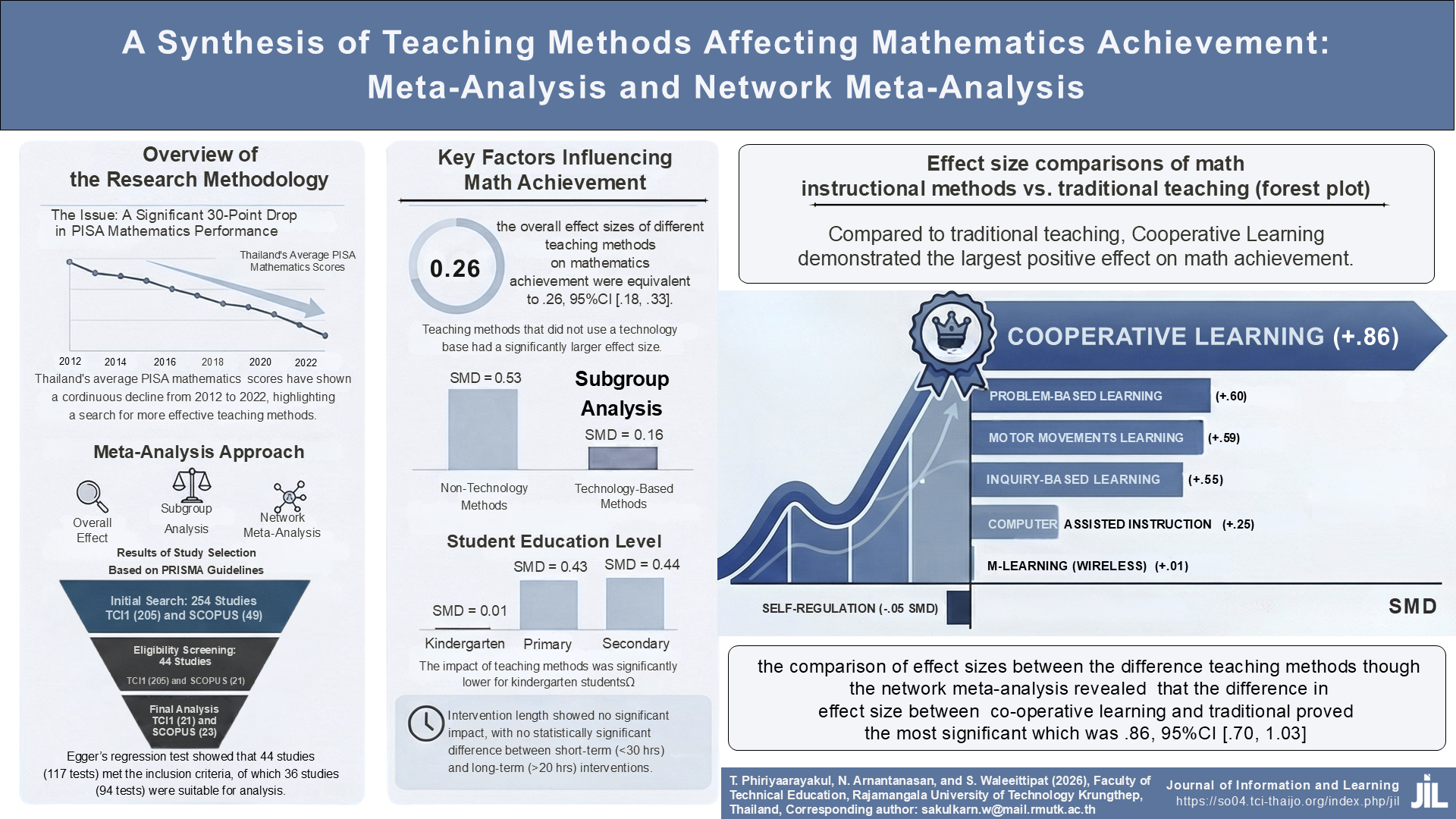
งานวิจัยนี้มีวัตถุประสงค์เพื่อวิเคราะห์ขนาดอิทธิพลในภาพรวมของวิธีการสอนที่มีต่อผลสัมฤทธิ์ทางการเรียนวิชาคณิตศาสตร์ และเพื่อเปรียบเทียบขนาดอิทธิพลของวิธีการสอนแบบต่าง ๆ ที่มีต่อผลสัมฤทธิ์ทางการเรียนวิชาคณิตศาสตร์ การวิเคราะห์อภิมานนี้ได้ตัวอย่างจำนวน 44 งานวิจัย ตัวอย่างวิจัย ได้แก่ งานวิจัยที่ใช้กลยุทธ์การค้นหาและผ่านเกณฑ์การคัดเข้าจากฐานข้อมูล TCI 1 จำนวน 23 งานวิจัย และจากฐานข้อมูล SCOPUS จำนวน 21 งานวิจัย วิเคราะห์ข้อมูลด้วยการวิเคราะห์ขนาดอิทธิพล การวิเคราะห์ความเป็นเอกพันธ์ การวิเคราะห์อภิมาน การวิเคราะห์กลุ่มย่อย และการวิเคราะห์อภิมานเครือข่าย ผลการวิจัย พบว่า ขนาดอิทธิพลของวิธีการสอนแบบต่าง ๆ ในภาพรวมมีต่อผลสัมฤทธิ์ทางการเรียนวิชาคณิตศาสตร์เท่ากับ 0.26, 95%CI [0.18, 0.33] ขนาดอิทธิพลของวิธีการสอนแบบต่าง ๆ ที่นำมาวิเคราะห์ทั้งหมดแตกต่างกันอย่างมีนัยสำคัญทางสถิติที่ระดับ .05 (Q(df = 93) = 364.473, p < .001, I2 = 76.69%) ผลการวิเคราะห์กลุ่มย่อย พบว่า คุณลักษณะของงานวิจัยที่ส่งผลให้ขนาดอิทธิพลของวิธีการสอนแตกต่างกัน คือ การใช้เทคโนโลยีเป็นฐาน นอกจากนี้ ผลการเปรียบเทียบขนาดอิทธิพลของวิธีการสอนแบบต่าง ๆ ด้วยการวิเคราะห์อภิมานเครือข่าย พบว่า วิธีการสอนแบบร่วมมือมีผลต่างของขนาดอิทธิพลโดยรวมจากวิธีการสอนแบบดั้งเดิมมากที่สุด (0.86, 95% CI [0.70, 1.03])
เอกสารอ้างอิง
Ali, A., Ahmad, N., & Hussain, S. (2021). An experimental study of collaborative instructional strategy (CIS) for teaching mathematics at primary level in Pakistan. Mathematics Teaching Research Journal, 13(1), 94–105. https://files.eric.ed.gov/fulltext/EJ1384864.pdf
Aragón-Mendizábal, E., Aguilar-Villagrán, M., Navarro-Guzmán, J. I., & Howell, R. (2017). Improving number sensein kindergarten children with low achievement in mathematics. Anales de Psicologia, 33(2), 311–318. http://dx.doi.org/10.6018/analesps.33.2.239391
Borenstein, M., Hedges, L. V., Higgins, J. P. T., & Rothstein, H. R. (2011). Introduction to meta-analysis. John Wiley & Sons.
Byun, J. H., & Joung, E. (2018). Digital game-based learning for K–12 mathematics education: A meta-analysis. School Science and Mathematics, 118(3–4), 113–126. https://doi.org/10.1111/ssm.12271
Caviola, S., Toffalini, E., Giofrè, D., Ruiz, J. M., Szucs, D., & Mammarella, I. C. (2021). Math performance and academic anxiety forms, from sociodemographic to cognitive aspects: A meta-analysis on 906,311 participants. Educational Psychology Review, 34, 363–399. https://doi.org/10.1007/s10648-021-09618-5
Chayaban, W., Tippayakulpairoj, D., Siripila, S., Noklang, S., Anantanasan, N., Chaiboonma, S., & Piromsombat, C. (2021). A network meta-analysis of teaching method influencing mathematics achievement of students. Journal of Educational Measurement, Mahasarakham University, 27(1), 244–260. https://so02.tci-thaijo.org/index.php/jemmsu/article/view/240457
Cheung, A. C. K., & Slavin, R. E. (2011). The effectiveness of educational technology applications for enhancing mathematics achievement in K-12 classrooms: A meta-analysis. Center for Research and Reform in Education, Johns Hopkins University.
Cheung, A. C. K., & Slavin, R. E. (2013). The effectiveness of educational technology applications for enhancing mathematics achievement in K-12 classrooms: A meta-analysis. Educational Research Review, 9, 88–113. http://dx.doi.org/10.1016/j.edurev.2013.01.001
Cohen J. (1988). Statistical power analysis for the behavioral sciences (2nd ed.). Lawrence Erlbaum Associates.
Cooper, H., & Hedges, L. V. (2009). Research synthesis as a scientific process. In H. Cooper, L. V. Hedges, J. C. Valentine, (Eds.), The handbook of research synthesis and meta-analysis (2nd ed.) (pp. 3–19). Russell Sage Foundation Publications.
Dias, S., Welton, N. J., Sutton, A. J., Caldwell, D. M., Lu, G., & Ades, A. E. (2013). Evidence synthesis for decision making 4: Inconsistency in networks of evidence based on randomized controlled trials. Medical Decision Making, 33(5), 641–656. https://doi.org/10.1177/0272989X12455847
Donoghue, G. M., & Hattie, J. A. C. (2021). A meta-analysis of ten learning techniques. Frontiers in Education, 6, Article 581216. https://doi.org/10.3389/feduc.2021.581216
Fadda, D., Pellegrini, M., Vivanet, G., & Callegher, C. Z. (2022). Effects of digital games on student motivation in mathematics: A meta-analysis in K-12. Journal of Computer Assisted Learning, 38(1), 304–325. https://doi.org/10.1111/jcal.12618
Harrer, M., Cuijpers, P., Furukawa, T. A., & Ebert, D. D. (2021). Doing meta-analysis with R: A hands-on guide. Chapmann & Hall/CRC Press.
Higgins, K., Huscroft-D’Angelo, J., & Crawford, L. (2019). Effects of technology in mathematics on achievement, motivation, and attitude: A meta-analysis. Journal of Educational Computing Research, 57(2), 283–319. https://doi.org/10.1177/0735633117748416
Holzberger, D., Reinhold, S., Lüdtke, O., & Seidel, T. (2020). A meta-analysis on the relationship between school characteristics and student outcomes in science and maths: Evidence from large-scale studies. Studies in Science Education, 56(1), 1–34. https://doi.org/10.1080/03057267.2020.1735758
Jacobse, A. E., & Harskamp, E. G. (2011). A meta-analysis of the effects of instructional interventions on students' mathematics achievement. GION, Gronings Instituut voor Onderzoek van Onderwijs, Opvoeding en Ontwikkeling, Rijksuniversiteit Groningen. https://research.rug.nl/en/publications/a-meta-analysis-of-the-effects-of-instructional-interventions-on-/
Kim, J., Gilbert, J., Yu, Q., & Gale, C. (2021). Measures matter: A meta-analysis of the effects of educational apps on preschool to grade 3 children’s literacy and math skills. AERA Open, 7(1), 1–19. https://doi.org/10.1177/23328584211004183
Lee, Y., Capraro, M. M., Capraro, R. M., & Bicer, A. (2018). A meta-analysis: Improvement of students' algebraic reasoning through metacognitive training. International Education Studies, 11(10), 42–49. https://doi.org/10.5539/ies.v11n10p42
Li, J., Ye, H., Tang, Y., Zhou, Z., & Hu, X. (2018). What are the effects of self-regulation phases and strategies for Chinese students? A meta-analysis of two decades research of the association between self-regulation and academic performance. Frontiers in Psychology, 9, Article 2434. https://doi.org/10.3389/fpsyg.2018.02434
Nilson, L. B., & Goodson, L. A. (2021). Online teaching at its best: Merging instructional design with teaching and learning research (2nd ed.). Jossey-Bass.
OECD. (2018). PISA 2018 assessment and analytical framework: Mathematics, reading, science, global competence and financial literacy. OECD Publishing. https://doi.org/10.1787/9789264305274-en
OECD. (2019a). Thailand: Country note PISA 2018 results. https://www.oecd.org/en/about/programmes/pisa/pisa-publications.html
OECD. (2019b). PISA 2018 results (volume I): What students know and can do. OECD Publishing. https://doi.org/10.1787/888934028235
OECD. (2023). PISA 2022 results (volume I and II) - country notes: Thailand. https://www.oecd.org/en/publications/pisa-2022-results-volume-i-and-ii-country-notes_ed6fbcc5-en/thailand_6138f4af-en.html
Pellegrini, M., Lake, C., Neitzel, A., & Slavin, R. E. (2021). Effective programs in elementary mathematics: A meta-analysis. AERA Open, 7(1), 1–29. https://doi.org/10.1177/2332858420986211
Ran, H., Kasli, M., & Secada, W. G. (2021). A meta-analysis on computer technology intervention effects on mathematics achievement for low-performing students in K-12 classrooms. Journal of Educational Computing Research, 59(1), 119–153. https://doi.org/10.1177/0735633120952063
Siregar, N. C., Rosli, R., Maat, S. M., & Capraro, M. M. (2020). The effect of science, technology, engineering and mathematics (STEM) program on students’ achievement in mathematics: A meta-analysis. International Electronic Journal of Mathematics Education, 15(1), Article em0549. https://doi.org/10.29333/iejme/5885
Spitzer, M. W. H., & Musslick, S. (2021). Academic performance of K-12 students in an online-learning environment for mathematics increased during the shutdown of schools in wake of the COVID-19 pandemic. PLOS ONE, 16(8), Article e0255629. https://doi.org/10.1371/journal.pone.0255629
Tokac, U., Novak, E., & Thompson, C. G. (2019). Effects of game-based learning on students’ mathematics achievement. Journal of Computer Assisted Learning, 35(3), 407–420. https://doi.org/10.1111/jcal.12347
Wu, W. -H., Hsiao, H. -C., Wu, P. -L., Lin, C. -H., & Huang, S. -H. (2012). Investigating the learning-theory foundations of game-based learning: A meta-analysis. Journal of Computer Assisted Learning, 28(3), 265–279. https://doi.org/10.1111/j.1365-2729.2011.00437.x
ดาวน์โหลด
ไฟล์ประกอบ
เผยแพร่แล้ว
รูปแบบการอ้างอิง
ฉบับ
ประเภทบทความ
หมวดหมู่
สัญญาอนุญาต
ลิขสิทธิ์ (c) 2026 Journal of Information and Learning

อนุญาตภายใต้เงื่อนไข Creative Commons Attribution-NonCommercial-NoDerivatives 4.0 International License.
Journal of Information and Learning ดำเนินการโดยสำนักวิทยบริการ มหาวิทยาลัยสงขลานครินทร์ วิทยาเขตปัตตานี บทความที่ได้รับการตีพิมพ์ในวารสารได้รับความคุ้มครองตามกฎหมายลิขสิทธิ์ โดยเจ้าของลิขสิทธิ์จะมีสิทธิในการทำซ้ำ ดัดแปลง และเผยแพร่งานบทความ ทั้งรูปแบบอิเล็กทรอนิกส์ การทำฉบับสำเนา การแปล และการผลิตซ้ำในรูปแบบต่างๆ ลิขสิทธิ์บทความเป็นของผู้เขียนและสำนักวิทยบริการ มหาวิทยาลัยสงขลานครินทร์ วิทยาเขตปัตตานี วารสารฯ ขอสงวนสิทธิ์ในการพิจารณาตีพิมพ์ตามความเหมาะสม รวมทั้งการตรวจทานแก้ไข การปรับข้อความ หรือขัดเกลาภาษาให้ถูกต้องตามเกณฑ์ที่กำหนด สำหรับผลการวิจัยและความคิดเห็นที่ปรากฏในบทความถือเป็นความคิดเห็นและอยู่ในความรับผิดชอบของผู้เขียน


