
Development of Learning Management Activities Integrating Artificial Intelligence Technology and Design Thinking to Enhance Innovation Capability and Learning Engagement of Eighth Grade Students
Keywords:
artificial intelligence, design thinking, innovation capability, learning engagementAbstract
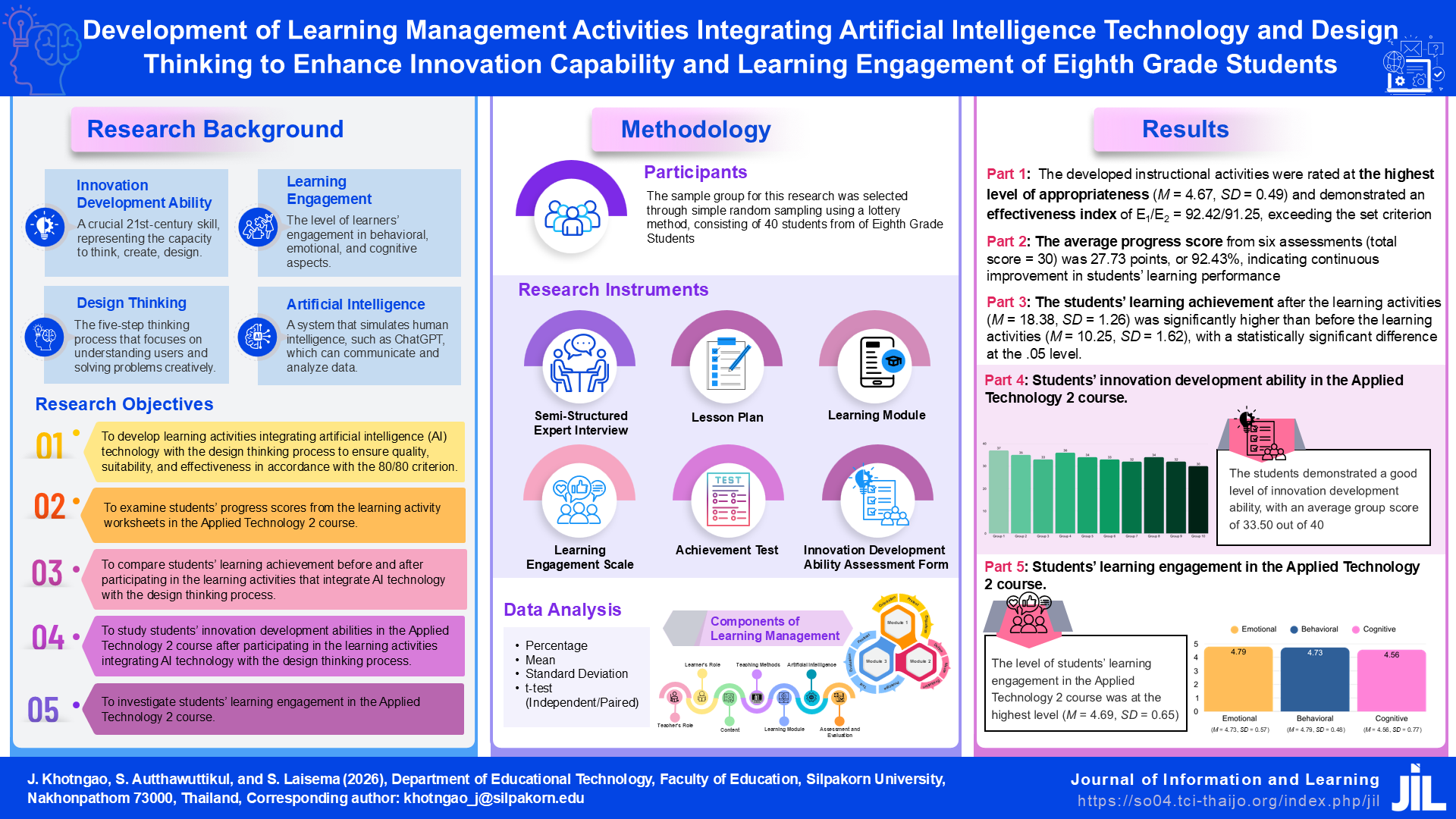
The objectives of this research are 1) to develop instructional activities integrating artificial intelligence (AI) technology with the design thinking process to achieve quality and effectiveness based on the 80/80 criterion; 2) to examine students’ progress scores from learning activity worksheets; 3) to compare students’ learning achievement before and after instruction; 4) to investigate students’ innovation capability; and 5) to examine students’ learning engagement. The samples consisted of 40 MathayomSuksa 2 students at Nawaminthrachinuthit Satriwitthaya Phutthamonthon School in the first semester of the academic year 2025, selected through simple random sampling. The research instruments included: 1) a semi-structured expert interview form; 2) an interactive learning module developed on the Google Classroom platform, integrating artificial intelligence technology with the design thinking process; 3) instructional activity plans; 4) an achievement test; 5) an innovation capability assessment form; and 6) a learning engagement scale. Data were analyzed using mean, standard deviation, percentage, and a dependent t-test. The results showed the following: 1) the developed instructional activities were rated at the highest level of appropriateness (M = 4.67, SD = 0.49) and demonstrated an effectiveness index of E1/E2 = 92.42/91.25, exceeding the set criterion; 2) the average progress score across six assessments (total score = 30) was 27.73 points, or 92.43%, indicating continuous improvement in students’ learning performance; 3) students’ posttest achievement scores were significantly higher than those of their pretest ones; 4) students’ innovation capability was at a good level (M = 33.50 out of 40); and 5) learning engagement after instruction reached the highest level (M = 4.69, SD = 0.65). The findings achieved all five research objectives, indicating that the developed instructional activities were of high quality and effectiveness, and could enhance students’ learning achievement, progress, innovation capability, and learning engagement effectively.
References
Albakry, N. S., Hashim, M. E. A., & Puandi, M. F. (2025). The integration of AI in design thinking for enhancing student creativity and critical thinking in digital media learning. Journal of Digital Learning and Education, 5(1), 1–15. https://semarakilmu.my/index.php/sijcad/article/view/597
Autthawuttikul, S., Laisema, S., & Bangtamai, E. (2022). A place-based digital learning environment with learning resources applications to enhance student learning and innovations. International Journal of Interactive Mobile Technologies, 16(19), 22–43. https://doi.org/10.3991/ijim.v16i19.32361
Barkley, E. F. (2009). Student engagement techniques: A handbook for college faculty. John Wiley and Sons. https://books.google.co.th/books?id=muAStyrwyZgC
Boonjit, W., & Wannasawade, W. (2025). Development of a learning management plan using the design thinking process for lower secondary students to enhance integrated problem-solving competency in conjunction with the sustainable use of generative artificial intelligence: Nabon School, Nakhon Si Thammarat. Journal of MCU Nakhondhat, 12(3), 121–132. https://so03.tci-thaijo.org/index.php/JMND/article/view/286451
Dam, R. F. (2025, July 18). The 5 stages in the design thinking process. IxDF-Interaction Design Foundation. https://www.interaction-design.org/literature/article/5-stages-in-the-design-thinking-process
Esfijani, A., & Sadeghi, F. (2024). Grouping strategy effects on students’ engagement in technology‑enhanced collaborative learning [Conference presentation]. Proceedings of the 11th International and 17th National Conference on E‑Learning and E‑Teaching (ICeLeT 2024), Isfahan, Iran. https://doi.org/10.1109/ICeLeT62507.2024.10493061
Fredricks, J. A., & McColskey, W. (2012). The measurement of student engagement: A comparative analysis of various methods and student self-report instruments. In S. L. Christenson, A. L. Reschly, & C. Wylie (Eds.), Handbook of research on Student Engagement (pp. 763–782). Springer. https://doi.org/10.1007/978-1-4614-2018-7_37
Holmes, W., Bialik, M., & Fadel, C. (2023). Artificial intelligence in education. Globethics Publications. https://doi.org/10.58863/20.500.12424/4276068
Hongngam, K., Injumpa, D., & Chanapai, K. (2022). The development of digital technology to support learning in children with disabilities. International Education Studies, 15(4), 117–124. https://eric.ed.gov/?id=EJ1357435
Innovation and Business Skills Australia. (2009). Developing innovation skills: A guide for trainers and assessors to foster the innovation skills of learners through professional practice. https://hdl.voced.edu.au/10707/374990
Interaction Design Foundation. (2018). Design thinking: A quick overview. Interaction Design Foundation. https://www.interaction-design.org/literature/topics/design-thinking
Iddris, F. (2016). Innovation capability: A systematic review and research agenda. Interdisciplinary Journal of Information, Knowledge, and Management, 11, 235–260. https://doi.org/10.28945/3571
Jia, L., Jalaludin, N. A., & Rasul, S. (2023). Design thinking and project-based learning (DT-PBL): A review of the literature. International Journal of Learning, Teaching and Educational Research, 22(8), 376–390. https://www.researchgate.net/publication/373702631_Design_Thinking_and_Project-Based_Learning_DT-PBL_A_Review_of_the_Literature
Kadsosot, K., & Pongpatrakant, P. (2023). The development of an instructional package using project-based learning with the design thinking process to develop innovators via artificial intelligence technology [Master’s thesis, Naresuan University]. NUIR. https://nuir.lib.nu.ac.th/dspace/handle/123456789/6479
Kelley, D., & Kelley, T. (2013). Creative Confidence: Unleashing the creative potential within us all [Excerpt]. Stanford Social Innovation Review. https://ssir.org/books/excerpts/entry/creative_confidence_unleashing_the_creative_potential_within_us_all
Laisema, S., & Bangthamai, E. (2025). Integrating open educational resources with design thinking: An instructional design model for enhancing innovator competencies. International Journal of Information and Education Technology, 15(5), 398–404. https://www.ijiet.org/show-226-2962-1.html
Lin, M.-Y., & Chang, Y. S. (2025). Effects of design thinking STEAM instruction on artificial intelligence learning and creativity. International Journal of Technology and Design Education, 35, 2025–2047. https://doi.org/10.1007/s10798-025-09977-y
Luan, H., Geczy, P., Lai, H., Gobert, J., Yang, S. J. H., Ogata, H., Baltes, J., Guerra, R., Li, P., & Tsai, C.- C. (2020). Challenges and future directions of big data and artificial intelligence in education. Frontiers in Psychology, 11, Article 580820. https://doi.org/10.3389/fpsyg.2020.580820
Luckin, R., Holmes, W., Griffiths, M., & Forcier, L. B. (2016). Intelligence unleashed: An argument for artificial intelligence in education. Pearson. https://www.researchgate.net/publication/299561597_Intelligence_Unleashed_An_argument_for_AI_in_Education
Mendoza‑Silva, A. (2020). Innovation capability: A systematic literature review. European Journal of Innovation Management, 24(3), 707–734. https://doi.org/10.1108/EJIM-09-2019-0263
Office of the Education Council, Ministry of Education. (2017). Education in Thailand (OEC Publication No. 6/2017). Prigwan Graphic. https://bic.moe.go.th/images/stories/pdf/EDUCATION_IN_THAILAND_2017.pdf
Poleac, D. (2024). Design thinking with AI. International Conference on Business Excellence, 18(1), 2891–2900. https://doi.org/10.2478/picbe-2024-0240
Razzouk, R., & Shute, V. (2012). What is design thinking and why is it important? Review of Educational Research, 82(3), 330–348. https://doi.org/10.3102/0034654312457429
Rao, D. T., & Kalyani, C. (2022). Design thinking: A human-centered approach towards innovation-a conceptual framework. International Journal of Marketing & Human Resource Management, 12(2), 59–65. https://www.researchgate.net/publication/360836282_DESIGN_THINKING_A_HUMAN-CENTERED_APPROACH_TOWARDS_INNOVATION_-A_CONCEPTUAL_FRAMEWORK
Šajben, J., Klimová, N., & Lovászová, G. (2020, July 6-7). Minecraft: Education edition as a game-based learning in Slovakia [Conference presentation]. 2th International Conference on Education and New Learning Technologies, Online Conference. http://dx.doi.org/10.21125/edulearn.2020.1946
Saritepeci, M., & Yildiz-Durak, H. (2024). Effectiveness of artificial intelligence integration in design-based learning on design thinking mindset, creative and reflective thinking skills: An experimental study. Education and Information Technologies, 29, 25175–25209. https://doi.org/10.1007/s10639-024-12829-2
Schmidberger, I., & Wippermann, S. (2024, June 18-21). Applying design thinking to support education for sustainable development in higher education [Conference presentation]. Tenth International Conference on Higher Education Advances, Valencia, Spain. https://doi.org/10.4995/HEAd24.2024.17073
Shinnaraj, C. (2020). Development creative innovate ability on 7E learning cycle with STEM education of grade 8 students [Master’s thesis, Srinakharinwirot University]. SWU Institutional Repository. http://ir-ithesis.swu.ac.th/dspace/handle/123456789/1294
Sisaeng, P. (2023). A virtual reality learning model based on creative problem‑solving to enhance undergraduate students’ innovation capability [Doctoral dissertation, Chulalongkorn University]. Chula Digital Collections. https://digital.car.chula.ac.th/chulaetd/10159
UNESCO. (2023). Artificial intelligence and education: Guidance for policy-makers. https://unesdoc.unesco.org/ark:/48223/pf0000385044
Wu, D., & Zhang, J. (2025). Generative artificial intelligence in secondary education: Applications and effects on students’ innovation skills and digital literacy. PLOS ONE, 20(5), Article e0323349. https://doi.org/10.1371/journal.pone.0323349
Yang, S., & Bai, H. (2020). The integration design of artificial intelligence and normal students’ education. Journal of Physics: Conference Series, 1453(1), Article 012090. https://doi.org/10.1088/1742-6596/1453/1/012090
Yuskovychzhukovska, V., Poplavska, T., Diachenko, O., Mishenina, T., Topolnyk, Y., & Gurevych, R. (2022). Application of artificial intelligence in education: Problems and opportunities for sustainable development. BRAIN. Broad Research in Artificial Intelligence and Neuroscience, 13(1Sup1), 339–356. https://doi.org/10.18662/brain/13.1Sup1/322
Downloads
Additional Files
Published
How to Cite
Issue
Section
Categories
License
Copyright (c) 2026 Journal of Information and Learning

This work is licensed under a Creative Commons Attribution-NonCommercial-NoDerivatives 4.0 International License.
The Journal of Information and Learning is operated by the Office of Academic Resources, Prince of Songkla University. All articles published in the journal are protected by Thailand copyright law. This copyright covers the exclusive rights to share, reproduce and distribute the article, including in electronic forms, reprints, translations, photographic reproductions, or similar. Authors own copyrights in the works they have created as well as the Office of Academic Resources. The Journal reserves the right to edit the language of papers accepted for publication for clarity and correctness, as well as to make formal changes to ensure compliance with the journal's guidelines. All authors must take public responsibility for the content of their paper.


