
การพัฒนากิจกรรมการจัดการเรียนรู้ด้วยเทคโนโลยีปัญญาประดิษฐ์ร่วมกับกระบวนการคิดเชิงออกแบบที่ส่งผลต่อความสามารถในการพัฒนานวัตกรรมและการยึดมั่นผูกพันในการเรียนของนักเรียนชั้นมัธยมศึกษาปีที่ 2
คำสำคัญ:
เทคโนโลยีปัญญาประดิษฐ์, กระบวนการคิดเชิงออกแบบ, ความสามารถในการพัฒนานวัตกรรม, การยึดมั่นผูกพันในการเรียนบทคัดย่อ
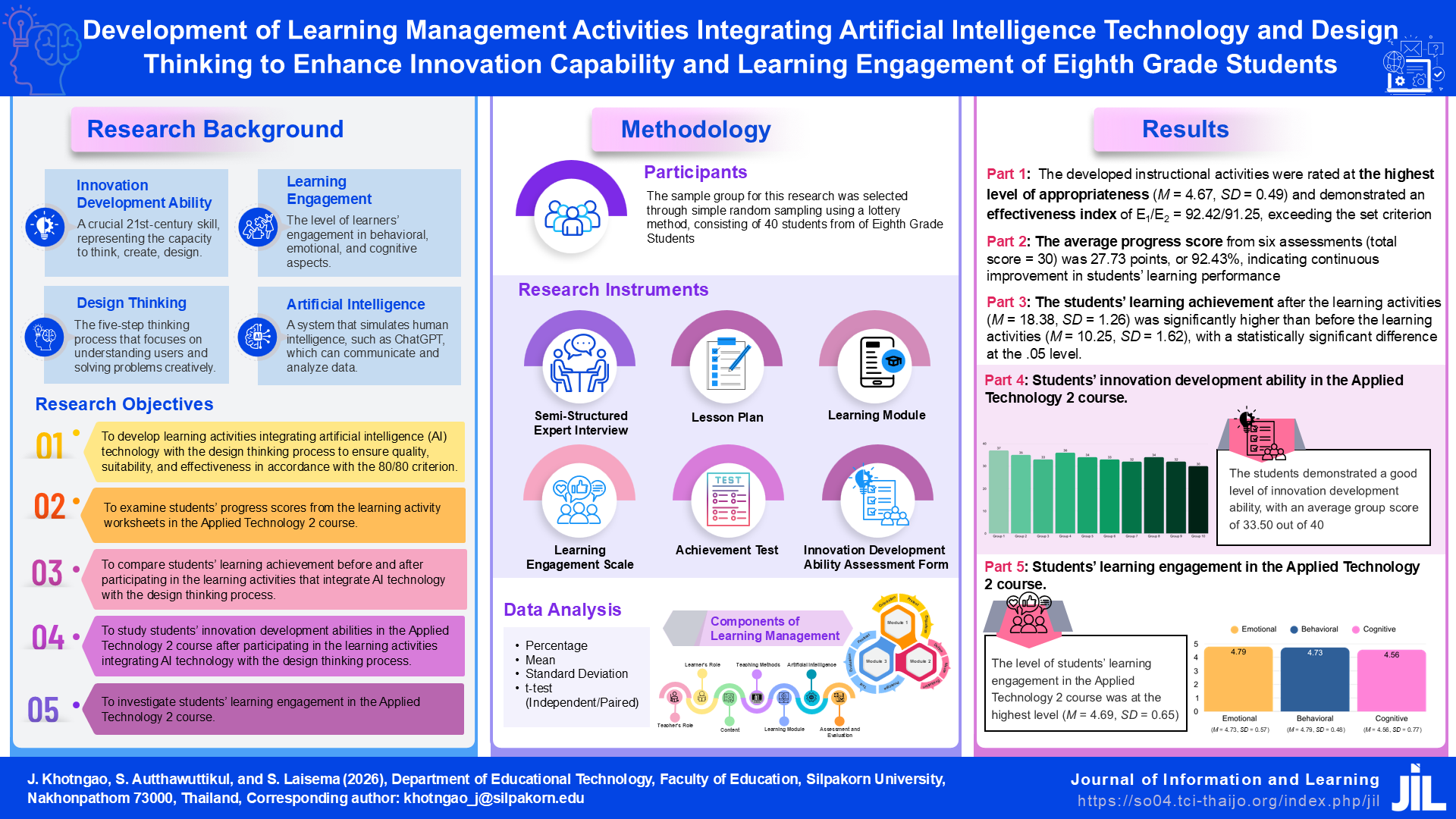
การวิจัยนี้มีวัตถุประสงค์เพื่อ 1) พัฒนากิจกรรมการจัดการเรียนรู้ด้วยเทคโนโลยีปัญญาประดิษฐ์ร่วมกับกระบวนการคิดเชิงออกแบบให้มีคุณภาพและประสิทธิภาพตามเกณฑ์ 80/80 2) ศึกษาคะแนนความก้าวหน้าจากใบกิจกรรม 3) เปรียบเทียบผลสัมฤทธิ์ทางการเรียนก่อนและหลังการเรียน 4) ศึกษาความสามารถในการพัฒนานวัตกรรม และ 5) ศึกษาการยึดมั่นผูกพันในการเรียนของนักเรียน กลุ่มตัวอย่าง คือ นักเรียนชั้นมัธยมศึกษาปีที่ 2 จำนวน 40 คน โรงเรียนนวมินทราชินูทิศ สตรีวิทยา พุทธมณฑล ภาคเรียนที่ 1 ปีการศึกษา 2568 โดยการสุ่มอย่างง่าย เครื่องมือวิจัยประกอบด้วย 1) แบบสัมภาษณ์ผู้เชี่ยวชาญกึ่งโครงสร้าง 2) มอดูลการเรียนรู้แบบเชิงโต้ตอบบนแพลตฟอร์ม Google Classroom ที่บูรณาการเทคโนโลยีปัญญาประดิษฐ์กับกระบวนการคิดเชิงออกแบบ 3) แผนการจัดกิจกรรมการจัดการเรียนรู้ 4) แบบทดสอบวัดผลสัมฤทธิ์ทางการเรียน 5) แบบประเมินความสามารถในการพัฒนานวัตกรรม และ 6) แบบวัดการยึดมั่นผูกพันในการเรียน การวิเคราะห์ข้อมูลใช้ค่าเฉลี่ย ส่วนเบี่ยงเบนมาตรฐาน ร้อยละ และสถิติ t-test แบบกลุ่มสัมพันธ์ ผลการวิจัยพบว่า 1) กิจกรรมการจัดการเรียนรู้มีความเหมาะสมในระดับมากที่สุด (M = 4.67, SD = 0.49) และมีประสิทธิภาพ E1/E2 เท่ากับ 92.42/91.25 สูงกว่าเกณฑ์ 2) คะแนนความก้าวหน้าเฉลี่ยจากการประเมิน 6 ครั้ง (คะแนนเต็ม 30) เท่ากับ 27.73 คะแนน คิดเป็นร้อยละ 92.43 สะท้อนพัฒนาการด้านผลสัมฤทธิ์อย่างต่อเนื่อง 3) ผลสัมฤทธิ์หลังเรียนสูงกว่าก่อนเรียนอย่างมีนัยสำคัญทางสถิติ 4) ความสามารถในการพัฒนานวัตกรรมอยู่ในระดับดี (M = 33.50 จาก 40 คะแนน) และ 5) การยึดมั่นผูกพันหลังเรียนอยู่ในระดับมากที่สุด (M = 4.69, SD = 0.65) ผลการวิจัยบรรลุวัตถุประสงค์ทั้งห้าข้อ แสดงให้เห็นว่า กิจกรรมที่พัฒนาขึ้นมีคุณภาพและประสิทธิภาพ สามารถส่งเสริมผลสัมฤทธิ์ ความก้าวหน้า ความสามารถในการพัฒนานวัตกรรม และการยึดมั่นผูกพันของผู้เรียนได้อย่างมีประสิทธิผล
เอกสารอ้างอิง
Albakry, N. S., Hashim, M. E. A., & Puandi, M. F. (2025). The integration of AI in design thinking for enhancing student creativity and critical thinking in digital media learning. Journal of Digital Learning and Education, 5(1), 1–15. https://semarakilmu.my/index.php/sijcad/article/view/597
Autthawuttikul, S., Laisema, S., & Bangtamai, E. (2022). A place-based digital learning environment with learning resources applications to enhance student learning and innovations. International Journal of Interactive Mobile Technologies, 16(19), 22–43. https://doi.org/10.3991/ijim.v16i19.32361
Barkley, E. F. (2009). Student engagement techniques: A handbook for college faculty. John Wiley and Sons. https://books.google.co.th/books?id=muAStyrwyZgC
Boonjit, W., & Wannasawade, W. (2025). Development of a learning management plan using the design thinking process for lower secondary students to enhance integrated problem-solving competency in conjunction with the sustainable use of generative artificial intelligence: Nabon School, Nakhon Si Thammarat. Journal of MCU Nakhondhat, 12(3), 121–132. https://so03.tci-thaijo.org/index.php/JMND/article/view/286451
Dam, R. F. (2025, July 18). The 5 stages in the design thinking process. IxDF-Interaction Design Foundation. https://www.interaction-design.org/literature/article/5-stages-in-the-design-thinking-process
Esfijani, A., & Sadeghi, F. (2024). Grouping strategy effects on students’ engagement in technology‑enhanced collaborative learning [Conference presentation]. Proceedings of the 11th International and 17th National Conference on E‑Learning and E‑Teaching (ICeLeT 2024), Isfahan, Iran. https://doi.org/10.1109/ICeLeT62507.2024.10493061
Fredricks, J. A., & McColskey, W. (2012). The measurement of student engagement: A comparative analysis of various methods and student self-report instruments. In S. L. Christenson, A. L. Reschly, & C. Wylie (Eds.), Handbook of research on Student Engagement (pp. 763–782). Springer. https://doi.org/10.1007/978-1-4614-2018-7_37
Holmes, W., Bialik, M., & Fadel, C. (2023). Artificial intelligence in education. Globethics Publications. https://doi.org/10.58863/20.500.12424/4276068
Hongngam, K., Injumpa, D., & Chanapai, K. (2022). The development of digital technology to support learning in children with disabilities. International Education Studies, 15(4), 117–124. https://eric.ed.gov/?id=EJ1357435
Innovation and Business Skills Australia. (2009). Developing innovation skills: A guide for trainers and assessors to foster the innovation skills of learners through professional practice. https://hdl.voced.edu.au/10707/374990
Interaction Design Foundation. (2018). Design thinking: A quick overview. Interaction Design Foundation. https://www.interaction-design.org/literature/topics/design-thinking
Iddris, F. (2016). Innovation capability: A systematic review and research agenda. Interdisciplinary Journal of Information, Knowledge, and Management, 11, 235–260. https://doi.org/10.28945/3571
Jia, L., Jalaludin, N. A., & Rasul, S. (2023). Design thinking and project-based learning (DT-PBL): A review of the literature. International Journal of Learning, Teaching and Educational Research, 22(8), 376–390. https://www.researchgate.net/publication/373702631_Design_Thinking_and_Project-Based_Learning_DT-PBL_A_Review_of_the_Literature
Kadsosot, K., & Pongpatrakant, P. (2023). The development of an instructional package using project-based learning with the design thinking process to develop innovators via artificial intelligence technology [Master’s thesis, Naresuan University]. NUIR. https://nuir.lib.nu.ac.th/dspace/handle/123456789/6479
Kelley, D., & Kelley, T. (2013). Creative Confidence: Unleashing the creative potential within us all [Excerpt]. Stanford Social Innovation Review. https://ssir.org/books/excerpts/entry/creative_confidence_unleashing_the_creative_potential_within_us_all
Laisema, S., & Bangthamai, E. (2025). Integrating open educational resources with design thinking: An instructional design model for enhancing innovator competencies. International Journal of Information and Education Technology, 15(5), 398–404. https://www.ijiet.org/show-226-2962-1.html
Lin, M.-Y., & Chang, Y. S. (2025). Effects of design thinking STEAM instruction on artificial intelligence learning and creativity. International Journal of Technology and Design Education, 35, 2025–2047. https://doi.org/10.1007/s10798-025-09977-y
Luan, H., Geczy, P., Lai, H., Gobert, J., Yang, S. J. H., Ogata, H., Baltes, J., Guerra, R., Li, P., & Tsai, C.- C. (2020). Challenges and future directions of big data and artificial intelligence in education. Frontiers in Psychology, 11, Article 580820. https://doi.org/10.3389/fpsyg.2020.580820
Luckin, R., Holmes, W., Griffiths, M., & Forcier, L. B. (2016). Intelligence unleashed: An argument for artificial intelligence in education. Pearson. https://www.researchgate.net/publication/299561597_Intelligence_Unleashed_An_argument_for_AI_in_Education
Mendoza‑Silva, A. (2020). Innovation capability: A systematic literature review. European Journal of Innovation Management, 24(3), 707–734. https://doi.org/10.1108/EJIM-09-2019-0263
Office of the Education Council, Ministry of Education. (2017). Education in Thailand (OEC Publication No. 6/2017). Prigwan Graphic. https://bic.moe.go.th/images/stories/pdf/EDUCATION_IN_THAILAND_2017.pdf
Poleac, D. (2024). Design thinking with AI. International Conference on Business Excellence, 18(1), 2891–2900. https://doi.org/10.2478/picbe-2024-0240
Razzouk, R., & Shute, V. (2012). What is design thinking and why is it important? Review of Educational Research, 82(3), 330–348. https://doi.org/10.3102/0034654312457429
Rao, D. T., & Kalyani, C. (2022). Design thinking: A human-centered approach towards innovation-a conceptual framework. International Journal of Marketing & Human Resource Management, 12(2), 59–65. https://www.researchgate.net/publication/360836282_DESIGN_THINKING_A_HUMAN-CENTERED_APPROACH_TOWARDS_INNOVATION_-A_CONCEPTUAL_FRAMEWORK
Šajben, J., Klimová, N., & Lovászová, G. (2020, July 6-7). Minecraft: Education edition as a game-based learning in Slovakia [Conference presentation]. 2th International Conference on Education and New Learning Technologies, Online Conference. http://dx.doi.org/10.21125/edulearn.2020.1946
Saritepeci, M., & Yildiz-Durak, H. (2024). Effectiveness of artificial intelligence integration in design-based learning on design thinking mindset, creative and reflective thinking skills: An experimental study. Education and Information Technologies, 29, 25175–25209. https://doi.org/10.1007/s10639-024-12829-2
Schmidberger, I., & Wippermann, S. (2024, June 18-21). Applying design thinking to support education for sustainable development in higher education [Conference presentation]. Tenth International Conference on Higher Education Advances, Valencia, Spain. https://doi.org/10.4995/HEAd24.2024.17073
Shinnaraj, C. (2020). Development creative innovate ability on 7E learning cycle with STEM education of grade 8 students [Master’s thesis, Srinakharinwirot University]. SWU Institutional Repository. http://ir-ithesis.swu.ac.th/dspace/handle/123456789/1294
Sisaeng, P. (2023). A virtual reality learning model based on creative problem‑solving to enhance undergraduate students’ innovation capability [Doctoral dissertation, Chulalongkorn University]. Chula Digital Collections. https://digital.car.chula.ac.th/chulaetd/10159
UNESCO. (2023). Artificial intelligence and education: Guidance for policy-makers. https://unesdoc.unesco.org/ark:/48223/pf0000385044
Wu, D., & Zhang, J. (2025). Generative artificial intelligence in secondary education: Applications and effects on students’ innovation skills and digital literacy. PLOS ONE, 20(5), Article e0323349. https://doi.org/10.1371/journal.pone.0323349
Yang, S., & Bai, H. (2020). The integration design of artificial intelligence and normal students’ education. Journal of Physics: Conference Series, 1453(1), Article 012090. https://doi.org/10.1088/1742-6596/1453/1/012090
Yuskovychzhukovska, V., Poplavska, T., Diachenko, O., Mishenina, T., Topolnyk, Y., & Gurevych, R. (2022). Application of artificial intelligence in education: Problems and opportunities for sustainable development. BRAIN. Broad Research in Artificial Intelligence and Neuroscience, 13(1Sup1), 339–356. https://doi.org/10.18662/brain/13.1Sup1/322
ดาวน์โหลด
ไฟล์ประกอบ
เผยแพร่แล้ว
รูปแบบการอ้างอิง
ฉบับ
ประเภทบทความ
หมวดหมู่
สัญญาอนุญาต
ลิขสิทธิ์ (c) 2026 Journal of Information and Learning

อนุญาตภายใต้เงื่อนไข Creative Commons Attribution-NonCommercial-NoDerivatives 4.0 International License.
Journal of Information and Learning ดำเนินการโดยสำนักวิทยบริการ มหาวิทยาลัยสงขลานครินทร์ วิทยาเขตปัตตานี บทความที่ได้รับการตีพิมพ์ในวารสารได้รับความคุ้มครองตามกฎหมายลิขสิทธิ์ โดยเจ้าของลิขสิทธิ์จะมีสิทธิในการทำซ้ำ ดัดแปลง และเผยแพร่งานบทความ ทั้งรูปแบบอิเล็กทรอนิกส์ การทำฉบับสำเนา การแปล และการผลิตซ้ำในรูปแบบต่างๆ ลิขสิทธิ์บทความเป็นของผู้เขียนและสำนักวิทยบริการ มหาวิทยาลัยสงขลานครินทร์ วิทยาเขตปัตตานี วารสารฯ ขอสงวนสิทธิ์ในการพิจารณาตีพิมพ์ตามความเหมาะสม รวมทั้งการตรวจทานแก้ไข การปรับข้อความ หรือขัดเกลาภาษาให้ถูกต้องตามเกณฑ์ที่กำหนด สำหรับผลการวิจัยและความคิดเห็นที่ปรากฏในบทความถือเป็นความคิดเห็นและอยู่ในความรับผิดชอบของผู้เขียน


