
The Relationship Between Attitudes Toward Artificial Intelligence and Work Performance: A Case Study of Support Staff at Prince of Songkla University, Surat Thani Campus
Keywords:
attitude, artificial intelligence (AI), work performanceAbstract
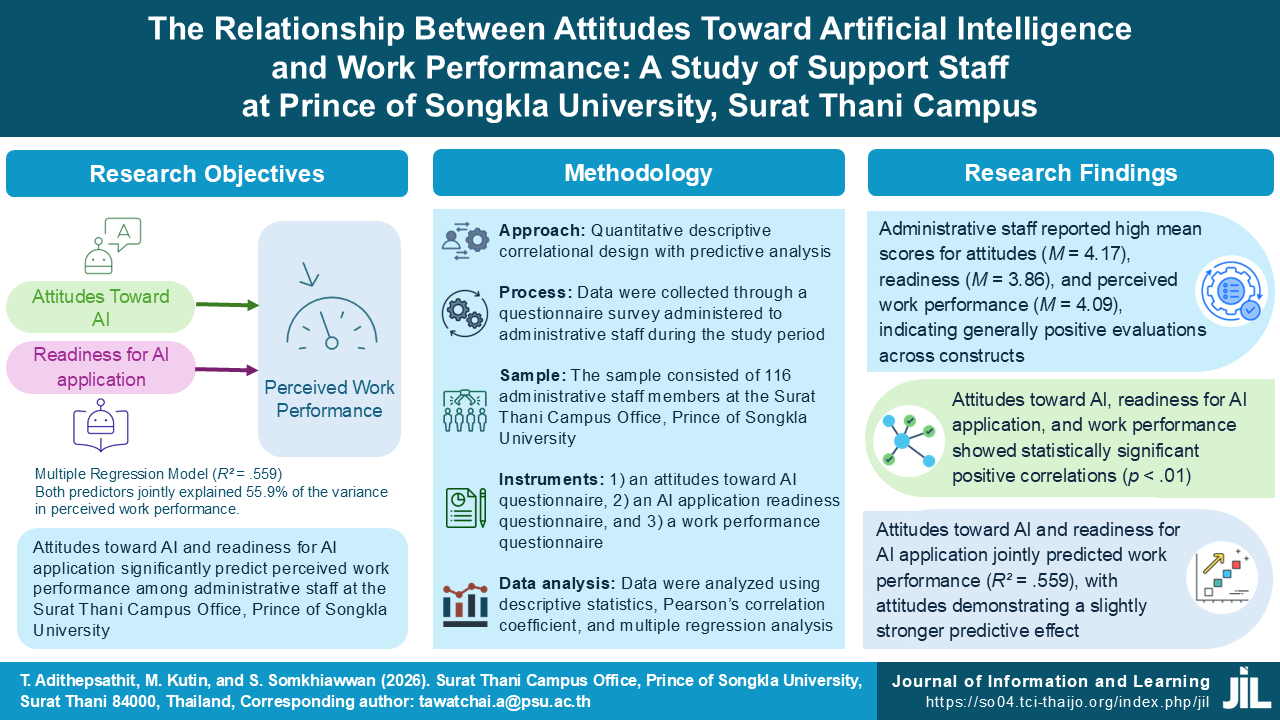
This research aimed to study the attitudes and readiness for applying artificial intelligence (AI) technology and to analyze the relationship between attitudes towards AI, readiness for applying such technology, and the performance of administrative staff in the Surat Thani Campus Office, Prince of Songkla University. The sample consisted of 116 administrative staff members, representing 77.33% of the total population. The research instrument was a questionnaire, which was validated using Cronbach's alpha coefficient of 0.86. Data were analyzed using descriptive statistics, Pearson's correlation coefficient, and multiple regression analysis. The results showed that administrative staff members had a high level of attitude towards AI (M = 4.17), a high level of overall performance (M = 4.09), and a high level of readiness for applying the technology. However, the mean score was lower than other aspects (M = 3.86). Correlation analysis showed that attitude, readiness, and performance had a statistically significant positive correlation at the .01 level. Furthermore, multiple regression analysis revealed that attitude towards AI and application readiness could jointly predict performance at a relatively high level (R² = 0.559), with attitude towards AI having a slightly greater predictive influence than application readiness. The research results reflect that promoting positive attitudes coupled with developing readiness for use, especially in terms of organizational support and access to resources, is crucial for supporting the application of AI in managerial roles and can be used as supporting information for policy planning and organizational management in the context of higher education institutions.
References
Ahmad, A., Ben Mimoun, M. S., & El-Gohary, H. (2025). Artificial intelligence and organisational performance: A systematic review of service employee perspective. Journal of Information & Knowledge Management, 25, Article 50075. https://doi.org/10.1142/S0219649225500753
Ajzen, I. (1985). From intentions to actions: A theory of planned behavior. In J. Kuhl, & J. Beckmann (Eds.), Action control: From cognition to behavior (pp. 11–39). Springer Berlin Heidelberg. https://doi.org/10.1007/978-3-642-69746-3_2
Ali, W., & Khan, A. Z. (2024). Factors influencing readiness for artificial intelligence: A systematic literature review. Data Science and Management, 8(2), 224–236. https://doi.org/10.1016/j.dsm.2024.09.005
Brynjolfsson, E., Li, D., & Raymond, L. R. (2025). Generative AI at work. The Quarterly Journal of Economics, 140(2), 889–942. https://academic.oup.com/qje/article/140/2/889/7990658
Chin, Y. S., Mohamad, A. A., & Lo, M. C. (2024). Harnessing the power of artificial intelligence (AI): A paradigm shift in HRM practices for employee sustainable performance. Global Knowledge, Memory and Communication. https://doi.org/10.1108/GKMC-06-2024-0355
Davis, F. D. (1989). Perceived usefulness, perceived ease of use, and user acceptance of information technology. MIS Quarterly, 13(3), 319–340. https://doi.org/10.2307/249008
Deci, E. L., & Ryan, R. M. (1985). Intrinsic motivation and self-determination in human behavior. Springer Science & Business Media. https://doi.org/10.1007/978-1-4899-2271-7
Dell'Acqua, F., McFowland III, E., Mollick, E. R., Lifshitz-Assaf, H., Kellogg, K., Rajendran, S., Krayer, L., Candelon, F., & Lakhani, K. R. (2026). Navigating the jagged technological frontier: Field experimental evidence of the effects of artificial intelligence on knowledge worker productivity and quality. Organization Science, 37(2), 403–423. https://doi.org/10.1287/orsc.2025.21838
Farhan, M., Alhazmi, A. K., & Alsakkaf, N. (2025). A model for AI-driven employee performance enhancement. Journal of Science and Technology, 30(2), 106–113. https://doi.org/10.20428/jst.v30i2.2760
Francis, N., Jones, S., & Smith, D. P. (2025). Generative AI in higher education: Balancing innovation and integrity. British Journal of Biomedical Science, 81, Article 14048. https://doi.org/10.3389/bjbs.2024.14048
Kelly, S., Kaye, S.-A., & Oviedo-Trespalacios, O. (2023). What factors contribute to the acceptance of artificial intelligence? A systematic review. Telematics and Informatics, 77, Article 101925. https://doi.org/10.1016/j.tele.2022.101925
Khumsamart, S., Nakrot, S., & Seesuay, J. (2025). Using artificial intelligence (AI) in educational administration for personalized learning enhancement: Roi Et Provincial Office of Learning Encouragement. Journal of Educational Innovation and Research, 9(1), 700–713. https://so03.tci-thaijo.org/index.php/jeir/article/view/282179
Kim, B., & Kim, D. (2026). Understanding the role of trust, perceived risk, and habit in organization members’ generative AI use. SAGE Open, 16(1). https://doi.org/10.1177/21582440251410620
Ma, J., Wang, P., Li, B., Wang, T., Pang, X. S., & Wang, D. (2025). Exploring user adoption of ChatGPT: A technology acceptance model perspective. International Journal of Human–Computer Interaction, 41(2), 1431–1445. https://doi.org/10.1080/10447318.2024.2314358
Ng, D. T. K., Chan, E. K. C., & Lo, C. K. (2025). Opportunities, challenges and school strategies for integrating generative AI in education. Computers and Education: Artificial Intelligence, 8, Article 100373. https://doi.org/10.1016/j.caeai.2025.100373
Noy, S., & Zhang, W. (2023). Experimental evidence on the productivity effects of generative artificial intelligence. Science, 381(6654), 187–192. https://doi.org/10.1126/science.adh2586
Ojha, B. R. (2025). Attitude towards artificial intelligence and job satisfaction: A correlational study among corporate employees of Odisha. International Journal of Science and Research Archive, 14(3), 1183–1190. https://doi.org/10.30574/ijsra.2025.14.3.0826
Salaheldin, S., & Hussein, S. (2025). The determinants of AI adoption and its impact on employee engagement: Evidence from Egyptian organizations. International Journal of Management and Applied Research, 12(2), 45–67. https://doi.org/10.18646/2056.122.25-004
Soulami, M., Benchekroun, S., & Galiulina, A. (2024). Exploring how AI adoption in the workplace affects employees: A bibliometric and systematic review. Frontiers in Artificial Intelligence, 7, Article 1473872. https://doi.org/10.3389/frai.2024.1473872
Sujkird, A. (2025). Technology acceptance affecting the intention to use artificial intelligence (AI) in the work of personnel of Valaya Alongkorn Rajabhat University under the Royal Patronage. Journal of Management Science, 27(1), 132–144. https://so03.tci-thaijo.org/index.php/msaru/article/view/284831
Taşgıt, Y. E., Baykal, Y., Aydın, U. C., Yakupoğlu, A., & Coşkuner, M. (2025). Do employees’ artificial intelligence attitudes affect individual business performance? Journal of Organizational Science and Innovation, 22(2), 176–190. https://doi.org/10.51659/josi.22.176
Valtonen, A., Saunila, M., Ukko, J., Treves, L., & Ritala, P. (2025). AI and employee wellbeing in the workplace: An empirical study. Journal of Business Research, 115, Article 115584. https://doi.org/10.1016/j.jbusres.2025.115584
Yamane, T. (1973). Statistics: An introductory analysis (3rd ed.). Harper and Row.
Downloads
Additional Files
Published
How to Cite
Issue
Section
Categories
License
Copyright (c) 2026 Journal of Information and Learning

This work is licensed under a Creative Commons Attribution-NonCommercial-NoDerivatives 4.0 International License.
The Journal of Information and Learning is operated by the Office of Academic Resources, Prince of Songkla University. All articles published in the journal are protected by Thailand copyright law. This copyright covers the exclusive rights to share, reproduce and distribute the article, including in electronic forms, reprints, translations, photographic reproductions, or similar. Authors own copyrights in the works they have created as well as the Office of Academic Resources. The Journal reserves the right to edit the language of papers accepted for publication for clarity and correctness, as well as to make formal changes to ensure compliance with the journal's guidelines. All authors must take public responsibility for the content of their paper.


