
ความสัมพันธ์ระหว่างทัศนคติต่อเทคโนโลยีปัญญาประดิษฐ์กับประสิทธิภาพการปฏิบัติงานของบุคลากรสายอำนวยการ สำนักงานวิทยาเขตสุราษฎร์ธานี มหาวิทยาลัยสงขลานครินทร์
คำสำคัญ:
ทัศนคติ, เทคโนโลยีปัญญาประดิษฐ์, ประสิทธิภาพการปฏิบัติงานบทคัดย่อ
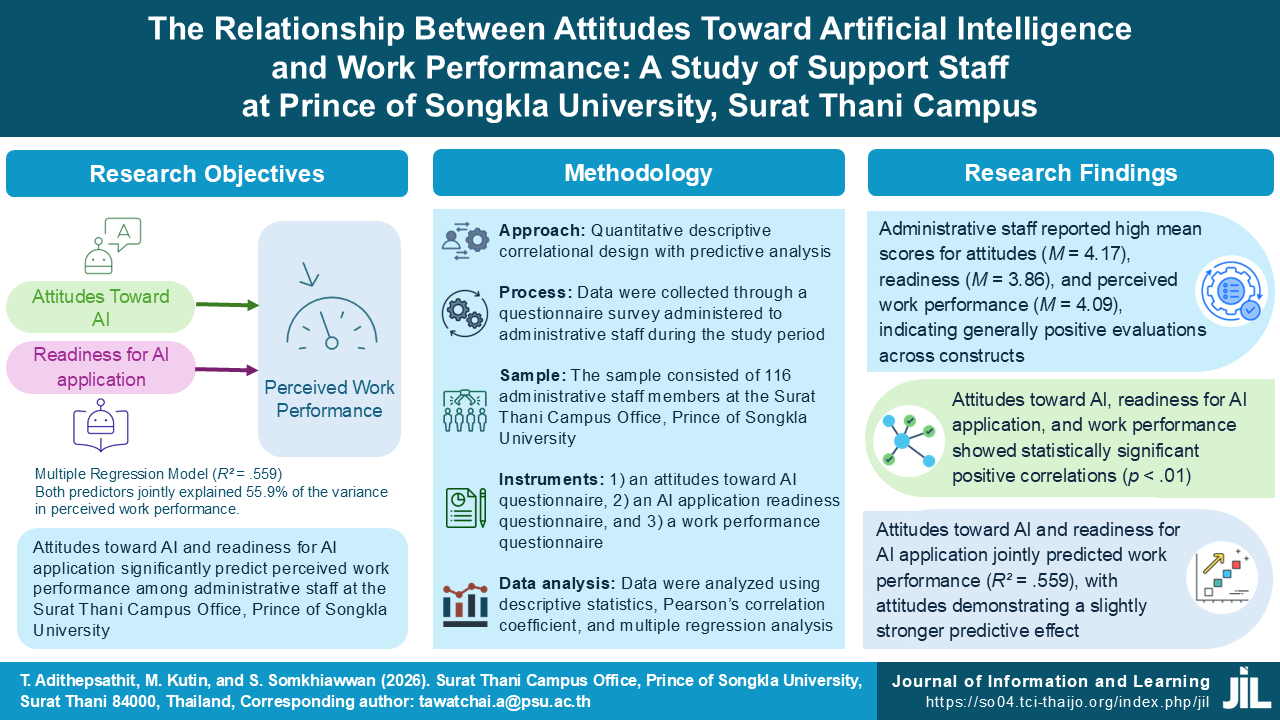
การวิจัยครั้งนี้มีวัตถุประสงค์เพื่อศึกษาทัศนคติและความพร้อมในการประยุกต์ใช้เทคโนโลยีปัญญาประดิษฐ์ (Artificial intelligence: AI) และวิเคราะห์ความสัมพันธ์ระหว่างทัศนคติต่อ AI ความพร้อมในการประยุกต์ใช้เทคโนโลยีดังกล่าว และประสิทธิภาพการปฏิบัติงานของบุคลากรสายอำนวยการ สำนักงานวิทยาเขตสุราษฎร์ธานี มหาวิทยาลัยสงขลานครินทร์ กลุ่มตัวอย่าง คือ บุคลากรสายอำนวยการจำนวน 116 คน คิดเป็นร้อยละ 77.33 ของประชากรทั้งหมด เครื่องมือที่ใช้ในการวิจัยเป็นแบบสอบถาม ซึ่งผ่านการตรวจสอบความเชื่อมั่นด้วยค่าสัมประสิทธิ์แอลฟาของครอนบาค (Cronbach’s alpha) เท่ากับ 0.86 วิเคราะห์ข้อมูลด้วยสถิติเชิงพรรณนา ค่าสัมประสิทธิ์สหสัมพันธ์ของเพียร์สัน และการถดถอยเชิงพหุคูณ ผลการวิจัยพบว่า บุคลากรสายอำนวยการมีทัศนคติต่อ AI อยู่ในระดับมาก (M = 4.17) มีประสิทธิภาพการปฏิบัติงานโดยรวมอยู่ในระดับมาก (M = 4.09) และมีความพร้อมในการประยุกต์ใช้ในระดับมากเช่นกัน แต่มีค่าเฉลี่ยต่ำกว่าด้านอื่น (M = 3.86) ผลการวิเคราะห์ความสัมพันธ์แสดงให้เห็นว่า ทัศนคติ ความพร้อม และประสิทธิภาพการปฏิบัติงานมีความสัมพันธ์เชิงบวกอย่างมีนัยสำคัญทางสถิติที่ระดับ .01 นอกจากนี้ ผลการวิเคราะห์การถดถอยเชิงพหุคูณ พบว่า ทัศนคติต่อ AI และความพร้อมในการประยุกต์ใช้สามารถร่วมกันพยากรณ์ประสิทธิภาพการปฏิบัติงานได้ในระดับค่อนข้างสูง (R² = 0.559) โดยทัศนคติต่อ AI มีอิทธิพลในการพยากรณ์สูงกว่าความพร้อมในการประยุกต์ใช้เล็กน้อย ผลการวิจัยสะท้อนให้เห็นว่า การส่งเสริมทัศนคติเชิงบวกควบคู่กับการพัฒนาความพร้อมในการใช้งาน โดยเฉพาะด้านการสนับสนุนจากองค์กรและการเข้าถึงทรัพยากร มีความสำคัญต่อการสนับสนุนการประยุกต์ใช้ AI ในงานสายอำนวยการ และสามารถนำไปใช้เป็นข้อมูลประกอบการวางแผนเชิงนโยบายและการบริหารจัดการองค์กรในบริบทของสถาบันอุดมศึกษาได้อย่างเหมาะสม
เอกสารอ้างอิง
Ahmad, A., Ben Mimoun, M. S., & El-Gohary, H. (2025). Artificial intelligence and organisational performance: A systematic review of service employee perspective. Journal of Information & Knowledge Management, 25, Article 50075. https://doi.org/10.1142/S0219649225500753
Ajzen, I. (1985). From intentions to actions: A theory of planned behavior. In J. Kuhl, & J. Beckmann (Eds.), Action control: From cognition to behavior (pp. 11–39). Springer Berlin Heidelberg. https://doi.org/10.1007/978-3-642-69746-3_2
Ali, W., & Khan, A. Z. (2024). Factors influencing readiness for artificial intelligence: A systematic literature review. Data Science and Management, 8(2), 224–236. https://doi.org/10.1016/j.dsm.2024.09.005
Brynjolfsson, E., Li, D., & Raymond, L. R. (2025). Generative AI at work. The Quarterly Journal of Economics, 140(2), 889–942. https://academic.oup.com/qje/article/140/2/889/7990658
Chin, Y. S., Mohamad, A. A., & Lo, M. C. (2024). Harnessing the power of artificial intelligence (AI): A paradigm shift in HRM practices for employee sustainable performance. Global Knowledge, Memory and Communication. https://doi.org/10.1108/GKMC-06-2024-0355
Davis, F. D. (1989). Perceived usefulness, perceived ease of use, and user acceptance of information technology. MIS Quarterly, 13(3), 319–340. https://doi.org/10.2307/249008
Deci, E. L., & Ryan, R. M. (1985). Intrinsic motivation and self-determination in human behavior. Springer Science & Business Media. https://doi.org/10.1007/978-1-4899-2271-7
Dell'Acqua, F., McFowland III, E., Mollick, E. R., Lifshitz-Assaf, H., Kellogg, K., Rajendran, S., Krayer, L., Candelon, F., & Lakhani, K. R. (2026). Navigating the jagged technological frontier: Field experimental evidence of the effects of artificial intelligence on knowledge worker productivity and quality. Organization Science, 37(2), 403–423. https://doi.org/10.1287/orsc.2025.21838
Farhan, M., Alhazmi, A. K., & Alsakkaf, N. (2025). A model for AI-driven employee performance enhancement. Journal of Science and Technology, 30(2), 106–113. https://doi.org/10.20428/jst.v30i2.2760
Francis, N., Jones, S., & Smith, D. P. (2025). Generative AI in higher education: Balancing innovation and integrity. British Journal of Biomedical Science, 81, Article 14048. https://doi.org/10.3389/bjbs.2024.14048
Kelly, S., Kaye, S.-A., & Oviedo-Trespalacios, O. (2023). What factors contribute to the acceptance of artificial intelligence? A systematic review. Telematics and Informatics, 77, Article 101925. https://doi.org/10.1016/j.tele.2022.101925
Khumsamart, S., Nakrot, S., & Seesuay, J. (2025). Using artificial intelligence (AI) in educational administration for personalized learning enhancement: Roi Et Provincial Office of Learning Encouragement. Journal of Educational Innovation and Research, 9(1), 700–713. https://so03.tci-thaijo.org/index.php/jeir/article/view/282179
Kim, B., & Kim, D. (2026). Understanding the role of trust, perceived risk, and habit in organization members’ generative AI use. SAGE Open, 16(1). https://doi.org/10.1177/21582440251410620
Ma, J., Wang, P., Li, B., Wang, T., Pang, X. S., & Wang, D. (2025). Exploring user adoption of ChatGPT: A technology acceptance model perspective. International Journal of Human–Computer Interaction, 41(2), 1431–1445. https://doi.org/10.1080/10447318.2024.2314358
Ng, D. T. K., Chan, E. K. C., & Lo, C. K. (2025). Opportunities, challenges and school strategies for integrating generative AI in education. Computers and Education: Artificial Intelligence, 8, Article 100373. https://doi.org/10.1016/j.caeai.2025.100373
Noy, S., & Zhang, W. (2023). Experimental evidence on the productivity effects of generative artificial intelligence. Science, 381(6654), 187–192. https://doi.org/10.1126/science.adh2586
Ojha, B. R. (2025). Attitude towards artificial intelligence and job satisfaction: A correlational study among corporate employees of Odisha. International Journal of Science and Research Archive, 14(3), 1183–1190. https://doi.org/10.30574/ijsra.2025.14.3.0826
Salaheldin, S., & Hussein, S. (2025). The determinants of AI adoption and its impact on employee engagement: Evidence from Egyptian organizations. International Journal of Management and Applied Research, 12(2), 45–67. https://doi.org/10.18646/2056.122.25-004
Soulami, M., Benchekroun, S., & Galiulina, A. (2024). Exploring how AI adoption in the workplace affects employees: A bibliometric and systematic review. Frontiers in Artificial Intelligence, 7, Article 1473872. https://doi.org/10.3389/frai.2024.1473872
Sujkird, A. (2025). Technology acceptance affecting the intention to use artificial intelligence (AI) in the work of personnel of Valaya Alongkorn Rajabhat University under the Royal Patronage. Journal of Management Science, 27(1), 132–144. https://so03.tci-thaijo.org/index.php/msaru/article/view/284831
Taşgıt, Y. E., Baykal, Y., Aydın, U. C., Yakupoğlu, A., & Coşkuner, M. (2025). Do employees’ artificial intelligence attitudes affect individual business performance? Journal of Organizational Science and Innovation, 22(2), 176–190. https://doi.org/10.51659/josi.22.176
Valtonen, A., Saunila, M., Ukko, J., Treves, L., & Ritala, P. (2025). AI and employee wellbeing in the workplace: An empirical study. Journal of Business Research, 115, Article 115584. https://doi.org/10.1016/j.jbusres.2025.115584
Yamane, T. (1973). Statistics: An introductory analysis (3rd ed.). Harper and Row.
ดาวน์โหลด
ไฟล์ประกอบ
เผยแพร่แล้ว
รูปแบบการอ้างอิง
ฉบับ
ประเภทบทความ
หมวดหมู่
สัญญาอนุญาต
ลิขสิทธิ์ (c) 2026 Journal of Information and Learning

อนุญาตภายใต้เงื่อนไข Creative Commons Attribution-NonCommercial-NoDerivatives 4.0 International License.
เข้าถึงบทความได้โดยไม่เสียค่าใช้จ่าย นโยบายสัญญาอนุญาตปัจจุบัน CC BY-NC 4.0 ตั้งแต่ปีที่ 37 ฉบับที่ 2 (2569) สำหรับบทความก่อนหน้านี้ โปรดตรวจเงื่อนไขสิทธิบนหน้าบทความแต่ละเรื่อง ดูนโยบายการเข้าถึงแบบเปิดและสัญญาอนุญาต


