
การศึกษาโมเดลสมการโครงสร้างเชิงสำรวจสำหรับความสามารถในการฟื้นพลังของครู
คำสำคัญ:
ความสามารถในการฟื้นพลัง, โมเดลสมการโครงสร้างเชิงสำรวจ, ครูบทคัดย่อ
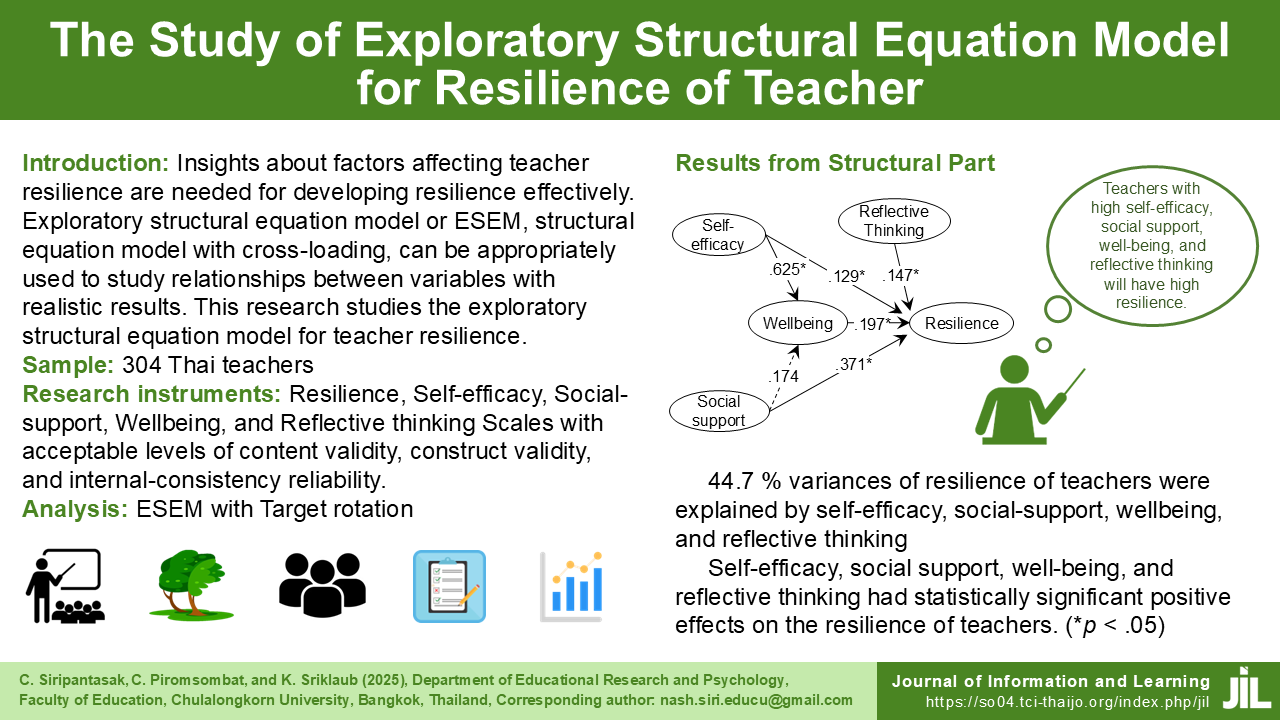
ความสามารถในการฟื้นพลังของครูมีความสำคัญต่อคุณภาพชีวิตและการทำงานของครูซึ่งมีผลต่อนักเรียนและโรงเรียน การทราบปัจจัยที่ส่งผลต่อความสามารถในการฟื้นพลังของครูอาจนำไปสู่การพัฒนาความสามารถในการฟื้นพลังของครูอย่างมีประสิทธิผล การวิจัยครั้งนี้จึงศึกษาและตรวจสอบโมเดลสมการโครงสร้างเชิงสำรวจของความสามารถในการฟื้นพลังของครู ตัวอย่างวิจัย ได้แก่ ครูจากโรงเรียนสังกัดสำนักงานคณะกรรมการการศึกษาขั้นพื้นฐานและโรงเรียนสังกัดกระทรวงการอุดมศึกษา วิทยาศาสตร์ วิจัยและนวัตกรรม 304 คน ได้มาจากการสุ่มแบบแบ่งชั้น เครื่องมือในการวิจัย ได้แก่ แบบวัดความสามารถในการฟื้นพลัง การรับรู้ความสามารถของตนเอง การสนับสนุนทางสังคม ความเป็นอยู่ที่ดี และการคิดเชิงสะท้อน การวิเคราะห์ข้อมูลใช้โมเดลสมการโครงสร้างเชิงสำรวจ ผลการวิจัยพบว่า โมเดลสมการโครงสร้างสำหรับความสามารถในการฟื้นพลังของครูสอดคล้องกับข้อมูลเชิงประจักษ์ (X2(44, n = 304) = 59.092, X2relative = 1.343, p = .064, RMSEA = .034, SRMR = .033) โดยการรับรู้ความสามารถของตนเองและการสนับสนุนทางสังคมร่วมกันอธิบายความผันแปรของความเป็นอยู่ที่ดีของครูได้ร้อยละ 15.8 โดยการรับรู้ความสามารถของตนเองมีอิทธิพลทางบวกต่อความเป็นอยู่ที่ดีของครูอย่างมีนัยสำคัญ การสนับสนุนทางสังคมมีอิทธิพลทางบวกต่อความเป็นอยู่ที่ดีของครูแต่ไม่พบนัยสำคัญ นอกจากนี้ การรับรู้ความสามารถของตนเอง การสนับสนุนทางสังคม ความเป็นอยู่ที่ดี และการคิดเชิงสะท้อน ร่วมกันอธิบายความผันแปรของความสามารถในการฟื้นพลังของครูได้ร้อยละ 44.7 โดย พบว่า การรับรู้ความสามารถของตนเอง การสนับสนุนทางสังคม ความเป็นอยู่ที่ดี และการคิดเชิงสะท้อน มีอิทธิพลทางบวกต่อความสามารถในการฟื้นพลังของครูอย่างมีนัยสำคัญ
เอกสารอ้างอิง
Alamer, A., & Marsh, H. (2022). Exploratory structural equation modeling in second language research: An applied example using the dualistic model of passion. Studies in Second Language Acquisition, 44(5), 1477–1500. https://doi.org/10.1017/S0272263121000863
Asparouhov, T., & Muthén, B. (2009). Exploratory structural equation modeling. Structural Equation Modeling: A Multidisciplinary Journal, 16(3), 397–438. https://doi.org/10.1080/10705510903008204
Beltman, S. (2020). Understanding and examining teacher resilience from multiple perspectives. In C. F. Mansfield (Ed.), Cultivating teacher resilience: International approaches, applications and impact (pp. 11–26). Springer Singapore. https://doi.org/10.1007/978-981-15-5963-1_2
Brunetti, G. J. (2006). Resilience under fire: Perspectives on the work of experienced, inner city high school teachers in the United States. Teaching and Teacher Education, 22(7), 812–825. https://doi.org/10.1016/j.tate.2006.04.027
D’Emidio-Caston, M. (2019). Addressing social, emotional development, and resilience at the heart of teacher education. Teacher Education Quarterly, 46(4), 116–149. https://www.jstor.org/stable/26841579
Daniilidou, A., Platsidou, M., & Gonida, E. (2020). Primary school teachers´ resilience: Association with teacher self-efficacy, burnout and stress. Electronic Journal of Research in Education Psychology, 18(52), 549–582. https://doi.org/10.25115/ejrep.v18i52.3487
Datu, J. A. D., Lee, A. S., Fung, W. K., Cheung, R. Y. M., & Chung, K. K. H. (2022). Prospering in the midst of the COVID-19 pandemic: The effects of PROSPER-based intervention on psychological outcomes among preschool teachers. Journal of School Psychology, 94, 66–82. https://doi.org/10.1016/j.jsp.2022.08.003
Davis, L. L. (1992). Instrument review: Getting the most from a panel of experts. Applied Nursing Research, 5(4), 194–197. https://doi.org/10.1016/S0897-1897(05)80008-4
Diasti, K. S. (2021). Constructing professional identity: Investigating stress factors and resilience experienced by EFL novice teachers. Scholaria: Jurnal Pendidikan dan Kebudayaan, 11(1), 1–10. https://doi.org/10.24246/j.js.2021.v11.i1.p1-10
Falecki, D., Mann, E. (2021). Practical applications for building teacher wellbeing in education. In C. F. Mansfield (Ed.), Cultivating teacher resilience. Springer. https://doi.org/10.1007/978-981-15-5963-1_11
Fernandes, L., Peixoto, F., Gouveia, M. J., Silva, J. C., & Wosnitza, M. (2019). Fostering teachers’ resilience and well-being through professional learning: Effects from a training programme. The Australian Educational Researcher, 46, 681–698. https://doi.org/10.1007/s13384-019-00344-0
Gomez, R., Stavropoulos, V., & Griffiths, M. D. (2020). Confirmatory factor analysis and exploratory structural equation modelling of the factor structure of the depression anxiety and stress scales-21. PloS One, 15(6), Article e0233998. https://doi.org/10.1371/journal.pone.0233998
Grapentine, T. (2000). Path analysis vs. structural equation modeling: Do the relative merits of path analysis and structure equation modeling outweight their limitations? Marketing Research, 12(3), 12–19. https://www.proquest.com/scholarly-journals/path-analysis-vs-structural-equation-modeling/docview/202679955/se-2
Gratacós, G., Mena, J., & Ciesielkiewicz, M. (2021). The complexity thinking approach: Beginning teacher resilience and perceived self-efficacy as determining variables in the induction phase. European Journal of Teacher Education, 46(2), 331–348. https://doi.org/10.1080/02619768.2021.1900113
Gu, Q., & Day, C. (2013). Challenges to teacher resilience: Conditions count. British Educational Research Journal, 39(1), 22–44. https://doi.org/10.1080/01411926.2011.623152
Hascher, T., & Waber, J. (2021). Teacher well-being: A systematic review of the research literature from the year 2000–2019. Educational Research Review, 34, Article 100411. https://doi.org/10.1016/j.edurev.2021.100411
Kangas-Dick, K., & O’Shaughnessy, E. (2020). Interventions that promote resilience among teachers: A systematic review of the literature. International Journal of School & Educational Psychology, 8(2), 131–146. https://doi.org/10.1080/21683603.2020.1734125
Kline, R. B. (2016). Principles and practice of structural equation modeling (4 ed.). Guilford publications.
Luthar, S. S., Cicchetti, D., & Becker, B. (2000). The construct of resilience: A critical evaluation and guidelines for future work. Child Development, 71(3), 543–562. https://doi.org/10.1111/1467-8624.00164
Mansfield, C. F., Beltman, S., Broadley, T., & Weatherby-Fell, N. (2016). Building resilience in teacher education: An evidenced informed framework. Teaching and Teacher Education, 54, 77–87. https://doi.org/10.1016/j.tate.2015.11.016
Mansfield, C. F., Beltman, S., Price, A., & McConney, A. (2012). “Don’t sweat the small stuff:” Understanding teacher resilience at the chalkface. Teaching and Teacher Education, 28(3), 357–367. https://doi.org/10.1016/j.tate.2011.11.001
Marsh, H. W., Balla, J. R., & McDonald, R. P. (1988). Goodness-of-fit indexes in confirmatory factor analysis: The effect of sample size. Psychological Bulletin, 103(3), 391–410. https://doi.org/10.1037/0033-2909.103.3.391
Marsh, H. W., Guo, J., Dicke, T., Parker, P. D., & Craven, R. G. (2020). Confirmatory factor analysis (CFA), exploratory structural equation modeling (ESEM), and set-ESEM: Optimal balance between goodness of fit and parsimony. Multivariate behavioral research, 55(1), 102–119. https://doi.org/10.1080/00273171.2019.1602503
Marsh, H. W., Morin, A. J., Parker, P. D., & Kaur, G. (2014). Exploratory structural equation modeling: An Integration of the best features of exploratory and confirmatory factor analysis. Annual Review of Clinical Psychology, 10, 85–110. https://doi.org/10.1146/annurev-clinpsy-032813-153700
McNeish, D. (2018). Thanks coefficient alpha, we’ll take it from here. Psychological Methods, 23(3), 412–433. https://doi.org/10.1037/met0000144
Mullen, C. A., Schools, C. C. P., Rustburg, V., & Tienken, C. H. (2021). Developing teacher resilience and resilient school cultures. AASA Journal of Scholarship and Practice, 18(1), 8–24. https://eric.ed.gov/?id=EJ1295967
Ngui, G. K., & Lay, Y. F. (2020). The effect of emotional intelligence, self-efficacy, subjective well-Being and resilience on student teachers' perceived practicum stress: A Malaysian case study. European Journal of Educational Research, 9(1), 277–291. https://doi.org/10.12973/eu-jer.9.1.277
Park, N.-S., Song, S.-M., & Kim, J. E. (2020). The mediating effect of childcare teachers’ resilience on the relationship between social support in the workplace and their self-care. International Journal of Environmental Research and Public Health, 17(22), Article 8513. https://doi.org/10.3390/ijerph17228513
Patterson, J. H., Collins, L., & Abbott, G. (2004). A study of teacher resilience in urban schools. Journal of Instructional Psychology, 31(1), 3–11. https://eric.ed.gov/?id=EJ774036
Platsidou, M., & Daniilidou, A. (2021). Meaning in life and resilience among teachers. Journal of Positive School Psychology, 5(2), 97–109. https://journalppw.com/index.php/jpsp/article/view/128/122
Price, A., Mansfield, C., & McConney, A. (2012). Considering ‘teacher resilience’ from critical discourse and labour process theory Pprspectives. British Journal of Sociology of Education, 33(1), 81–95. https://doi.org/10.1080/01425692.2011.614748
Prokofieva, M., Stavropoulos, V., & Zarate, D. (2023). Package "esem": Exploratory structural equation modeling ESEM. The Comprehensive R Archive Network https://cran.r-project.org/web/packages/esem/esem.pdf
Regional Educational Laboratory Pacific. (2022). How to grow teacher wellbeing in your schools. Institute of Education Sciences. https://ies.ed.gov/rel-pacific/2025/01/infographic-20
Rosseel, Y., Jorgensen, T. D., Wilde, L. D., Oberski, D., Byrnes, J., Vanbrabant, L., Savalei, V., Merkle, E., Hallquist, M., Rhemtulla, M., Katsikatsou, M., Barendse, M., Rockwood, N., Scharf, F., Du, H., Jamil, H., & Classe, F. (2024). Package ‘lavaan’: Latent variable analysis. lavaan. https://lavaan.ugent.be
Schumacker, R. E., & Lomax, R. G. (2004). A beginner's guide to structural equation modeling. Psychology Press.
Shirazizadeh, M., Tajik, L., & Amanzadeh, H. (2019). Reflection, resilience and role stress among iranian EFL teachers: A mixed methods study. Issues in Language Teaching, 8(2), 1–24. https://doi.org/10.22054/ilt.2020.48955.448
Silvestrin M, T. d. B. L. (2022). esemComp: ESEM-within-CFA syntax composer. esemComp. https://mateuspsi.github.io/esemComp
Sneha, K., & Maheswari, G. (2021). Resilience, An effective method of stress management among private school teachers of Port Blair: A critical study. Journal of Xi'an University of Architecture & Technology, 13(2), 185–189. https://xajzkjdx.cn/volume-xiii-issue-2-2021
Stavraki, C., & Karagianni, E. (2020). Exploring Greek EFL teachers’ resilience. Journal for the Psychology of Language Learning, 2(1), 142–179. https://jpll.org/index.php/journal/article/view/stavraki_karagianni
Suryaratri, R. D., Yudhistira, S., & Ulayya, D. (2020, Sep 5). The influence of social support towards high school teachers' resilience in Jakarta, Indonesia [Conference presentation]. The 4th International Conference on Learning Innovation and Quality Education, Surakarta, Indonesia. https://doi.org/10.1145/3452144.3452241
Turner, K., Thielking, M., & Meyer, D. (2021). Teacher wellbeing, teaching practice and student learning. Issues in Educational Research, 31(4), 1293–1311. https://www.iier.org.au/iier31/turner.pdf
Zhang, L., Pang, J., & Zhu, F. (2022). Effect of perceived social support on psychache: Mediating effect of psychological resilience. Iranian Journal of Public Health, 51(2), 386–394. https://doi.org/10.18502/ijph.v51i2.8691
ดาวน์โหลด
ไฟล์ประกอบ
เผยแพร่แล้ว
รูปแบบการอ้างอิง
ฉบับ
ประเภทบทความ
หมวดหมู่
สัญญาอนุญาต
ลิขสิทธิ์ (c) 2025 Journal of Information and Learning [JIL]

อนุญาตภายใต้เงื่อนไข Creative Commons Attribution-NonCommercial-NoDerivatives 4.0 International License.
Journal of Information and Learning ดำเนินการโดยสำนักวิทยบริการ มหาวิทยาลัยสงขลานครินทร์ วิทยาเขตปัตตานี บทความที่ได้รับการตีพิมพ์ในวารสารได้รับความคุ้มครองตามกฎหมายลิขสิทธิ์ โดยเจ้าของลิขสิทธิ์จะมีสิทธิในการทำซ้ำ ดัดแปลง และเผยแพร่งานบทความ ทั้งรูปแบบอิเล็กทรอนิกส์ การทำฉบับสำเนา การแปล และการผลิตซ้ำในรูปแบบต่างๆ ลิขสิทธิ์บทความเป็นของผู้เขียนและสำนักวิทยบริการ มหาวิทยาลัยสงขลานครินทร์ วิทยาเขตปัตตานี วารสารฯ ขอสงวนสิทธิ์ในการพิจารณาตีพิมพ์ตามความเหมาะสม รวมทั้งการตรวจทานแก้ไข การปรับข้อความ หรือขัดเกลาภาษาให้ถูกต้องตามเกณฑ์ที่กำหนด สำหรับผลการวิจัยและความคิดเห็นที่ปรากฏในบทความถือเป็นความคิดเห็นและอยู่ในความรับผิดชอบของผู้เขียน


