
กรอบแนวคิดในการพัฒนาความรอบรู้ด้านเทคโนโลยีสารสนเทศสีเขียวของบุคลากรด้าน IT
คำสำคัญ:
เทคโนโลยีสารสนเทศสีเขียว, ความรู้ด้านเทคโนโลยีสารสนเทศสีเขียว, วงจรชีวิตของ IT, เป้าหมายการพัฒนาที่ยั่งยืนบทคัดย่อ
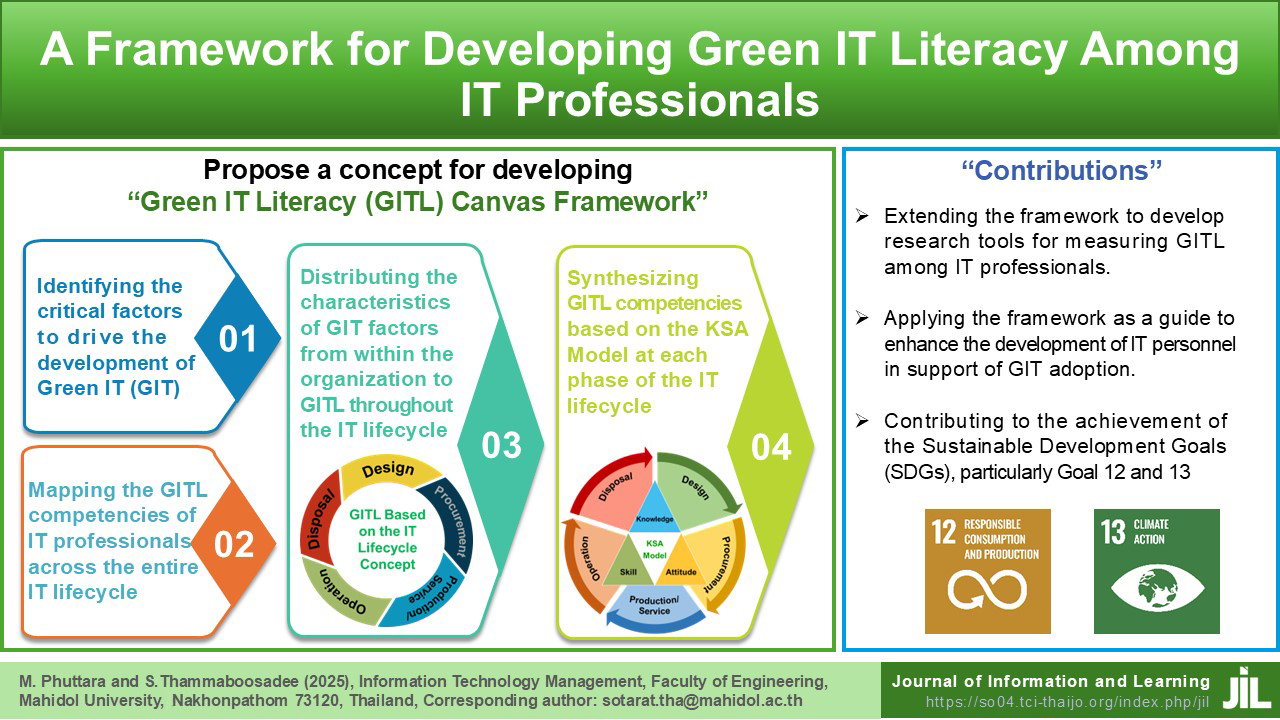
บทความนี้มีวัตถุประสงค์เพื่อเสนอกรอบแนวคิดในการพัฒนาความรู้ด้านเทคโนโลยีสารสนเทศสีเขียว (Green IT literacy: GITL) สำหรับบุคลากรด้าน IT ซึ่งยังไม่มีการศึกษาในงานวิชาการมาก่อน โดยกรอบแนวคิดที่เสนอใช้ชื่อว่า GITL Canvas Framework ซึ่งประกอบด้วย 4 กระบวนการหลัก ได้แก่ 1) การระบุปัจจัยหลักที่ขับเคลื่อนไปสู่การพัฒนาองค์กรเทคโนโลยีสารสนเทศสีเขียว (GIT) โดยใช้กรอบทฤษฎีเชิงปฏิบัติ (PBV) 2) การระบุ GITL ของบุคลากรตามวงจรชีวิตของ IT 3) การกระจายคุณลักษณะของปัจจัย GIT ในองค์กรไปสู่ GITL ตลอดวงจรชีวิตของ IT และ 4) การสังเคราะห์ปัจจัย GITL โดยอ้างอิงแบบจำลอง KSA ในแต่ละช่วงของวงจรชีวิต IT การนำกรอบแนวคิดนี้ไปใช้งานจริง ต้องเริ่มต้นจากความมุ่งมั่นและการมีส่วนร่วมของผู้บริหาร รวมถึงการพัฒนาความรอบรู้ ทักษะ และทัศนคติของบุคลากร เพื่อให้สามารถขับเคลื่อนองค์กรไปสู่การใช้เทคโนโลยีสารสนเทศสีเขียวได้อย่างมีประสิทธิภาพ ประโยชน์ของบทความนี้ ได้แก่ 1) การนำกรอบแนวคิดนี้ไปต่อยอดในการวิจัยเพื่อพัฒนาเครื่องมือวัด GITL ของบุคลากรด้าน IT 2) การใช้แนวคิดนี้เป็นแนวทางในการพัฒนาบุคลากรด้าน IT เพื่อสนับสนุนการขับเคลื่อนองค์กรไปสู่ GIT และ 3) การสนับสนุนเป้าหมายการพัฒนาที่ยั่งยืน (SDGs) โดยเฉพาะ เป้าหมายที่ 12: การบริโภคและการผลิตอย่างรับผิดชอบ และเป้าหมายที่ 13: การเปลี่ยนแปลงสภาพภูมิอากาศและผลกระทบที่เกิดขึ้น
เอกสารอ้างอิง
Abdelkareem, R. S., Mady, K., Lebda, S. E., & Elmantawy, E. S. (2024). The effect of green competencies and values on carbon footprint on sustainable performance in healthcare sector. Cleaner and Responsible Consumption, 12, Article 100179. https://doi.org/10.1016/j.clrc.2024.100179
Aggarwal, P., & Agarwala, T. (2023). Relationship of green human resource management with environmental performance: mediating effect of green organizational culture. Benchmarking: An International Journal, 30(7), 2351–2376. https://doi.org/10.1108/BIJ-08-2021-0474
Ahmed, M., Zehou, S., Raza, S. A., Qureshi, M. A., & Yousufi, S. Q. (2020). Impact of CSR and environmental triggers on employee green behavior: The mediating effect of employee well-being. Corporate Social Responsibility and Environmental Management, 27(5), 2225–2239. https://doi.org/10.1002/csr.1960
Algarni, M. A., Ali, M., Albort-Morant, G., Leal-Rodríguez, A. L., Latan, H., Ali, I., & Ullah, S. (2022). Make green, live clean! Linking adaptive capability and environmental behavior with financial performance through corporate sustainability performance. Journal of Cleaner Production, 346, Article 131156. https://doi.org/10.1016/j.jclepro.2022.131156
Ali, M., Malik, M., Yaqub, M. Z., Jabbour, C. J. C., de Sousa Jabbour, A. B. L., & Latan, H. (2023). Green means long life-green competencies for corporate sustainability performance: A moderated mediation model of green organizational culture and top management support. Journal of Cleaner Production, 427, Article 139174. https://doi.org/10.1016/j.jclepro.2023.139174
Anthony, B., Abdul Majid, M., & Romli, A. (2018). Heterogeneous agent-enabled decision system for evaluating Green IT performance in industrial environments. Journal of Decision Systems, 27(1), 37–62. https://doi.org/10.1080/12460125.2018.1490550
Anthony Jr, B. (2019). Green information system integration for environmental performance in organizations: An extension of belief–action–outcome framework and natural resource-based view theory. Benchmarking: An International Journal, 26(3), 1033–1062. https://doi.org/10.1108/BIJ-05-2018-0142
Bag, S. (2024). From resources to sustainability: a practice-based view of net zero economy implementation in small and medium business-to-business firms. Benchmarking: An International Journal, 31(6), 1876–1894. https://doi.org/10.1108/BIJ-01-2023-0056
Bromiley, P., & Rau, D. (2014). Towards a practice-based view of strategy. Strategic Management Journal, 35(8), 1249–1256. https://doi.org/10.1002/smj.2238
Buba, A. K., Ibrahim, O., & Shehzad, H. M. F. (2022). Behavioral intention model for green information technology adoption in Nigerian manufacturing industries. Aslib Journal of Information Management, 74(1), 158–180. https://doi.org/10.1108/AJIM-05-2021-0128
Cabral, C., & Dhar, R. L. (2019). Green competencies: Construct development and measurement validation. Journal of Cleaner Production, 235, 887–900. https://doi.org/10.1016/j.jclepro.2019.07.014
Celik, M., Cebi, S., Kahraman, C., Er, I.D., (2009). An integrated fuzzy QFD model proposal on routing of shipping investment decisions in crude oil tanker market. Expert Systems with Applications, 36 (3), 6227–6235. https://doi.org/10.1016/j.eswa.2008.07.031
Chen, A., & Roberts, N. (2024). Joint drivers of different shades of green IT/IS practices: a strategic cognition perspective. Information Technology & People, 37(3), 1103–1125. https://doi.org/10.1108/ITP-07-2022-0562
Chiang, C. T. (2024). A systematic literature network analysis of green information technology for sustainability: Toward smart and sustainable livelihoods. Technological Forecasting and Social Change, 199, Article 123053. https://doi.org/10.1016/j.techfore.2023.123053
Cucchiella, F., D’Adamo, I., Koh, S. L., & Rosa, P. (2015). Recycling of WEEEs: An economic assessment of present and future e-waste streams. Renewable and Sustainable Energy Reviews, 51, 263–272. https://doi.org/10.1016/j.rser.2015.06.010
D'Adamo, I., Mazzanti, M., Morone, P., & Rosa, P. (2022). Assessing the relation between waste management policies and circular economy goals. Waste Management, 154, 27–35. https://doi.org/10.1016/j.wasman.2022.09.031
Dalvi-Esfahani, M., Alaedini, Z., Nilashi, M., Samad, S., Asadi, S., & Mohammadi, M. (2020). Students’ green information technology behavior: Beliefs and personality traits. Journal of Cleaner Production, 257, Article 120406. https://doi.org/10.1016/j.jclepro.2020.120406
Eppich, W.J., Gormley, G.J., Teunissen, P.W. (2019). In-depth interviews. In D. Nestel, J. Hui, K. Kunkler, M. Scerbo, A. Calhoun (Eds), Healthcare Simulation Research. Springer, Cham. https://doi.org/10.1007/978-3-030-26837-4_12
Goethals, F., & Ziegelmayer, J. L. (2024). The greening of IT use: The impact of environmental concerns on the use of internet systems. Information Technology & People, 37(1), 356–373. https://doi.org/10.1108/ITP-11-2021-0844
Gou, X., Liao, H., Xu, Z., Min, R., & Herrera, F. (2019). Group decision making with double hierarchy hesitant fuzzy linguistic preference relations: Consistency based measures, index and repairing algorithms and decision model. Information Sciences, 489, 93–112. https://doi.org/10.1016/j.ins.2019.03.037
Hardin-Ramanan, S., Chang, V., & Issa, T. (2018). A green information technology governance model for large Mauritian companies. Journal of Cleaner Production, 198, 488–497. https://doi.org/10.1016/j.jclepro.2018.07.047
Ilyas, S., Hu, Z., & Wiwattanakornwong, K. (2020). Unleashing the role of top management and government support in green supply chain management and sustainable development goals. Environmental Science and Pollution Research, 27(8), 8210–8223. https://doi.org/10.1007/s11356-019-07268-3
Khan, A. N., Mehmood, K., & Kwan, H. K. (2024). Green knowledge management: A key driver of green technology innovation and sustainable performance in the construction organizations. Journal of Innovation & Knowledge, 9(1), Article 100455. https://doi.org/10.1016/j.jik.2023.100455
Khan, S. A. R., Tabish, M., & Zhang, Y. (2023). Embracement of industry 4.0 and sustainable supply chain practices under the shadow of practice-based view theory: Ensuring environmental sustainability in corporate sector. Journal of Cleaner Production, 398, Article 136609. https://doi.org/10.1016/j.jclepro.2023.136609
Kirchner-Krath, J., Morschheuser, B., Sicevic, N., Xi, N., von Korflesch, H. F., & Hamari, J. (2024). Challenges in the adoption of sustainability information systems: A study on green IS in organizations. International Journal of Information Management, 77, Article 102754. https://doi.org/10.1016/j.ijinfomgt.2024.102754
Kumar, A., & Dixit, G. (2019). A novel hybrid MCDM framework for WEEE recycling partner evaluation on the basis of green competencies. Journal of Cleaner Production, 241, Article 118017. https://doi.org/10.1016/j.jclepro.2019.118017
Liu, J., Liu, Y., & Yang, L. (2020). Uncovering the influence mechanism between top management support and green procurement: The effect of green training. Journal of Cleaner Production, 251, Article 119674. https://doi.org/10.1016/j.jclepro.2019.119674
Liu, Q., Jing, Y., Yan, Y., & Li, Y. (2024). Mean-based Borda count for paradox-free comparisons of optimization algorithms. Information Sciences, 660, Article 120120. https://doi.org/10.1016/j.ins.2024.120120
Mat Nawi, M. N., Fauzi, M. A., Ting, I. W. K., Wider, W., & Amaka, G. B. (2024). Green information technology and green information systems: Science mapping of present and future trends. Kybernetes. https://doi.org/10.1108/K-10-2023-2139
Owolabi, H. O., Ayandele, J. K., & Olaoye, D. D. (2020).A systematic review of structural equation model (SEM). Open Journal of Educational Development, 1(2), 27–39. https://doi.org/10.52417/ojed.v1i2.163
Patón-Romero, J. D., Baldassarre, M. T., Rodriguez, M., Pérez-Canencio, J. G., Ojeda-Solarte, M. L., Rey-Piedrahita, A., & Piattini, M. (2022). Application of ISO/IEC TR 33014 to the improvement of Green IT processes. Computer Standards & Interfaces, 82, Article 103611. https://doi.org/10.1016/j.csi.2021.103611
Patón-Romero, J. D., Baldassarre, M. T., Rodriguez, M., & Piattini, M. (2019). A revised framework for the governance and management of green IT. Journal of Universal Computer Science, 25(13), 1736–1760. https://doi.org/10.3217/jucs-025-13-1736
Patón-Romero, J. D., Baldassarre, M. T., Rodríguez, M., Runeson, P., Höst, M., & Piattini, M. (2021). Governance and management of green IT: A multi-case study. Information and Software Technology, 129, Article 106414. https://doi.org/10.1016/j.infsof.2020.106414
Picaud-Bello, K., Schiele, H., Koch, V., & Francillette, M. (2024). Innovation through sustainability: Identifying purchaser skills fostering green innovation. Cleaner Logistics and Supply Chain, 10, Article 100136. https://doi.org/10.1016/j.clscn.2023.100136
Rathachatranon, W. (2019). Future research using delphi technique. Journal of Interdisciplinary Research: Graduate Studies, 8(2). https://ssrn.com/abstract=3461240
Riaz, A., Cepel, M., Ferraris, A., Ashfaq, K., & Rehman, S. U. (2024). Nexus among green intellectual capital, green information systems, green management initiatives and sustainable performance: a mediated-moderated perspective. Journal of Intellectual Capital, 25(2/3), 297–327. https://doi.org/10.1108/JIC-03-2023-0063
Ribeiro, M. P. L., Tommasetti, R., Gomes, M. Z., Castro, A., & Ismail, A. (2021). Adoption phases of Green Information Technology in enhanced sustainability: A bibliometric study. Cleaner Engineering and Technology, 3, Article 100095. https://doi.org/10.1016/j.clet.2021.100095
Sanderson, J., Esfahbodi, A., & Lonsdale, C. (2022). The effect of team-member knowledge, skills and abilities (KSAs) and a common learning experience on sourcing teamwork effectiveness. International Journal of Physical Distribution & Logistics Management, 52(5/6), 393–413. https://doi.org/10.1108/IJPDLM-07-2021-0277
Sharma, R., Chawla, S., Dagar, V., & Dagher, L. (2025). Corporate SDG adoption, share price synchronicity, and the role of incentive-compatible contracts in India. Finance Research Letters, 74. Article 106739. https://doi.org/10.1016/j.frl.2025.106739
Taherdoost, H., & Madanchian, M. (2023). Multi-criteria decision making (MCDM) methods and concepts. Encyclopedia, 3(1), 77–87. https://doi.org/10.3390/encyclopedia3010006
Tiwari, P., Sadeghi, J. K., & Eseonu, C. (2020). A sustainable lean production framework with a case implementation: Practice-based view theory. Journal of Cleaner Production, 277, Article 123078. https://doi.org/10.1016/j.jclepro.2020.123078
Treacy, R., Humphreys, P., McIvor, R., & Lo, C. (2019). ISO14001 certification and operating performance: A practice-based view. International Journal of Production Economics, 208, 319–328. https://doi.org/10.1016/j.ijpe.2018.12.012
Tyminski, Q., & Owens, G. B. (2024). An exploration of higher education leadership competencies: knowledge, skills and attitudes. International Journal of Educational Management, 38(7). https://doi.org/10.1108/IJEM-02-2024-0126
United Nations. (2022). The sustainable development goals report 2022. SDG Indicators. https://unstats.un.org/sdgs/report/2022/
Wang, Z., Huang, Y., Ankrah, V., & Dai, J. (2023). Greening the knowledge-based economies: Harnessing natural resources and innovation in information and communication technologies for green growth. Resources Policy, 86, Article 104181. https://doi.org/10.1016/j.resourpol.2023.104181
Yuan, Y., Ren, S., Haochen, J., & Tang, G. (2021). Commitment or exhaustion? Effects of green human resource management on employee green behavior. Academy of management proceedings, Briarcliff Manor, NY, USA, 2021(1), p. 12393. https://doi.org/10.5465/AMBPP.2021.12393abstract
ดาวน์โหลด
ไฟล์ประกอบ
เผยแพร่แล้ว
รูปแบบการอ้างอิง
ฉบับ
ประเภทบทความ
หมวดหมู่
สัญญาอนุญาต
ลิขสิทธิ์ (c) 2025 Journal of Information and Learning [JIL]

อนุญาตภายใต้เงื่อนไข Creative Commons Attribution-NonCommercial-NoDerivatives 4.0 International License.
Journal of Information and Learning ดำเนินการโดยสำนักวิทยบริการ มหาวิทยาลัยสงขลานครินทร์ วิทยาเขตปัตตานี บทความที่ได้รับการตีพิมพ์ในวารสารได้รับความคุ้มครองตามกฎหมายลิขสิทธิ์ โดยเจ้าของลิขสิทธิ์จะมีสิทธิในการทำซ้ำ ดัดแปลง และเผยแพร่งานบทความ ทั้งรูปแบบอิเล็กทรอนิกส์ การทำฉบับสำเนา การแปล และการผลิตซ้ำในรูปแบบต่างๆ ลิขสิทธิ์บทความเป็นของผู้เขียนและสำนักวิทยบริการ มหาวิทยาลัยสงขลานครินทร์ วิทยาเขตปัตตานี วารสารฯ ขอสงวนสิทธิ์ในการพิจารณาตีพิมพ์ตามความเหมาะสม รวมทั้งการตรวจทานแก้ไข การปรับข้อความ หรือขัดเกลาภาษาให้ถูกต้องตามเกณฑ์ที่กำหนด สำหรับผลการวิจัยและความคิดเห็นที่ปรากฏในบทความถือเป็นความคิดเห็นและอยู่ในความรับผิดชอบของผู้เขียน


