
Exploring Technology Acceptance and Social Media Addiction: Effects on Academic Success among International University Students
คำสำคัญ:
technology acceptance, online social media addiction, academic success, perceived usefulness, perceived ease of useบทคัดย่อ
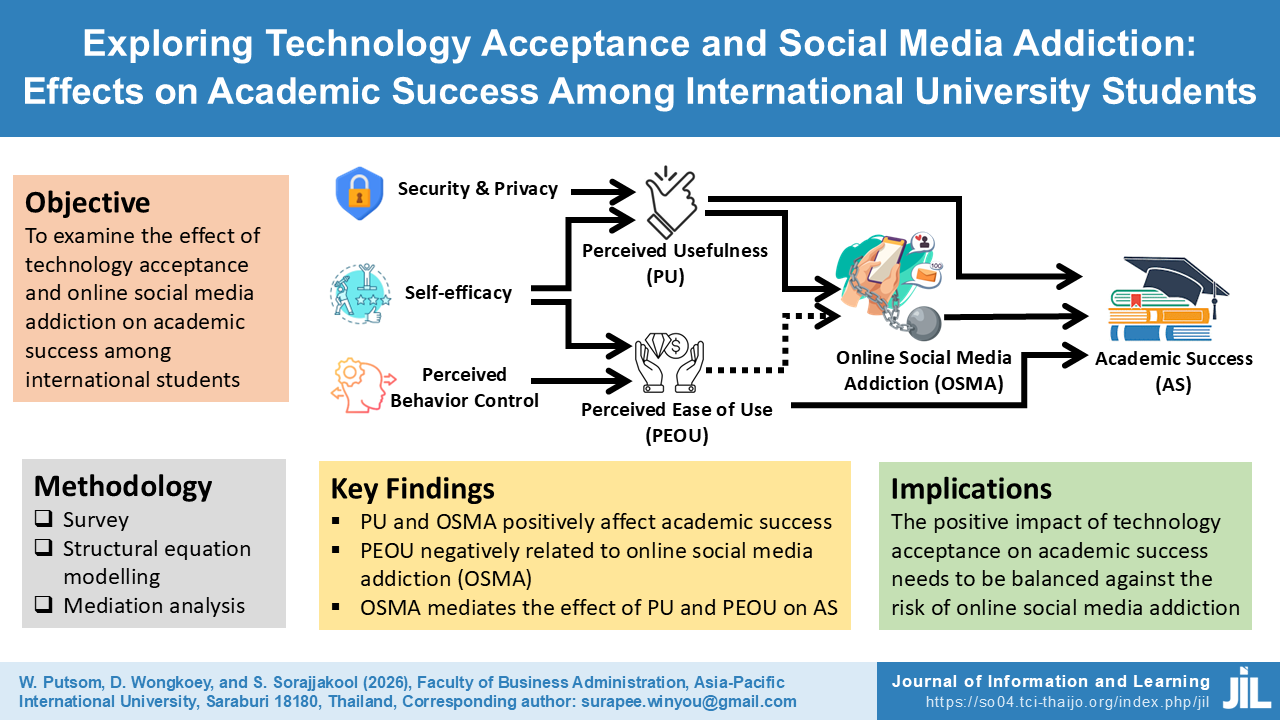
This research aims to study the effects of technology acceptance and social media addiction on the academic achievement of international university students. Data were collected via online questionnaires from a sample of 556 students. Data were collected from 556 students and analyzed using Exploratory Factor Analysis (EFA), correlation, Confirmatory Factor Analysis (CFA), and Structural Equation Modeling (SEM). Model fit was acceptable (ײ/df = 1.10; p = 0.10; GFI = 0.96; AGFI = 0.94; NFI = 0.97; IFI = 1.00; CFI = 1.00; RMSEA = 0.01), with maximum likelihood estimation. The results of the research found that security and privacy and perceived behavioral control had a positive impact on perceived usefulness. Self-efficacy and perceived behavioral control had a positive effect on perceived ease of use. In addition, perceived usefulness had a positive impact on online social media addiction and academic success; and perceived ease of use had a positive effect on academic success. However, the data analysis showed that perceived ease of use had a negative effect on online social media addiction. Furthermore, security and privacy did not affect perceived ease of use, self-efficacy did not affect perceived usefulness, and perceived ease of use did not affect perceived usefulness. The study concludes that perceived usefulness, perceived ease of use, and online social media addiction are positively associated with academic success, suggesting that students who view social media as academically useful may paradoxically become more dependent on it for learning and non-learning purposes.
เอกสารอ้างอิง
Ajzen, I. (2002). Perceived behavioral control, self-efficacy, locus of control, and the theory of planned behavior. Journal of Applied Social Psychology, 32(4), 665–683. https://doi.org/10.1111/j.1559-1816.2002.tb00236.x
Akmal, A. (2017). Influence of perceived usefulness and ease of use on students’ continuous intention in learning on-line English lessons: An extended TAM [Conference presentation]. 4th UAD TEFL International Conference. Yogyakarta, Indonesia. https://doi.org/10.12928/utic.v1.146.2017
Al-Rahmi, A. M., Shamsuddin, A., Alturki, U., Aldraiweesh, A., Yusof, F. M., Al-Rahmi, W. M., & Aljeraiwi, A. A. (2021). The influence of information system success and technology acceptance model on social media factors in education. Sustainability, 13(14), Article 7770. https://doi.org/10.3390/su13147770
Aljarrah, E., Elrehail, H., & Aababneh, B. (2016). E-voting in Jordan: Assessing readiness and developing a system. Computers in Human Behavior, 63, 860–867. https://doi.org/10.1016/j.chb.2016.05.076
Alsyouf, A., Lutfi, A., Alsubahi, N., Alhazmi, F. N., Al-Mugheed, K., Anshasi, R. J., Alharbi, N. I., & Albugami, M. (2023). The use of a technology acceptance model (TAM) to predict patients’ usage of a personal health record system: The role of security, privacy, and usability. International Journal of Environmental Research and Public Health, 20(2), Article 1347. https://doi.org/10.3390/ijerph20021347
Alzaidi, M. S., & Agag, G. (2022). The role of trust and privacy concerns in using social media for e-retail services: The moderating role of COVID-19. Journal of Retailing and Consumer Services, 68, Article 103042. https://doi.org/10.1016/j.jretconser.2022.103042
Andreassen, C. S. (2015). Online social network site addiction: A comprehensive review. Current Addiction Reports, 2, 175–184. https://doi.org/10.1007/s40429-015-0056-9
Andreassen, C. S., Torsheim, T., Brunborg, G. S., & Pallesen, S. (2012). Development of a Facebook addiction scale. Psychological Reports, 110(2), 501–517. https://doi.org/10.2466/02.09.18.PR0.110.2.501-517
Byrne, B. M. (2013). Structural equation modeling with Mplus: Basic concepts, applications, and programming. Routledge. https://doi.org/10.4324/9780203807644
Chen, B. C., Chen, M. Y., Wu, Y. F., & Wu, Y. T. (2022). The relationship of social media addiction with internet use and perceived health: The moderating effects of regular exercise intervention. Frontiers in Public Health, 10, Article 854532. https://doi.org/10.3389/fpubh.2022.854532
Chen, X., Jiang, L., Zhou, Z., & Li, D. (2025). Impact of perceived ease of use and perceived usefulness of humanoid robots on students' intention to use. Acta Psychologica, 258, Article 105217. https://doi.org/10.1016/j.actpsy.2025.105217
Cheng, C., Lau, Y. C., Chan, L., & Luk, J. W. (2021). Prevalence of social media addiction across 32 nations: Meta-analysis with subgroup analysis of classification schemes and cultural values. Addictive Behaviors, 117, Article 106845. https://doi.org/10.1016/j.addbeh.2021.106845
Chowdhury, E. K., & Begum, R. (2025). The academic implications of social media use and multitasking: Evidence from university students in a developing nation. Social Sciences & Humanities Open, 11, Article 101623. https://doi.org/10.1016/j.ssaho.2025.101623
Davis, F. D. (1989). Perceived usefulness, perceived ease of use, and user acceptance of information technology. MIS Quarterly, 13(3), 319–340. https://doi.org/10.2307/249008
Denaputri, A., & Usman, O. (2019, December 16). Effect of perceived trust, perceived security, perceived usefulness and perceived ease of use on customers’ intention to use mobile payment. SSRN. https://papers.ssrn.com/sol3/papers.cfm?abstract_id=3511632
Dhagarra, D., Goswami, M., & Kumar, G. (2020). Impact of trust and privacy concerns on technology acceptance in healthcare: an Indian perspective. International Journal of Medical Informatics, 141, Article 104164. https://doi.org/10.1016/j.ijmedinf.2020.104164
Erduran Tekin, Ö. (2024). Academic self-discipline as a mediating variable in the relationship between social media addiction and academic achievement: mixed methodology. Humanities and Social Sciences Communications, 11(1), 1–9. https://doi.org/10.1057/s41599-024-03633-x
Fornell, C., & Larcker, D. F. (1981). Evaluating structural equation models with unobservable variables and measurement error. Journal of Marketing Research, 18(1), 39–50. https://doi.org/10.1177/002224378101800104
Galindo-Domínguez, H., Bezanilla, M. J., & Campo, L. (2024). Relationship between social media use and critical thinking in university students. Education and Information Technologies, 1–25. https://doi.org/10.1007/s10639-024-12953-z
Griffiths, M. (2005). A ‘components’ model of addiction within a biopsychosocial framework. Journal of Substance Use, 10(4), 191–197. https://doi.org/10.1080/14659890500114359
Gupta, S., & Bashır, L. (2018). Social networking usage questionnaire: Development and validation in an Indian higher education context. Turkish Online Journal of Distance Education, 19(4), 214–227. https://doi.org/10.17718/tojde.471918
Hair Jr, J. F., Sarstedt, M., Hopkins, L., & Kuppelwieser, V. G. (2014). Partial least squares structural equation modeling (PLS-SEM) An emerging tool in business research. European Business Review, 26(2), 106–121. https://doi.org/10.1108/EBR-10-2013-0128
Handoyo, S. (2024). Purchasing in the digital age: A meta-analytical perspective on trust, risk, security, and e-WOM in e-commerce. Heliyon, 10(8), Article e29714. https://doi.org/10.1016/j.heliyon.2024.e29714
He, Q., Turel, O., & Bechara, A. (2017). Brain anatomy alterations associated with Social Networking Site (SNS) addiction. Scientific Reports, 7, Article 45064. https://www.nature.com/articles/srep45064
Huang, X., Mayer, R. E., & Usher, E. L. (2020). Better together: Effects of four self-efficacy-building strategies on online statistical learning. Contemporary Educational Psychology, 63, Article 101924. https://doi.org/10.1016/j.cedpsych.2020.101924
Kandee, P., Thapinta, D., Skulphan, S., & Thungjaroenkul, P. (2022). A model of factors influencing social media addiction in university students. Pacific Rim International Journal of Nursing Research, 26(4), 674–689. https://he02.tci-thaijo.org/index.php/PRIJNR/article/view/259275
Kelly, S., Kaye, S. A., & Oviedo-Trespalacios, O. (2023). What factors contribute to the acceptance of artificial intelligence? A systematic review. Telematics and Informatics, 77, Article 101925. https://doi.org/10.1016/j.tele.2022.101925
Kline, R. B. (2023). Principles and practice of structural equation modeling. Guilford publications.
Krishna, S. H., Jayanthi, M., Ghosh, P., Tamrakar, A. K., Gopinathan, R., & Dagar, P. (2022). A study on positive and negative effects of social media on society. International Journal of Early Childhood Special Education, 14(5), 6289–6300. https://www.int-jecse.net/media/article_pdfs/6289-6300.pdf
Kulsawat, T., & Narkwatchara, P. (2021). Factors affecting social media addiction of undergraduate students in the eastern region university. Journal of MCU Nakhondhat, 8(10), 1–15. https://so03.tci-thaijo.org/index.php/JMND/article/view/256092
Kurnia, E., & Yolanda, M. (2024). Impact of perceived usefulness, ease of use, and privacy & security on QRIS adoption: Mediating role of behavioral intention. Marketing Management Studies, 4(2), 157–169. https://jkmp.ppj.unp.ac.id/index.php/mms/article/view/504
Landa-Blanco, M., García, Y. R., Landa-Blanco, A. L., Cortés-Ramos, A., & Paz-Maldonado, E. (2024). Social media addiction relationship with academic engagement in university students: The mediator role of self-esteem, depression, and anxiety. Heliyon, 10(2), Article e24384. https://doi.org/10.1016/j.heliyon.2024.e24384
Lee, A. T., Ramasamy, R. K., & Subbarao, A. (2025). Understanding psychosocial barriers to healthcare technology adoption: A review of TAM technology acceptance model and unified theory of acceptance and use of technology and UTAUT frameworks. Healthcare, 13(3), Article 250. https://doi.org/10.3390/healthcare13030250
Lew, S. L., Lau, S. H., & Leow, M. C. (2019). Usability factors predicting continuance of intention to use cloud e-learning application. Heliyon, 5(6), Article e01788. https://doi.org/10.1016/j.heliyon.2019.e01788
Malak, M. Z., Shuhaiber, A. H., Al-amer, R. M., Abuadas, M. H., & Aburoomi, R. J. (2022). Correlation between psychological factors, academic performance and social media addiction: model-based testing. Behaviour & Information Technology, 41(8), 1583–1595. https://doi.org/10.1080/0144929X.2021.1891460
Malesev, S., & Cherry, M. (2021). Digital and social media marketing-growing market share for construction SMEs. Construction Economics and Building, 21(1), 65–82. https://search.informit.org/doi/abs/10.3316/informit.747666622867324
Montag, C., Wegmann, E., Sariyska, R., Demetrovics, Z., & Brand, M. (2021). How to overcome taxonomical problems in the study of internet use disorders and what to do with “smartphone addiction”? Journal of Behavioral Addictions, 9(4), 908–914. https://doi.org/10.1556/2006.8.2019.59
Mosharrafa, R. A., Akther, T., & Siddique, F. K. (2024). Impact of social media usage on academic performance of university students: Mediating role of mental health under a cross-sectional study in Bangladesh. Health Science Reports, 7(1), Article e1788. https://doi.org/10.1002/hsr2.1788
Mou, Q., Zhuang, J., Wu, Q., Zhong, Y., Dai, Q., Cao, X., Gao, Y., Lu, Q., & Zhao, M. (2024). Social media addiction and academic engagement as serial mediators between social anxiety and academic performance among college students. BMC Psychology, 12(1), Article 190. https://doi.org/10.1186/s40359-024-01635-7
Nayanajith, D. G., & Damunupola, K. A. (2020). Impact of perceived behavioral control on e-learning adoption. Interdisciplinary Research in Education, 5(1–2), 1–14. https://doi.org/10.3126/ire.v5i1-2.34728
Ning, W., & Inan, F. A. (2023). Impact of social media addiction on college students’ academic performance: An interdisciplinary perspective. Journal of Research on Technology in Education, 56(5), 616–631. https://doi.org/10.1080/15391523.2023.2196456
Nuamsamrarn, S., & Achwarin, N. (2023). A structural equation model of the determinants affecting students’ behavioral intention and satisfaction towards blended leaning of English as a foreign language at a Bangkok Public University. Journal of Education Naresuan University, 25(1), 36–45. https://so06.tci-thaijo.org/index.php/edujournal_nu/article/view/248848
Nugroho, M. A., Dewanti, P. W., & Novitasari, B. T. (2018, September). The impact of perceived usefulness and perceived ease of use on student's performance in mandatory e-learning use. International Conference on Applied Information Technology and Innovation (ICAITI). IEEE. https://doi.org/10.1109/ICAITI.2018.8686742
Nuryakin, N., Rakotoarizaka, N. L. P., & Musa, H. G. (2023). The effect of perceived usefulness and perceived easy to use on student satisfaction the mediating role of attitude to use online learning. Asia Pacific Management and Business Application, 11(3), 323–336. https://apmba.ub.ac.id/index.php/apmba/article/view/637
Paiman, N., & Fauzi, M. A. (2024). Exploring determinants of social media addiction in higher education through the integrated lenses of technology acceptance model (TAM) and usage habit. Journal of Applied Research in Higher Education, 16(3), 776–803. https://doi.org/10.1108/JARHE-03-2023-0114
Pellegrino, A., Stasi, A., & Bhatiasevi, V. (2022). Research trends in social media addiction and problematic social media use: A bibliometric analysis. Frontiers in Psychiatry, 13, Article 1017506. https://doi.org/10.3389/fpsyt.2022.1017506
Peng, P., & Liao, Y. (2023). Six addiction components of problematic social media use in relation to depression, anxiety, and stress symptoms: A latent profile analysis and network analysis. BMC Psychiatry, 23(1), Article 321. https://doi.org/10.1186/s12888-023-04837-2
Pitafi, A. H., Kanwal, S., & Khan, A. N. (2020). Effects of perceived ease of use on SNSs-addiction through psychological dependence, habit: The moderating role of perceived usefulness. International Journal of Business Information Systems, 33(3), 383–407. https://doi.org/10.1504/IJBIS.2020.105831
Pratista, N. D., & Marsasi, E. G. (2023). Effects of perceived usefulness and perceived ease of use for driving purchase intention. Jurnal Ekonomi, 28(3), 488–509. https://doi.org/10.24912/je.v28i3.1940
Purnama, Y., & Asdlori, A. (2023). The role of social media in students’ social perception and interaction: Implications for learning and education. Technology and Society Perspectives (TACIT), 1(2), 45–55. https://doi.org/10.61100/tacit.v1i2.50
Rachmi, I. F., Asta, F. R., & Kartiko, N. D. (2023). The effects of perceived ease of use, perceived usefulness, and computer self-efficacy on e-Nofa Application user satisfaction. E3S Web of Conferences, 388, Article 04017. https://doi.org/10.1051/e3sconf/202338804017
Rauniar, R., Rawski, G., Yang, J., & Johnson, B. (2014). Technology acceptance model (TAM) and social media usage: An empirical study on Facebook. Journal of Enterprise Information Management, 27(1), 6–30. https://doi.org/10.1108/JEIM-04-2012-0011
Registrar Office. (2023). Number of students in Year 2023. SARRA. https://sarra.apiu.edu/Secured/Statistics/StudentStatPage.aspx
Rhemtulla, M., Brosseau-Liard, P. É., & Savalei, V. (2012). When can categorical variables be treated as continuous? A comparison of robust continuous and categorical SEM estimation methods under suboptimal conditions. Psychological Methods, 17(3), 354–373. https://doi.org/10.1037/a0029315
Romansky, R. P., & Noninska, I. S. (2020). Challenges of the digital age for privacy and personal data protection. Mathematical Biosciences and Engineering, 17(5), 5288–5303. https://doi.org/10.3934/mbe.2020286
Sahin, C. (2018). Social media addiction scale-student form: The reliability and validity study. Turkish Online Journal of Educational Technology, 17(1), 169–182. https://eric.ed.gov/?id=EJ1165731
Saville, J. D., & Foster, L. L. (2021). Does technology self-efficacy influence the effect of training presentation mode on training self-efficacy?. Computers in Human Behavior Reports, 4, Article 100124. https://doi.org/10.1016/j.chbr.2021.100124
Sefriani, R., Yunus, Y., & Syah, N. (2023). Correlation of social media addiction to academic achievement in e-learning. Indonesian Journal of Computer Science, 12(6), 3444–3451. http://ijcs.net/ijcs/index.php/ijcs/article/view/3581
Starcevic, V. (2013). Is Internet addiction a useful concept? Australian & New Zealand Journal of Psychiatry, 47(1), 16–19. https://doi.org/10.1177/0004867412461693
Sumida Garcia, L., & Costa Silva, C. M. (2017). Differences between perceived usefulness of social media and institutional channels by undergraduate students. Interactive Technology and Smart Education, 14(3), 196–215. https://doi.org/10.1108/ITSE-01-2017-0009
Tutgun-Ünal, A., & Deniz, L. (2015). Development of the social media addiction scale. AJIT-e: Academic Journal of Information Technology, 6(21), 51–70. https://doi.org/10.5824/1309-1581.2015.4.004.x
Wilson, K., Fornasier, S., & White, K. M. (2010). Psychological predictors of young adults' use of social networking sites. Cyberpsychology, Behavior, and Social Networking, 13(2), 173–177. https://doi.org/10.1089/cyber.2009.0094
Wu, P. J., Hou, H. Y., & Huang, C. C. (2021). Applying talent quality-management system (ttqs) to enhance information literacy, learning motivation, and computational thinking competency of nursing undergraduates. Sustainability, 13(12), Article 6528. https://doi.org/10.3390/su13126528
Yang, H. (2024). Factors impacting college student satisfaction, perceived usefulness, and continuance intention with e-learning in Dezhou, China. Scholar: Human Sciences, 16(1), 171–180. https://doi.org/10.14456/shserj.2024.18
ดาวน์โหลด
ไฟล์ประกอบ
เผยแพร่แล้ว
รูปแบบการอ้างอิง
ฉบับ
ประเภทบทความ
หมวดหมู่
สัญญาอนุญาต
ลิขสิทธิ์ (c) 2026 Journal of Information and Learning

อนุญาตภายใต้เงื่อนไข Creative Commons Attribution-NonCommercial-NoDerivatives 4.0 International License.
Journal of Information and Learning ดำเนินการโดยสำนักวิทยบริการ มหาวิทยาลัยสงขลานครินทร์ วิทยาเขตปัตตานี บทความที่ได้รับการตีพิมพ์ในวารสารได้รับความคุ้มครองตามกฎหมายลิขสิทธิ์ โดยเจ้าของลิขสิทธิ์จะมีสิทธิในการทำซ้ำ ดัดแปลง และเผยแพร่งานบทความ ทั้งรูปแบบอิเล็กทรอนิกส์ การทำฉบับสำเนา การแปล และการผลิตซ้ำในรูปแบบต่างๆ ลิขสิทธิ์บทความเป็นของผู้เขียนและสำนักวิทยบริการ มหาวิทยาลัยสงขลานครินทร์ วิทยาเขตปัตตานี วารสารฯ ขอสงวนสิทธิ์ในการพิจารณาตีพิมพ์ตามความเหมาะสม รวมทั้งการตรวจทานแก้ไข การปรับข้อความ หรือขัดเกลาภาษาให้ถูกต้องตามเกณฑ์ที่กำหนด สำหรับผลการวิจัยและความคิดเห็นที่ปรากฏในบทความถือเป็นความคิดเห็นและอยู่ในความรับผิดชอบของผู้เขียน


