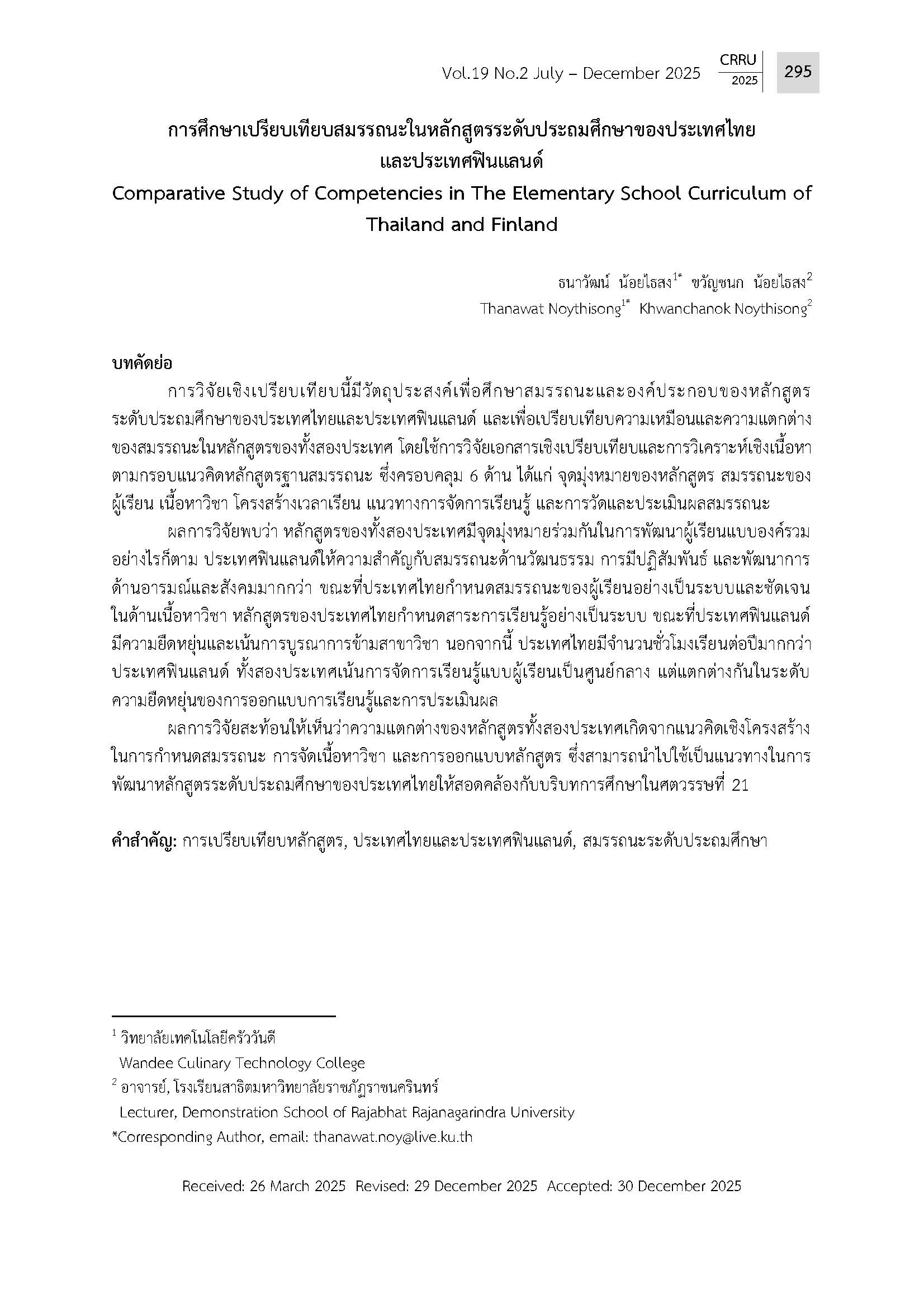
Comparative Study of Competencies in The Elementary School Curriculum of Thailand and Finland
Keywords:
Curriculum comparison, Elementary school competency, , Thailand and FinlandAbstract
This comparative study aims to examine the competencies and curriculum components of elementary education in Thailand and Finland, as well as to compare similarities and differences in competencies within the curricula of the two countries. The research employed a comparative documentary research design, using content analysis based on a competency-based curriculum framework. The analytical framework encompassed six dimensions: curriculum objectives, student competencies, subject content, instructional time structure, learning management approaches, and competency assessment and evaluation.
The findings indicate that the curricula of both countries share a common objective of promoting holistic learner development. However, Finland places greater emphasis on cultural competencies, interaction, and socio-emotional development, whereas Thailand defines student competencies in a more systematic and structured manner. Regarding subject content, Thailand’s curriculum specifies learning areas in a clearly structured format, while Finland’s curriculum demonstrates greater flexibility and emphasizes interdisciplinary integration. In addition, Thailand allocates more instructional hours per year than Finland. Both countries emphasize student-centered learning; however, they differ in the degree of flexibility in learning design and assessment practices.
The results suggest that differences between the curricula of the two countries primarily stem from structural conceptual approaches to competency formulation, subject content organization, and curriculum design. These findings may serve as useful guidelines for improving Thailand’s elementary school curriculum in alignment with the educational context of the 21st century.
References
Francis, C., Breland, T. A., Østergaard, E., Lieblein, G., & Morse, S. (2013). Phenomenon-based learning in agroecology: A prerequisite for transdisciplinarity and responsible action. Agroecology and Sustainable Food Systems, 37(1), 60–75.
Halinen, I. (2018). The new educational curriculum in Finland. In M. Matthes, L. Pulkkinen, C. Clouder, & B. Heys (Eds.), Improving the quality of childhood in Europe (Vol. 7, pp. 75–89). Alliance for Childhood European Network Foundation.
Institute for the Promotion of Teaching Science and Technology. (2020). Findings from PISA on the growth mindset framework. Focus: Issues from PISA, 49, 1–4. (in Thai)
Kaewbutr, P. (2020). Students' interest in extracurricular activities in Chinese language courses: A case study of Chinese language students at Prince of Songkla University, Surat Thani Campus. Srinakharinwirot Research and Development Journal (Humanities and Social Sciences), 12(3), 27–38. (in Thai)
Lonka, K. (2020). Phenomenal learning from Finland: Theory and practice of engaging learning environments. Helsinki: Edita Publishing.
Mahawichit, P. (2017). Educational innovation from Finland. IPST Magazine, 46(209), 40–45. (in Thai)
Mattila, P., & Silander, P. (Eds.). (2015). How to create the school of the future: Revolutionary thinking and design from Finland (p. 45). Finland: Multprint.
Organization for Economic Co-operation and Development. (2014). Education at a glance 2014: OECD indicators. OECD Publishing. https://doi.org/10.1787/eag-2014-en
Office of the Basic Education Commission. (2021). Draft framework of the Basic Education Curriculum (Competency-Based Curriculum) B.E. ...... (pp. 1–28). Retrieved from https://cbethailand.com/wp-content/uploads/2021/11/ร่างกรอบหลักสูตร-17.11.64.pdf (in Thai)
Taba, H. (1962). Curriculum development: Theory and practice (p. 129). New York: Harcourt Brace Jovanovich.
Younchuen, P. (2013). A comparison of English listening and speaking abilities and interest in English language learning of Grade 8 students taught using learning center activities based on the natural approach versus the traditional teaching method. Journal of Educational Research, Faculty of Education, Srinakharinwirot University, 7(2), 184–194. (in Thai)
Zhou, K. (2017). Non-cognitive skills: Potential candidates for global measurement. European Journal of Education, 52, 487–497. https://doi.org/10.1111/ejed.12241
Downloads
Published
How to Cite
Issue
Section
License
Copyright (c) 2025 KASALONGKHAM RESEARCH JOURNAL, Chiang Rai Rajabhat University

This work is licensed under a Creative Commons Attribution-NonCommercial-NoDerivatives 4.0 International License.