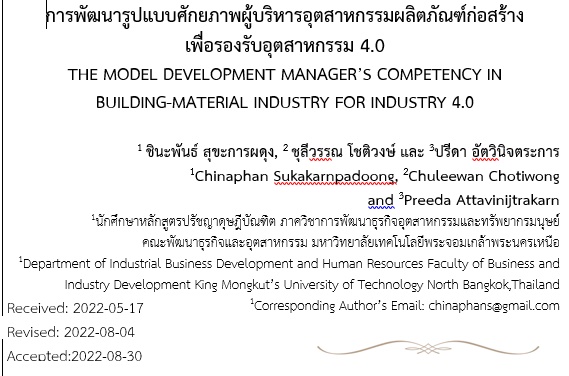
การพัฒนารูปแบบศักยภาพผู้บริหารอุตสาหกรรมผลิตภัณฑ์ก่อสร้างเพื่อรองรับอุตสาหกรรม 4.0
Article Sidebar
Main Article Content
บทคัดย่อ
การวิจัยครั้งนี้มีวัตถุประสงค์เพื่อ 1) ศึกษาองค์ประกอบการพัฒนาศักยภาพผู้บริหารอุตสาหกรรมผลิตภัณฑ์ก่อสร้างเพื่อรองรับอุตสาหกรรม4.0 2) พัฒนารูปแบบศักยภาพผู้บริหารอุตสาหกรรมผลิตภัณฑ์ก่อสร้างเพื่อรองรับอุตสาหกรรม4.0 และ 3) จัดทำคู่มือการพัฒนาศักยภาพผู้บริหารอุตสาหกรรมผลิตภัณฑ์ก่อสร้างเพื่อรองรับอุตสาหกรรม4.0 การดำเนินการวิจัยเป็นแบบผสมผสานทั้งเชิงคุณภาพและเชิงปริมาณ การวิจัยเชิงคุณภาพใช้การสัมภาษณ์เชิงลึก โดยผู้ทรงคุณวุฒิ สำหรับการวิจัยเชิงปริมาณใช้การสอบถามผู้บริหารโรงงานอุตสาหกรรมผลิตภัณฑ์ก่อสร้าง โดยมีผู้ตอบแบบสอบถามจำนวน 433 คน ใช้การวิเคราะห์องค์ประกอบเชิงสำรวจผลการวิจัยพบว่า รูปแบบศักยภาพผู้บริหารอุตสาหกรรมผลิตภัณฑ์ก่อสร้างเพื่อรองรับอุตสาหกรรม4.0 ประกอบด้วยองค์ประกอบหลัก 3 องค์ประกอบ และองค์ประกอบย่อย 10 องค์ประกอบ ดังนี้ องค์ประกอบหลักด้านความรู้ระบบอุตสาหกรรม 4.0 ประกอบด้วย 3 องค์ประกอบย่อย คือ 1) มีความรู้ IoT, Big-Data, Cyber-physical Systems, Visualization, AI. , Cloud 2) รู้แนวทางการประเมินอุตสาหกรรม4.0 และ 3) รอบรู้การนำระบบดิจิทัลมาพัฒนาการสื่อสารในองค์กร องค์ประกอบหลักด้านทักษะการจัดการโรงงานและนวัตกรรม ประกอบด้วย 4 องค์ประกอบย่อย 1) สามารถมอบหมายงานและพัฒนาพนักงานทั่วทั้งองค์กร 2) เชี่ยวชาญด้านการผลิตและบำรุงรักษาเครื่องจักร 3) สามารถวิเคราะห์ข้อมูลและออกแบบผลิตภัณฑ์ด้วยเทคโนโลยีอัจฉริยะ 4) สามารถปฎิบัติตามแนวทางป้องกันภัยคุกคามบนโลกไซเบอร์ องค์ประกอบหลักด้านคุณลักษณะผู้นำ ประกอบด้วย 3 องค์ประกอบย่อย 1) กล้าคิด กล้าทำ กล้าเปลี่ยนแปลงอย่างสร้างสรรค์ 2) มีความพร้อมก้าวทันการเปลี่ยนแปลง 3) มีความสามารถในการทำงานเป็นทีม สำหรับคู่มือการพัฒนาศักยภาพผู้บริหารอุตสาหกรรมผลิตภัณฑ์ก่อสร้างเพื่อรองรับอุตสาหกรรม4.0 ประกอบด้วยแนวปฏิบัติตามองค์ประกอบในแต่ละด้านและตัวชี้วัดความสำเร็จ ผลการประเมินโดยผู้ทรงคุณวุฒิเห็นว่ารูปแบบศักยภาพผู้บริหารอุตสาหกรรมผลิตภัณฑ์ก่อสร้างเพื่อรองรับอุตสาหกรรม4.0 ที่สร้างขึ้นมีความเหมาะสมร้อยละ 86 และคู่มือการพัฒนาศักยภาพผู้บริหารอุตสาหกรรมผลิตภัณฑ์ก่อสร้างเพื่อรองรับอุตสาหกรรม4.0 ที่จัดทำขึ้นมีความเหมาะสมเพื่อนำไปใช้งานในระดับเห็นด้วยมากที่สุด ค่าเฉลี่ย 4.76 จากคะแนนเต็ม 5
Article Details

อนุญาตภายใต้เงื่อนไข Creative Commons Attribution-NonCommercial-NoDerivatives 4.0 International License.
เอกสารอ้างอิง
Alcácer, V., & Cruz-Machado, V. (2019). Scanning the Industry 4.0: A Literature Review on Technologies for Manufacturing Systems. Engineering Science and Technology, an International Journal. 22(3), 899–919. Retrieved Jan 29, 2022, From https://www.sciencedirect.com/science/article/pii/S2215098618317750.
Dacher, A., & Schmid, R. (2017). Asset Monitoring & Predictive Maintenance. Deloitte. Retrieved Jan 29, 2022, From https://www2.deloitte.com/us/en/pages/operations/solutions/internet-of-things-turnkey-iot.html.
Davies, R., Coole, T., & Smith, A. (2017). Review of socio-technical considerations to ensure successful implementation of Industry 4.0. 11, 1288-1295, Retrieved Jan 29, 2022, From https://www.sciencedirect.com/science/article/pii/S235197891730464X.
Delen, D., & Ram, S. (2018). Research challenges and opportunities in business analytics. Journal of Business Analytics. 1(1), 2-12, Retrieved Jan 29, 2022, From https://doi.org/10.1080/2573234X.2018.1507324.
Dopico, M., Gómez, A., De la Fuente, D., García, N., Rosillo, R., & Puche, J. (2016). A vision of industry 4.0 from an artificial intelligence point of view. Proceedings on the International Conference on Artificial Intelligence. 16, 407-413. Retrieved Jan 29, 2022, From http://worldcomp-proceedings.com/proc/p2016/ICA7532.pdf.
Kanchanakongka, A. (2021). Information Technology Risk and Cyber Security. Retrieved Jan 29, 2022, From http://huexonline.com/knowledge/28/557/.
Keawchaoon, K. (2017). Team Working for Increasing Work Effectiveness. Dusit Thani College Journal, 11(1), 355-370.
Lee, J., Bagheri, B., & Kao, H. A. (2015). A cyber-physical systems architecture for industry 4.0-based manufacturing systems.
Manufacturing Letters. 3, 18-23, Retrieved Jan 29, 2022, From https://www.sciencedirect.com/science/article/pii/S221384631400025X.
Magdalena, B., & Wyrwicka, M. (2017). Towards Lean Production in Industry 4.0. Procedia Engineering.182, 466-473 Retrieved Jan 29, 2022, From https://www.sciencedirect.com/ rticle/pii/S1877705817312717.
Makhasiranon, T. & OngInsee, N. (2004). Emotionally intelligent leadership. (1ed.). Bangkok:Expernet.
Marknual, C. (2019). Robot Industry and the Development of Thai Manufacturing Sector (Part 1) Retrieved Jan 16, 2022, from https://www.krungsri.com/th/research/research-intelligence/ri-robotic-series1-landscape.
Matey, A., Danquah, P., Koi-Akrofi, G., & Asampana, I. (2021). Critical Infrastructure Cybersecurity Challenges:IoT in Perspective.
International Journal of Network Security & Its Applications 13(4), 41-58. Retrieved Jan 29, 2022, From DOI:10.5121/ijnsa.2021.13404.
Mongkol, C. (2019). The Institute for People Analytics Bridges the Enterprise Gap with Artificial Intelligence Retrieved Jan 22, 2022, from https://www.ftpi.or.th/2019/32813.
Office of the Civil Service Commission. (2010). Manual for the determination of competency in civil service. Retrieved Jan 16, 2022, From https://www.ocsc.go.th/node/2726.
Pantaweesak. N. (2019). AI empowers business Industry 4.0 era. Retrieved Feb 1, 2021, From https://www.prachachat.net/columns/news-279032 .
Pecas, P., Encarnacao, J. Gamboa, M., Sampayo, M. & Jorge, D. (2021). PDCA 4.0: A New Conceptual Approach for Continuous Improvement in the Industry 4.0 Paradigm. Applied Sciences. 11(16), 7671, Retrieved Jan 29, 2022, From
https://www.mdpi.com/2076-3417/11/16/7671.
Pereira, A. C., & Romero, F. (2017). A review of the meanings and the implications of the Industry 4.0 concept. Procedia Manufacturing. 13, 1206–1214. Retrieved Jan 29, 2022, From https://www.sciencedirect.com/science/article/pii/S2351978917306649.
Saucedo-Martínez, J. A., Pérez-Lara, M., Marmolejo-Saucedo, J. A., Salais-Fierro, T. E., & Vasant, P. (2018). Industry 4.0 framework for management and operations: a review. Journal of Ambient Intelligence and Humanized Computing. 9(3), 789–801. Retrieved Jan 29, 2022, From https://www.infona.pl/resource/bwmeta1.element.springer-doi-10_1007-S12652-017-0533-1.
Schallock, B., Rybski, C., Jochemb,R., & Kohl, H. (2018). Learning Factory for Industry 4.0 to provide future skills beyond technical training. Procedia Manufacturing.23, 27-32. Retrieved Jan 29, 2022, From https://www.sciencedirect.com/science/article/pii/S2351978918304608.
Sirichan, T. (2015). A model and strategies for leadership development in the twenty first century of student organization board. (Doctoral Dissertation). Chulalongkorn University Intellectual Repository. Bangkok. Retrieved Dec 16, 2021, from http://cuir.car.chula.ac.th/handle/123456789/50933.
Thailand Productivity Institute. (2019). Organizational Diagnosis according to Industry 4.0 Guidelines, Project to Transform Thai Industry to Industry 4.0. Retrieved Jan 16, 2022, From https://piu.ftpi.or.th/wp-content/uploads/2020/12/e-book_4.0_final.pdf.
Udomtanateera, K. (2016). Benefit from Big Data. Retrieved Jan 16, 2022, from https://www.iok2u.com/index.php/article/information-technology/793-big-data-big-data-2.
Vaidya, S., Ambad, P., & Bhosle, S. (2018). Industry 4.0 – A glimpse. Procedia Manufacturing. 20, 233–238. Retrieved Jan 29, 2022, From https://www.sciencedirect.com/science/article/pii/S2351978918300672.
Wagner, T., Herrmann, C., & Thiede, S. (2017). Industry 4.0 Impacts on Lean Production Systems. Procedia CIRP. 63, 125–131. Retrieved Jan 29, 2022, From https://www.sciencedirect.com/science/article/pii/S2212827117301385.
Zhong, R. Y., Xu, X., Klotz, E., & Newman, S. T. (2017). Intelligent manufacturing in the context of industry 4.0: a review. Proceedings of the Estonian Academy of Sciences: Engineering. 3(5), 616–630. Retrieved Jan 29, 2022, From https://researchportal.bath.ac.uk/en/publications/intelligent-manufacturing-in-the-context-of-industry-40-a-review.
