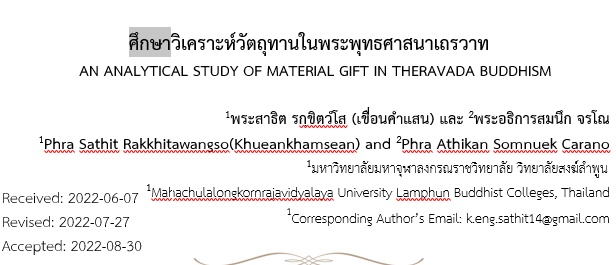
An Analytical Study of Material Gift in Theravada Buddhism
Article Sidebar
Main Article Content
Abstract
The three main goals of this study were; 1) to study almsgiving in Theravada Buddhism, 2) to investigate material gift in Theravada Buddhism, and 3) to analyze material gift in Theravada Buddhism. This study used a qualitative approach. Scriptures, Tipitaka, commentary, and Buddhist literature were used to analyze the facts. The data were gathered via in-depth interviews with fifteen key informants using the in-depth interview tool. The information was evaluated and given in a descriptive form.
The findings were as follows:
Giving entails making sacrifices, letting up of selfishness, and placing one's attention on the good of others. The intention prior to giving, the intention during giving, and the intention after giving were significant elements. Giving was separated into dharma giving and material gifts.
Giving objects as gifts was referred to as a "material gift." The ten material gifts Anunam, Panang, Vatthang, Yanang, Mala, Sanut, Vilepana, Seiya, Avasthang, and Paripayayang were referenced in the numerous sutras.
According to the sense-doors, there are six different kinds of offerings: Rupa-dana (giving of forms), Satta-dana (giving of sounds), Kandha-dhana (giving of scents), Rasa-dana (giving of tastes), Pothabpha-dana (giving of tangible objects), and Dhamma-dana (giving of mental objects). These offerings are divided into two major categories: those that originate from within us (Ajjatta) and those that originate from outside of us (Bhahiddha).
Material gifts were prioritized for rapidity of acquisition in the era of fast change, with solely the virtue of giving material goods being considered. This made the merit of the giving insufficient because it didn't take the benefit of the recipient into account. This study was done to examine the material gifts in Theravada Buddhism in order to foster understanding and happiness for both the givers and the receivers.
Article Details

This work is licensed under a Creative Commons Attribution-NonCommercial-NoDerivatives 4.0 International License.
References
Bodhichayatham, B. (2012) A comparative study of the giving dering the time of the buddha and the giving by the people in Nalueng Sub-District Villagers, Selaphum District, Roi-et Province.
Buddhism, (Graduate School: Mahachulalongkornrajavidyalaya University).
Chaiwong, S. (1998) “An analytical study on “alms giving” in Buddhism”, Master of Arts thesis. (Graduate School: Chiang Mai University) .
Chanrang, T. (2010) Theravada Buddhism. (8 ed.). Chiang Mai: Pongsawad Printing Factory, Mahachulalongkornrajavidyalaya University.
Mahachulalongkornrajavidyalaya University. (1996). Thai Tripitakas. Bangkok: MCU Press.
Mangkalajarn, S. (1994) Mangalatthadeepani Translation, Volume 3, 18th Edition, (Bangkok: Mahamakut Wittayalai Publishing House).
Payutto, P. (2016) Buddhist dictionary Dharma edition. 36th Edition, Bangkok: Pallitham.
Prathumthong, K. (2007) analytical study Panjamaha Donations appearing in Buddhist scriptures, Theravada department, Master of Buddhist Thesis Major in Buddhism, (Graduate School: Mahachulalongkornrajavidyalaya University).Publishing House.
Suksiri P. (2015). “An analysis of alms in Theravada Buddhist philosophy that appears in Isan Phaya”. Journal of Mahamakut Wittayalai University Roi Et Campus. Year 4 Issue 2 (July-December).
Thammanusit, P. (2003), “Comparative study of examples of alms giving in monks Suttantapitaka and the real practice in Lamphun”, Master of Buddhist Thesis Major in.
