
The Development of Grade 7 Students' Scientific Competency through Inquiry - based Leaning with Using the Context in Personal, Local/ National, and Global Levels
Keywords:
Science Competencies, Inquiry-based Learning Combined with Using the Contextual Situations in Life, At the Personal, National, and Global Levels, Classroom Action ResearchAbstract
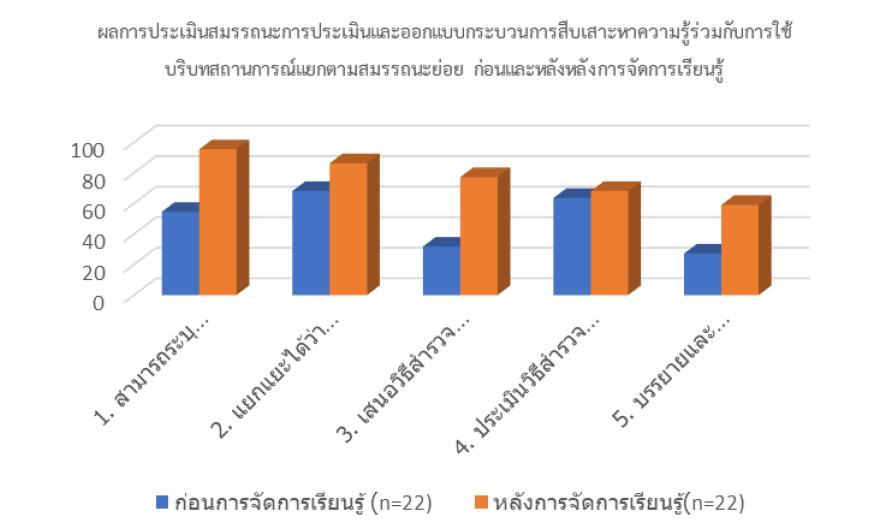
The objective of this research was to develop the scientific competencies of Grade 7 students through inquiry-based learning, along with the application of contextual situations in personal, national, and global contexts. The research participants consisted of 22 grade 7 school students who participated in the development program over the course of 1 academic year. This research utilized classroom action research, and the research data was collected by Inquiry-based Learning combined with Contextual Situations, Lesson Plans, Scientific Competency Assessment, Student Reflective Journal and Teaching Logs. The research findings show that students achieved the high level of competency development (Level 4 out of 5) in identifying scientific issues. They were able to distinguish scientific issues or stories from other topics with scientific evidence. Students could identify which questions could be answered through scientific testing and which questions could not be examined using scientific tests. They could also self-assess and determine what information or evidence they needed to collect to design data collection accurately. In terms of using scientific evidence, students did not demonstrate clear development in this competency. This is possibly because the learning activities did not emphasize the promotion of this aspect, especially in the context of using information or evidence obtained through research to support conclusions or make predictions or forecasts. This research highlights that inquiry-based learning, combined with the contextual situations in levels of personal, national, and global, enhances the development of scientific competencies.
Keywords: Science Competencies, Inquiry-based Learning Combined with Using the Contextual Situations in Life, At the Personal, National, and Global Levels, Classroom Action Research
References
Changwangprang, N. (2002). Doing science project activities that affect academic achievement in subjects science of year 6 worship students [Master Dissertation, Prince of Songkla University]. [in Thai]
Coghlan, D., & Brannick, T. (2001). Doing action research in your own organization. Sage.
Hmelo-Silver, C. E., Duncan, R. G., & Chinn, C. A. (2007). Scaffolding and achievement in problem-based and inquiry learning: A response to Kirschner, Sweller, and Clark (2006). Educational Psychologist, 42(2), 99-107.
Institute for the Promotion of Teaching Science and Technology. (2018). Manual for using the additional course curriculum, science, chemistry, high school level science learning group (revised edition 2017) according to the Basic Education Core Curriculum 2008, Chulalongkorn University Press. [in Thai]
Khaemmanee, T. (2010). Teaching science: knowledge for organizing effective learning processes efficiency (13th edition). Chulalongkorn University Press. [in Thai]
Khumraksa, B. (2021). The use of research-based learning to promote an active learning in science learning. CMU Journal of Education, 5(1), 58-74. (in Thai)
Krajcik, J. S., & Czerniak, C. M. (2014). Teaching science in elementary and middle school: A project-based approach (5th ed.). Routledge.
Phannapa, A., & Rombklao, J. (2019). Assessing the impact of inquiry-based learning using collaborative models and evidence-based reasoning models on the understanding of dissolution, electrolysis, and electrochemistry of 5th year high school students. Journal of Learning Innovation, 5 (1), 65 - 83. [in Thai]
Downloads
Published
Issue
Section
License
Copyright (c) 2024 Journal of Kasetsart Educational Review

This work is licensed under a Creative Commons Attribution-NonCommercial-NoDerivatives 4.0 International License.
บทความทุกบทความเป็นลิขสิทธิ์ของวารสารคณะศึกษาศาสตร์ มหาวิทยาลัยเกษตรศาสตร์ วิทยาเขตบางเขน
วารสารศึกษาศาสตร์ปริทัศน์ (Kasetsart Educational Review)



