
THE EFFECT OF USING LEARNING PACKAGE BASED ON PROBLEM-BASED LEARNING WITH FINANCIAL CONTEXT TOWARDS MATHEMATICAL LITERACY OF UPPER SECONDARY SCHOOL STUDENTS
Keywords:
Mathematical literacy, Problem-based learning, Learning packages, Financial contextAbstract
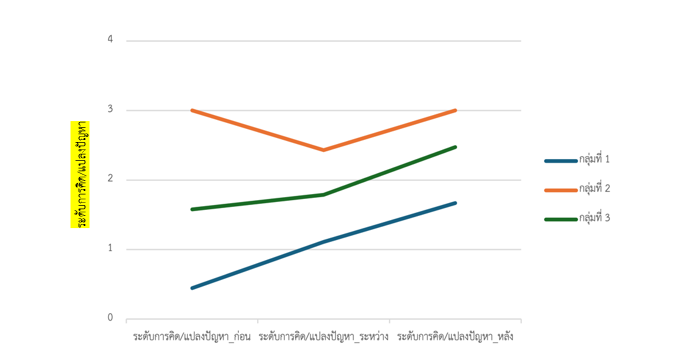
Mathematical literacy is the capacity of each person to formulate, employ, and interpret and evaluate mathematics to solve problems in real-life contexts. It's also defined as the tools for predicting and describing real-life phenomena. The objective of this research was to study the development of upper secondary school students' mathematical literacy after learning through learning packages based on problem-based learning with a financial context. The participants for the research were 35 upper secondary school students from a school in Bangkok. The research instruments included the learning packages based on problem-based learning with financial context and mathematical literacy tests. The research results were analyzed using descriptive statistics, frequency and percentages, and a K-means clustering algorithm to generate groups based on the transition of students’ level of mathematical literacy. The results of this research revealed that students' level of mathematical literacy after learning through learning packages based on problem-based learning with financial context were mostly at a moderate and good level, which was higher than that of students before learning; additionally, the students' level of mathematical literacy after learning through the learning packages increased students’ tendency to formulate and employ mathematical concepts, while literacy in terms of interpreting and evaluating did not change.
Keyword: Mathematical literacy, Problem-based learning, Learning packages, Financial context
References
Barrows, H., & Tamblyn, R. (1980). Problem-based learning: Rationale and definition. In Editor (Eds.), Problem-Based Learning an Approach to Medical Education (pp. 1-18). Springer Publishing Company Inc.
Boriboon, A. (2018). Development of mathematics instructional packages using problem based learning (PBL) and team games tournament (TGT) to enhance mathayomsuksa 3 students’ mathematics process skills, attitude and learning achievement. Education Journal Faculty of Education Kamphaengphet Rajabhat University, 3(5), 107-131. [in Thai].
Hemlock-Silver, C., (2004). Problem-based learning: What and how do students learn. Educational Psychology Review, 16(3), 235-244.
Khamphala, S. & Asvaraksha, N. (2023). The effect of learning by concept attainment model about decimal of mathayomsuksa 1 students at watpromjariyawat municipality school. Journal of Legal Entity Management and Local Innovation. 9(8), 1109-1131. [in Thai].
Laamena, C. M., & Laurens, T. (2021). Mathematical literacy ability and metacognitive characteristics of mathematics pre-service teacher. Infinity journal, 10(2), 259-270.
Organization for Economic Co-operation and Development (OECD). (2023). PISA 2022 Assessment and Analytical Framework. https://www.oecd.org
Simamora, R., Sidabutar, D., & Surya, E. (2017). Improving learning activity and students’ problem-solving skill through problem based learning (PBL) in junior high school. International Journal of Science: Basic and Applied Research, 33(2), 321-331.
Tabun, H., Taneo, P., & Deniel, F. (2020). The ability of student math literacy on problem based learning modeling (PBL). EduMa: Mathematics Education Learning and Teaching, 9(1), 43-48.
The Institute for the Promotion of Teaching Science and Technology (IPST). (2023, December 6). PISA 2022 Assessment. http://ipst.pisatest.ipst.ac.th [in Thai].
Downloads
Published
Issue
Section
License
Copyright (c) 2024 Journal of Kasetsart Educational Review

This work is licensed under a Creative Commons Attribution-NonCommercial-NoDerivatives 4.0 International License.
บทความทุกบทความเป็นลิขสิทธิ์ของวารสารคณะศึกษาศาสตร์ มหาวิทยาลัยเกษตรศาสตร์ วิทยาเขตบางเขน
วารสารศึกษาศาสตร์ปริทัศน์ (Kasetsart Educational Review)



