Students’ Mathematical Concepts from blending Embodiment and Symbolism in Active Learning Classroom
Keywords:
Mathematical Concept, Embodiment, Symbolism, Open ApproachAbstract
This research was conducted within the context of integrating the embodiment and the symbolism in mathematics classrooms focused on promoting active learning. The research objectives are to: 1) analyze students' advanced mathematical concept, and 2) study the details of the procedure and practices of teaching methods that enhance students' mathematical conceptualization. The target group consisted of 11 grade 8 students from Wat Thanon Kae School. The research employed a qualitative approach, using tools such as lesson plans, activity sheets, and field notes. The effectiveness score of the lesson plan was 4.12.
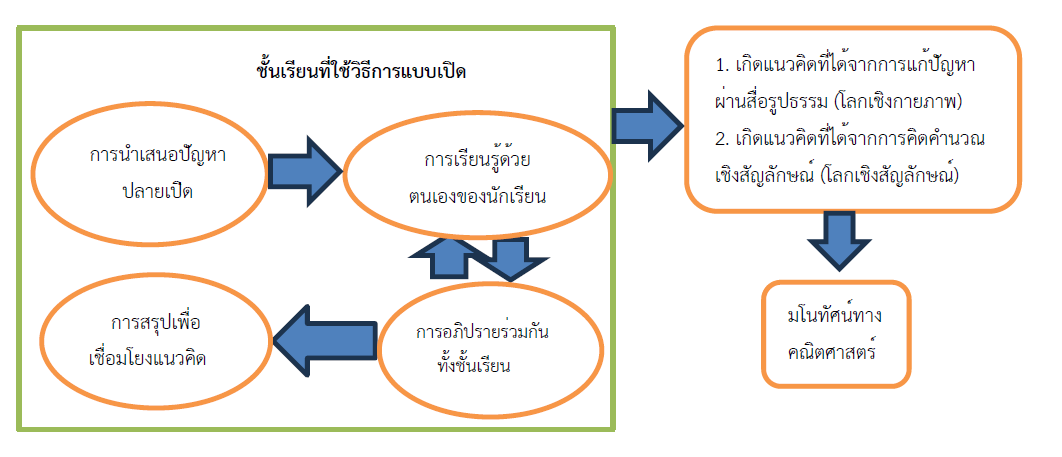
The research findings revealed that: 1) students' advanced mathematical conceptualization arises from problem-solving ideas through concrete media (embodiment) and conceptual calculations (symbolism) and 2) the teaching methods that promote mathematical conceptualization are open-ended approaches. Such teaching methods help students generate mathematical thinking for meaningful mathematical learning. Furthermore, a new finding in this research is that after students develop ideas from the embodiment and the symbolism in mathematics, they learn to think mathematically, which leads to the formation of mathematical concepts.
Keywords: Mathematical Conceptualization, Embodiment, Symbolism, Active Learning
References
Becker, J. P., & Shimada, S. (1997). The Open-Ended Approach: A New Proposal for Teaching Mathematics. Reston, Virginia: National Council of Teachers of Mathematics.
Changsri, N. (2022). ‘There is not just one way to find the answer.’ A mathematics classroom that emphasizes process rather than product. Retrieved from https://thepotential.org/creative-learning/teaching-mathematics-open-approach. [in Thai]
Gray, E. M., & Tall D. O. (1992). Success and failure in Mathematics: Procept and procedure 1. A primary perspective. Published in Workshop on Mathematics Education and Computers, April 1992 (pp. 209–215). Taipei National University.
Inprasitha, M. (2006). Open-ended approach and teacher education. Tsukuba Journal of Educational Study in Mathematics, 25, 169-178. [in Thai]
Inprasitha, M. (2010). One feature of adaptive lesson study in Thailand: Designing learning unit. Proceeding of the 45th Korean National Meeting of Mathematics Education (pp. 193-206). Dongkook University. [in Thai]
Inprasitha, M. (2022). Lesson study and open approach development in Thailand: A longitudinal study. International Journal for Lesson and Learning Studies, 11(5), 1-15.
Inprasitha, M. (2024). Learning to think mathematically in Thai classroom using Thailand Lesson Study Incorporated with Open Approach (TLSOA). Proceeding of the National Academy of Mathematics Education (TSMED 10 ), February 3-4, 2024 (p. 2). Phra Nakhon Si Ayutthaya Rajabhat University. [in Thai]
Makhanong, A. (2010). Skills and mathematical processes development for development. Chulalongkorn University Press. [in Thai]
Petcharaporn, K. (2020). Learning management science. Faculty of Education, Suan Sunandha Rajaphat University. [in Thai]
Saengpun, J & Kanchaisak, P. (2017). From Embodied to Symbolic World: Learning Process in Addition of First Grade Students in
Classroom taught through Open Approach. Journal of Inclusive and Innovative Education,1(1), 53-67.[in Thai]
Suthisung N. (2013). The function of abstraction process for students’ concept formation through Mathematical activity in classroom using lesson study and open approach [Unpublished doctoral dissertation]. Khonkaen University. [in Thai]
Tall, D. (2004). Introducing three worlds of Mathematics. For the Learning of Mathematics, 23(3), 29–33.
Tall, D., & Isoda, M. (2007). Long-term development of mathematical thinking and lesson study. https://homepages.warwick.ac.uk/staff/David.Tall/ pdfs/dot2007x-tall-isoda-lessonstudy.pdf
Tall, D. (2013). How humans learn to think Mathematically: Exploring the three worlds of Mathematics. Cambridge University Press.
Downloads
Published
Issue
Section
License
Copyright (c) 2024 Journal of Kasetsart Educational Review

This work is licensed under a Creative Commons Attribution-NonCommercial-NoDerivatives 4.0 International License.
บทความทุกบทความเป็นลิขสิทธิ์ของวารสารคณะศึกษาศาสตร์ มหาวิทยาลัยเกษตรศาสตร์ วิทยาเขตบางเขน
วารสารศึกษาศาสตร์ปริทัศน์ (Kasetsart Educational Review)



