
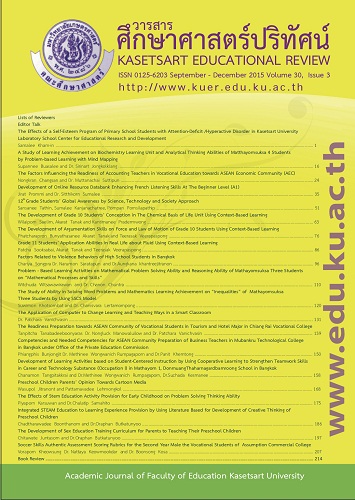
The Effects of a Self-Esteem Program of Primary School Students with Attention-Deficit /Hyperactive Disorder in Kasetsart University Laboratory School Center for Educational Research and Development
Keywords:
Self-Esteem, Self-Esteem Program, Attention-Deficit/Hyperactivity DisorderAbstract
The Effects of a Self-Esteem Program of Primary School Students with Attention-Deficit /Hyperactive Disorder in Kasetsart University Laboratory School Center for Educational Research and Development
The current research aimed to study the effects of a self-esteem program for primary school students with attention - deficit/hyperactivity disorder (ADHD) conducted in the academic year 2014 at Kasetsart University Laboratory School Center for Educational Research and Development.
In carrying out this inquiry, the researcher adopted the quasi-experimental design method.
The research population consisted of 84 primary school students with ADHD enrolled in the academic year 2014. The method of purposive sampling was used to select the members of the sample population. These members were 20 Prathom Sueksa Six students with ADHD diagnosed by physicians as not having concurrent complications. They also expressed willingness to participate in the program.
These twenty students were randomly assigned to experimental and control groups of ten each. The research instrument was bipartite: a Five-Scale Test for Self-Esteem for Children (FSC) in Thai (1998) and a self-esteem program.
Using the Wilcoxon matched-pairs signed ranks test, the data for the experimental and control groups were comparatively analyzed prior to and after participation (experimental group) or non-participation (control group) in the self-esteem program. Utilizing the Mann-Whitney U test, the researcher thence compared the self-esteem scores of the members of the experimental and control groups.
Findings were as follows:
1. The students who participated in the self-esteem program (experimental group) exhibited self-esteem at a higher level than prior to participate in the program at the statistically significant level of 0.01.
2. The students who participated in the self-esteem program (experimental group) evinced self-esteem at a higher level than those who did not participate (control group) at the statistically significant level of 0.01.
Downloads
Issue
Section
License
บทความทุกบทความเป็นลิขสิทธิ์ของวารสารคณะศึกษาศาสตร์ มหาวิทยาลัยเกษตรศาสตร์ วิทยาเขตบางเขน
วารสารศึกษาศาสตร์ปริทัศน์ (Kasetsart Educational Review)



