
The Development of a Mobile Application to Enhance Communication Knowledge in Service Tasks at Convenience Stores for People with Hearing Impairments
Keywords:
sign language, hearing-impaired, applicationAbstract
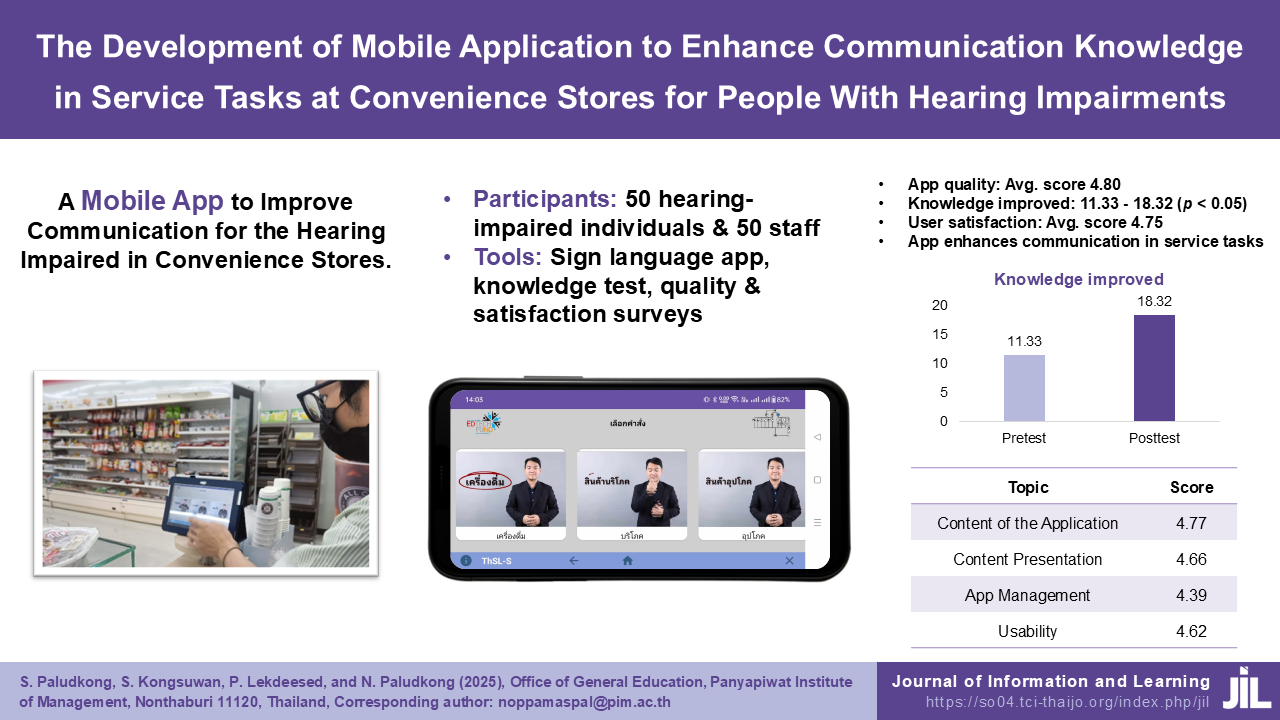
This research aimed to develop and evaluate an application designed to facilitate communication during service tasks in convenience stores for individuals with hearing impairments. The sample group consisted of 100 participants, selected through purposive sampling, including 50 individuals with hearing impairments and 50 convenience store employees. The research instruments included a sign language application for communication in convenience store services, an application quality assessment form, a communication knowledge test for service operations, and a user satisfaction survey. Data analysis was performed using descriptive statistics, including percentage, mean, and standard deviation, as well as inferential statistics using the paired sample t-test. The findings revealed that the application featured a structured vocabulary organized into four categories: beverages, consumables, non-consumables, and services. It also incorporated six types of sentences: statements, questions, requests, refusals, commands, and prohibitions. The application's quality was assessed and rated as excellent, with an average score of 4.80. During the testing phase, participants achieved an average pre-training knowledge test score of 11.33, which significantly increased to 18.32 after training. A paired sample t-test analysis confirmed that the improvement was statistically significant at the .05. User satisfaction with the application was also rated as excellent, with an average score of 4.75. This application has the potential to enhance communication in convenience store service operations for individuals with hearing impairments.
References
Chumchim, P., & Maneerat, P. (2020). Application development of sign language translation systems for hearing-impaired people. PKRU SciTech Journal, 4(1), 22–32. https://ph01.tci-thaijo.org/index.php/pkruscitech/article/view/240583
Department of Empowerment of Persons with Disabilities. (2008). Phrarātchabanyat kaancātkaan sɯ̄ksaa sam rap kon phi kaan Phō̜.Sō̜. 2551. [Empowerment of persons with disabilities act, B.E. 2007]. https://dep.go.th/images/uploads/Downloads/pdf/888_09.pdf
Khumwichai, P. (2017, March 11). Core UX/UI for mobile app design. Maejo University. https://erp.mju.ac.th/acticleDetail.aspx?qid=632
Kongsuwan, S., & Ruachai, B. (2020). Teaching and learning for the deaf in Thailand: Problems, modelsand bilingual teaching methods. Mangrai Saan Journal of Humanities and Social Sciences Language Institute and Global Affairs, CRRU, 8(1), 1–14. https://so04.tci-thaijo.org/index.php/mrsj/article/view/240858/165728
Lersilp, T., & Lersilp, S. (2019). Use of information technology for communication and learning in secondary school students with a hearing disability. Education Sciences, 9(1), 1–14. https://doi.org/10.3390/educsci9010057
Maneerat, S., Vinitasatikul, P., & Gowithayakorn, T. (2023). The approach to creating learning skills for children with hearing impairment. Journal of Education Burapha University, 34(3), 1–11. https://so02.tci-thaijo.org/index.php/edubuu/article/view/264636
Ministry of Digital Economy and Society. (2023). Hearing or communication disorder [Digital Service for disability Office of the National Digital Economy and Society Commission, B.E. 2016]. https://d4d.onde.go.th/app-portal/group/2
Nulueang, P., & Panich, W. (2018). The development of instructional video program on restaurant service for senior high school hearing impaired students in school for the deaf. Journal of Research and Development in Special Education, 7(2), 35–46. https://ejournals.swu.ac.th/index.php/rise/article/view/11480
Petersen, K., Wohlin, C., & Baca, D. (2009, June 15-17). The Waterfall Model in large-scale development. In F. Bomarius, M. Oivo, P. Jaring, P. Abrahamsson (Eds.), Product-focused software process improvement. Lecture Notes in Business Information Processing, vol 32. Berlin, Heidelberg. https://doi.org/10.1007/978-3-642-02152-7_29
Rais, K., Patil, G., Patil, Y., Patil, N., Khairnar, S., Parkhe, S., & Patil, S. (2024). The Waterfall Model-software engineering. International Journal of Research Publication and Reviews, 5(4), 7825–7830. https://ijrpr.com/uploads/V5ISSUE4/IJRPR25788.pdf
Sutttiwong Busara. (2020, December 8). Operation manual organizing training collaborative project with agency (In-house training). Office of Continuing Education. https://www.stou.ac.th/study/sumrit/Publish%20work/3-63%5B4-12-63%5D/3-63%5B8-12-63%5D.pdf
Thongplew, T., & Ploysuayngam, W. (2017, December 7-8). The development of a mobile application for solving hearing impairment [Conference session]. National Kasetsart University Kamphaeng Saen Conference, Nakhon Pathom, Thailand. https://kukrdb.lib.ku.ac.th/proceedings/PKPS/search_detail/dowload_digital_file/20002390/196213
Wongkorm, K., Hongngam, K., Vinitastitkun, P., & Maneerat, S. (2023). The development of digital technology for deaf to information of archaeological sites and tourist attractions. NRRU Community Research Journal, 17(3), 57–70. https://doi.org/10.14456/nrru-rdi.2023.35
Downloads
Additional Files
Published
How to Cite
Issue
Section
Categories
License
Copyright (c) 2025 Journal of Information and Learning [JIL]

This work is licensed under a Creative Commons Attribution-NonCommercial-NoDerivatives 4.0 International License.
Free access to published articles. Current licensing policy: CC BY-NC 4.0 from Volume 37, Issue 2 (2026). For earlier articles, consult the rights information on the individual article page. See our Open Access, Copyright and Licensing policy.


