
การพัฒนาแอปพลิเคชันเพื่อการสื่อสารในงานบริการในร้านสะดวกซื้อ สำหรับกลุ่มผู้บกพร่องทางการได้ยิน
คำสำคัญ:
ภาษามือเพื่องานบริการ, ผู้บกพร่องทางการได้ยิน, แอปพลิเคชันบทคัดย่อ
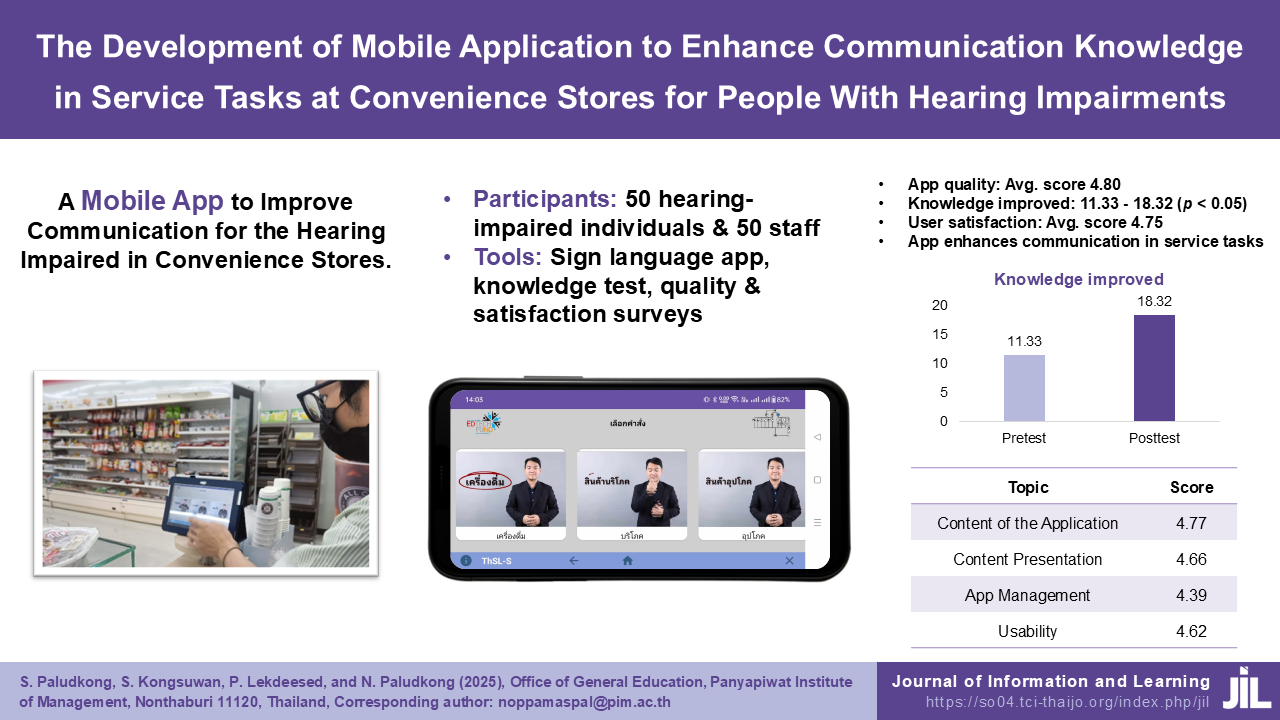
การวิจัยนี้มีวัตถุประสงค์เพื่อ 1) พัฒนาแอปพลิเคชันเพื่อการสื่อสารในงานบริการในร้านสะดวกซื้อสำหรับกลุ่มผู้บกพร่องทางการได้ยิน 2) ทดลองใช้งานแอปพลิเคชันเพื่อการสื่อสารในงานบริการในร้านสะดวกซื้อ กลุ่มตัวอย่าง จำนวน 100 คน เลือกแบบเฉพาะเจาะจง ได้แก่ กลุ่มผู้บกพร่องทางการได้ยิน จำนวน 50 คน และพนักงานให้บริการในร้านสะดวกซื้อ จำนวน 50 คน เครื่องมือวิจัย ได้แก่ แอปพลิเคชันภาษามือเพื่อการสื่อสารในงานบริการในร้านสะดวกซื้อ แบบประเมินคุณภาพแอปพลิเคชัน แบบทดสอบความรู้การสื่อสารในงานบริการในร้านสะดวกซื้อ และแบบวัดความพึงพอใจต่อการใช้งานแอปพลิเคชัน วิเคราะห์ข้อมูลด้วยสถิติเชิงพรรณนา ได้แก่ ร้อยละ ค่าเฉลี่ย และส่วนเบี่ยงเบนมาตรฐาน สถิติที่ใช้ในการทดสอบสมมติฐาน Paired Sample t-test ผลการวิจัยพบว่า 1) แอปพลิเคชันเพื่อการสื่อสารในงานบริการในร้านสะดวกซื้อ ประกอบด้วยโครงสร้างของคำศัพท์ 4 กลุ่ม คือ เครื่องดื่ม สินค้าบริโภค สินค้าอุปโภค และหมวดบริการ ประโยค 6 ลักษณะ คือ บอกเล่า คำถาม ขอร้อง ปฏิเสธ คำสั่ง และห้าม ประเมินคุณภาพของแอปพลิเคชันอยู่ในระดับดีมาก (M = 4.80, SD = 0.25) 2) การทดลองใช้งานแอปพลิเคชัน คะแนนทดสอบความรู้ก่อนทดลองใช้งานค่าเฉลี่ย 11.33 และหลังการทดลองใช้งานค่าเฉลี่ย 18.32 คะแนนหลังการทดลองใช้งานแอปพลิเคชันมีค่าเฉลี่ยสูงกว่าก่อนทดลองใช้งานอย่างมีนัยสำคัญทางสถิติที่ระดับ .05 ส่วนความพึงพอใจต่อการใช้งานแอปพลิเคชันอยู่ในระดับดีมาก (M = 4.75, SD = 0.25) แอปพลิเคชันนี้สามารถนำไปใช้ประโยชน์สำหรับการสื่อสารในร้านสะดวกซื้อของกลุ่มผู้บกพร่องทางได้ยิน
เอกสารอ้างอิง
Chumchim, P., & Maneerat, P. (2020). Application development of sign language translation systems for hearing-impaired people. PKRU SciTech Journal, 4(1), 22–32. https://ph01.tci-thaijo.org/index.php/pkruscitech/article/view/240583
Department of Empowerment of Persons with Disabilities. (2008). Phrarātchabanyat kaancātkaan sɯ̄ksaa sam rap kon phi kaan Phō̜.Sō̜. 2551. [Empowerment of persons with disabilities act, B.E. 2007]. https://dep.go.th/images/uploads/Downloads/pdf/888_09.pdf
Khumwichai, P. (2017, March 11). Core UX/UI for mobile app design. Maejo University. https://erp.mju.ac.th/acticleDetail.aspx?qid=632
Kongsuwan, S., & Ruachai, B. (2020). Teaching and learning for the deaf in Thailand: Problems, modelsand bilingual teaching methods. Mangrai Saan Journal of Humanities and Social Sciences Language Institute and Global Affairs, CRRU, 8(1), 1–14. https://so04.tci-thaijo.org/index.php/mrsj/article/view/240858/165728
Lersilp, T., & Lersilp, S. (2019). Use of information technology for communication and learning in secondary school students with a hearing disability. Education Sciences, 9(1), 1–14. https://doi.org/10.3390/educsci9010057
Maneerat, S., Vinitasatikul, P., & Gowithayakorn, T. (2023). The approach to creating learning skills for children with hearing impairment. Journal of Education Burapha University, 34(3), 1–11. https://so02.tci-thaijo.org/index.php/edubuu/article/view/264636
Ministry of Digital Economy and Society. (2023). Hearing or communication disorder [Digital Service for disability Office of the National Digital Economy and Society Commission, B.E. 2016]. https://d4d.onde.go.th/app-portal/group/2
Nulueang, P., & Panich, W. (2018). The development of instructional video program on restaurant service for senior high school hearing impaired students in school for the deaf. Journal of Research and Development in Special Education, 7(2), 35–46. https://ejournals.swu.ac.th/index.php/rise/article/view/11480
Petersen, K., Wohlin, C., & Baca, D. (2009, June 15-17). The Waterfall Model in large-scale development. In F. Bomarius, M. Oivo, P. Jaring, P. Abrahamsson (Eds.), Product-focused software process improvement. Lecture Notes in Business Information Processing, vol 32. Berlin, Heidelberg. https://doi.org/10.1007/978-3-642-02152-7_29
Rais, K., Patil, G., Patil, Y., Patil, N., Khairnar, S., Parkhe, S., & Patil, S. (2024). The Waterfall Model-software engineering. International Journal of Research Publication and Reviews, 5(4), 7825–7830. https://ijrpr.com/uploads/V5ISSUE4/IJRPR25788.pdf
Sutttiwong Busara. (2020, December 8). Operation manual organizing training collaborative project with agency (In-house training). Office of Continuing Education. https://www.stou.ac.th/study/sumrit/Publish%20work/3-63%5B4-12-63%5D/3-63%5B8-12-63%5D.pdf
Thongplew, T., & Ploysuayngam, W. (2017, December 7-8). The development of a mobile application for solving hearing impairment [Conference session]. National Kasetsart University Kamphaeng Saen Conference, Nakhon Pathom, Thailand. https://kukrdb.lib.ku.ac.th/proceedings/PKPS/search_detail/dowload_digital_file/20002390/196213
Wongkorm, K., Hongngam, K., Vinitastitkun, P., & Maneerat, S. (2023). The development of digital technology for deaf to information of archaeological sites and tourist attractions. NRRU Community Research Journal, 17(3), 57–70. https://doi.org/10.14456/nrru-rdi.2023.35
ดาวน์โหลด
ไฟล์ประกอบ
เผยแพร่แล้ว
รูปแบบการอ้างอิง
ฉบับ
ประเภทบทความ
หมวดหมู่
สัญญาอนุญาต
ลิขสิทธิ์ (c) 2025 Journal of Information and Learning [JIL]

อนุญาตภายใต้เงื่อนไข Creative Commons Attribution-NonCommercial-NoDerivatives 4.0 International License.
Journal of Information and Learning ดำเนินการโดยสำนักวิทยบริการ มหาวิทยาลัยสงขลานครินทร์ วิทยาเขตปัตตานี บทความที่ได้รับการตีพิมพ์ในวารสารได้รับความคุ้มครองตามกฎหมายลิขสิทธิ์ โดยเจ้าของลิขสิทธิ์จะมีสิทธิในการทำซ้ำ ดัดแปลง และเผยแพร่งานบทความ ทั้งรูปแบบอิเล็กทรอนิกส์ การทำฉบับสำเนา การแปล และการผลิตซ้ำในรูปแบบต่างๆ ลิขสิทธิ์บทความเป็นของผู้เขียนและสำนักวิทยบริการ มหาวิทยาลัยสงขลานครินทร์ วิทยาเขตปัตตานี วารสารฯ ขอสงวนสิทธิ์ในการพิจารณาตีพิมพ์ตามความเหมาะสม รวมทั้งการตรวจทานแก้ไข การปรับข้อความ หรือขัดเกลาภาษาให้ถูกต้องตามเกณฑ์ที่กำหนด สำหรับผลการวิจัยและความคิดเห็นที่ปรากฏในบทความถือเป็นความคิดเห็นและอยู่ในความรับผิดชอบของผู้เขียน


