
Analysis of Information Features for Identification of Digital Intellectual Property Metadata Elements
Keywords:
digital intellectual property, metadata, metadata elementAbstract
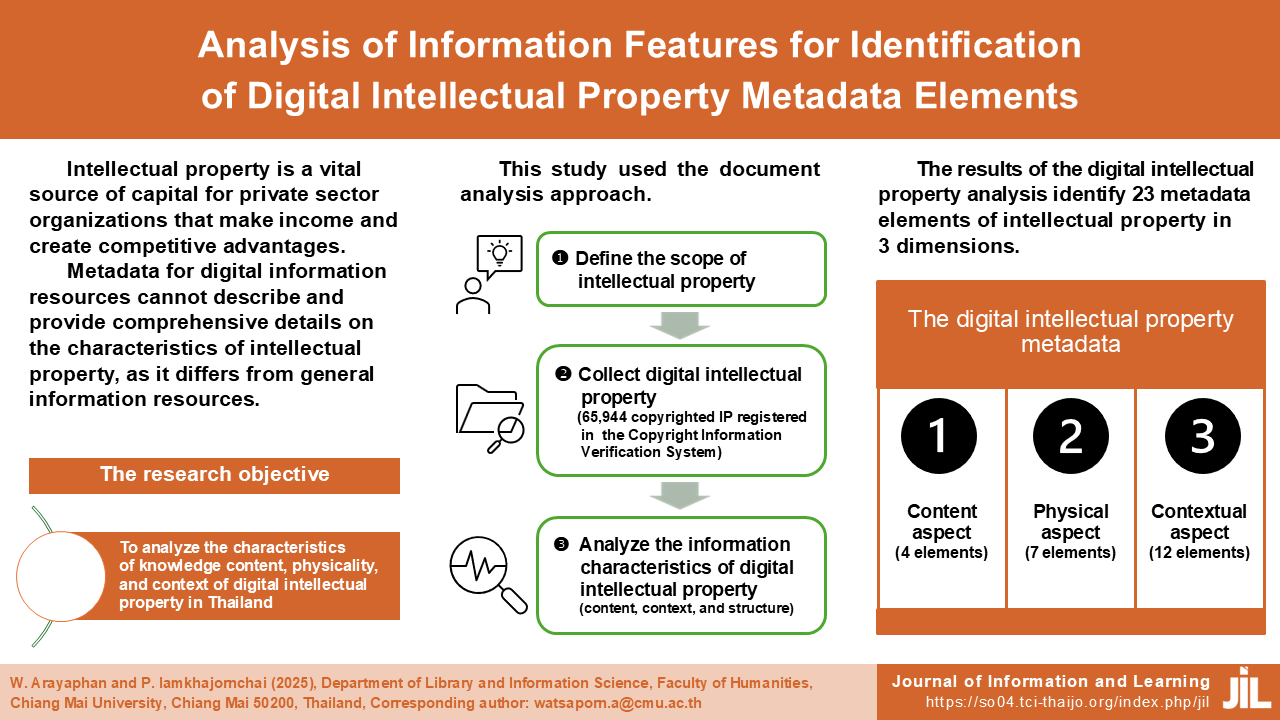
This research aims to analyze the content of physical and contextual characteristics of digital intellectual property in Thailand. The sample consists of copyrighted digital intellectual property registered and recorded in the copyright information verification system of the Department of Intellectual Property, Ministry of Commerce, from 2017 to 2024, totaling 65,944 items. This study employs qualitative research methodology, focusing on information attribute analysis. Research results of the digital intellectual property analysis can identify 23 metadata elements of intellectual property in three dimensions. The first dimention is content that consists of four elements: type of copyrighted works, details of creation or inspiration, title of the work, and language of the work. The second one is a physical aspect that consists of seven elements: copyright owner, agent, creator or pseudonym, copyright ownership, contact address, the informant on the use of copyright infringement exceptions for the benefit of disabled persons who cannot access copyrighted works and the nature of creative works. The third one is a contextual aspect that
consists of twelve elements: filing date, receipt date, application number, notification number, data registration, advertisement of copyrighted work, place of creation of the work, year of creation, information on the use of copyright infringement exceptions for the benefit of disabled persons, types of media exempted from copyright infringement for the benefit of disabled persons, list of requests for revocation of copyright information and supporting documents for copyright notification. A metadata framework has been developed by organizations and entities involved in intellectual property to capture knowledge and the management of intellectual property in both traditional and digital forms, enabling users to access knowledge from intellectual property effectively.
References
Baca, M. (Ed.). (2008). Introduction to metadata (3rd ed.). Getty Research Institute. https://www.getty.edu/publications/intrometadata/
Bandy, A. E. (2018). Know your rights Metadata and copyright for the future. Humanities Division, UCLA College. https://humtech.ucla.edu/news/know-rights-metadata-copyright-future/
Caplan, P. (2003). Metadata fundamentals for all librarians. American Library.
Chaichuay, V. (2013). Metadata scheme development for a digitized inscriptions management [Unpublished doctoral dissertation]. Khon Kaen University.
Chaichuay, V., Manmart, L., Wuwongse, V., & Chamnongsri, N. (2017). Analysis of information features for identification of inscription metadata elements. Academic Services Journal, Prince of Songkla University, 28(1), 39–52. https://journal.oas.psu.ac.th/index.php/asj/article/view/986
Clausen, H. (2004). Intellectual property, the internet and the libraries. New Library World, 105(1206/1207), 417–422.
Daum, J. H. (2003). Intangible assets and value creation. John Wiley & Sons.
Department of Intellectual Property. (2020). Rabīap krom sapsin thāng panyā wādūai kān rap čhǣng khō̜mūn likkhasit læ kānchai bō̜rikān khō̜mūn likkhasit Phō̜.Sō̜ 2563 [Rules of DIP on the regulations regarding receiving notification of copyright and providing copyright information services B.E. 2020]. https://www.ipthailand.go.th/images/3534/2563/Copyright/regul_CPR2020.pdf
Department of Intellectual Property. (2021a). Khwām māi khō̜ng likkhasit [Meaning of copyright]. https://www.ipthailand.go.th/th/component/zoo/item/42-282-copy.html
Department of Intellectual Property. (2021b). Statistics of copyright registration by DIP. https://catalog.ipthailand.go.th/dataset/dip_010401/resource/a72efd21-645a-4a35-8950-5c1de5d5b750/view/e972b8a5-70ee-4947-b142-4497b34d73dc
Dublin Core. (2025). Dublin Core metadata element set, version 1.1: Reference description. https://www.dublincore.org/specifications/dublin-core/dces
Foulonneau, M., & Riley, J. (2008). Metadata for digital resources: implementation, systems design and interoperability. Chandos.
Geller, L. (2010). Data management in academic settings: an intellectual property perspective. Science and Engineering Ethics, 16, 769–775. https://doi.org/10.1007/s11948-010-9240-4
Gilliland, A. J. (2016). Setting the stage. In M. Baca (Ed.), Introduction to metadata (3rd ed.). Getty Publications. https://www.getty.edu/publications/intrometadata/setting-the-stage/
Haynes, D. (2004). Metadata for information management and retrieval. Facet.
Haynes, D. (2017). Metadata for information management and retrieval, understanding metadata and its use. Facet.
Hemarajata, C. (2001). Characteristics of intellectual property law. Plate Processor.
Khamyard, S. (2023). A study on the application of the preservation metadata standard “PREservation metadata: implementation strategies (PREMIS)” for rare book digital collections [Unpublished master's thesis]. Chulalongkorn University.
Kittayatham, T. (1999). Copyright owner of thesis [Master's thesis, Ramkhamhaeng University]. https://doi.nrct.go.th/ListDoi/listDetail?Resolve_DOI=10.14457/RU.the.1999.255
Linder, C. & Seidenstricker, S. (2011). The current intellectual property debate: A citation-based analysis. Management, 6(1), 3–24. https://www.fm-kp.si/zalozba/ISSN/1854-4231/6_003-024.pdf
Maemura, E. (2025). Conceptualizing aggregate-level description in web archives. Archival Science, 25, Article 6. https://doi.org/10.1007/s10502-025-09475-z
Palawongpanich, P. (2011). Legal framework for public participation: A case study on the operation of nuclear power plant in Thailand [Master's thesis, Chulalongkorn University]. https://doi.org/10.14457/CU.the.2011.954
Pomerantz, J. (2015). Metadata. MIT Press.
Reitzig, M. (2004). Improving patent valuations for management purposes-validating new indicators by analyzing application rationales. Research Policy, 33(6–7), 939–957. https://doi.org/10.1016/j.respol.2004.02.004
Riley, J. (2017). Understanding metadata: what is metadata, and what is it for? National Information Standards Organization. https://groups.niso.org/higherlogic/ws/public/download/17446/UnderstandingMetadata.pdf
Rivette, K. G., & Kline, D. (1999). Rembrandt in the attic: Unlocking the hidden value of patents. Harvard Business School.
Sarita, V. B., & Inutan, S. M. B. (2025). Technology transfer management practices among selected state universities and colleges in Davao Region, Philippines. Journal of Interdisciplinary perspectives, 3(4), 114–130. https://doi.org/10.69569/jip.2025.070
Score Detect Team. (2024, February 2). The importance of metadata in copyright protection explained. https://www.scoredetect.com/blog/posts/the-importance-of-metadata-in-copyright-protection-explained?
Shaw, M. K. (2024). Cataloging library resources: An introduction (2nd ed.). Rowman & Littlefield Publishers.
Taylor, A. G., & Joudrey, D. N. (2009). The organization of information (3rd ed.). Libraries Unlimited.
Thammastitkul, A. (2023). A study of using artificial intelligence to enhance digital image metadata. Burapha University. https://buuir.buu.ac.th/bitstream/1234567890/10280/1/2567_070.pdf
Trust, J. P. G. (2006). CDWA lite: Specification for an xml schema for contributing records via the OAI harvesting protocol. Getty. https://www.getty.edu/research/publications/electronic_publications/cdwa/cdwalite.pdf
Weinberger, D. (2023). Unanticipating metadata: Metadata in the ages of the internet and AI. Information Services and Use, 43(3-4), 243–247. https://journals.sagepub.com/doi/epub/10.3233/ISU-230204
World Intellectual Property Organization. (2010). World intellectual property indicators. https://www.wipo.int/edocs/pubdocs/en/intproperty/941/wipo_pub_941_2010.pdf
World Intellectual Property Organization. (2024). Copyright and related rights. http://www.wipo.int/copyright/en/
Zeng, M. L., & Qin, J. (2016). Metadata (2nd ed.). Neal-Schuman.
Downloads
Additional Files
Published
How to Cite
Issue
Section
Categories
License
Copyright (c) 2025 Journal of Information and Learning [JIL]

This work is licensed under a Creative Commons Attribution-NonCommercial-NoDerivatives 4.0 International License.
Free access to published articles. Current licensing policy: CC BY-NC 4.0 from Volume 37, Issue 2 (2026). For earlier articles, consult the rights information on the individual article page. See our Open Access, Copyright and Licensing policy.


