
A Study on the Application of an Innovative Curriculum Platform for Emergency Medical Education in Secondary Schools in Pattani Province
Keywords:
platform innovation, curriculum and process, emergency medical learning, secondary school teachers and studentsAbstract
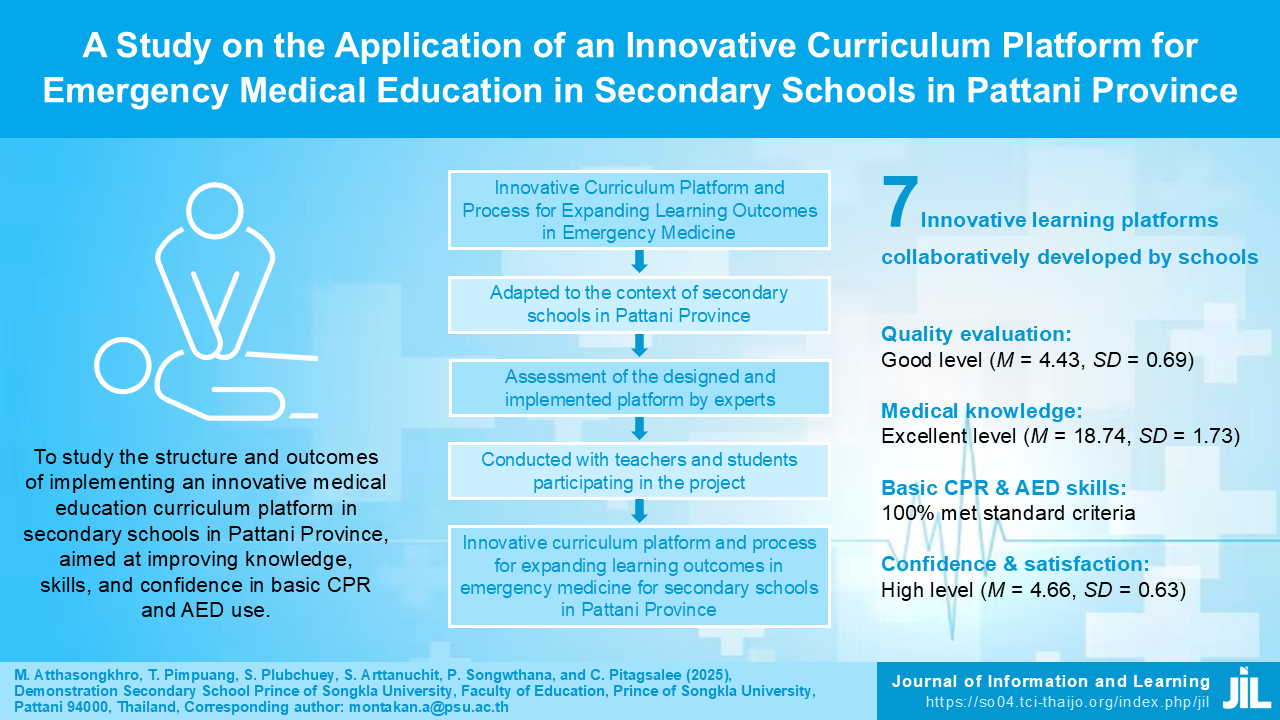
This is a part of research and development aimed at studying the structure and outcomes of implementing an innovative medical education curriculum platform in secondary schools in Pattani Province. The sample were 2,996 teachers and students from 15 secondary schools. Instruments consisted of content and learning resources modified from course prototype from Chiangmai to be appropriate with cultural context. Data were collected by using a questionnaire on knowledge and skill in basic CPR and AED and observation of participation. Data was analyzed using descriptive statistics. The research findings revealed: 1) All secondary schools in Pattani Province demonstrated their active participation in applying to learning platform by modifying in seven context-appropriate platforms, which were evaluated by experts and assessed as of good quality (M = 4.43, SD = 0.69). The finding showed that all participated teachers and students demonstrated exceptionally high levels of knowledge in emergency medical care, basic life support, and AED usage (M = 18.74, SD = 1.73). All (100%) met a standard of basic CPR and AED skills and gained extremely high confidence and satisfaction levels in basic life support and AED usage (M = 4.66, SD = 0.63). It is suggested to scale up an emergency medical learning platform to every secondary school.
References
Boonmak, P., Suraseranivongse, S., Pattaravit, N., Boonmak, S., Jirativanont, T., Lertbunnaphong, T., Arora, R., Watcharotayangul, J., Imsuwan, I., Kwangwaropas, P., & Wittayachamnankul, B.(2022). Simulation-based medical education in Thailand: A cross-sectional online national survey. BMC Medical Education, 22, Article 298. https://doi.org/10.1186/s12909-022-03369-9
Borg, W. R., & Gall, M. D. (1989). Educational research: An introduction (5th ed.). Longman.
Buosonte, R. (2019). Kānwičhai læ phatthanā nawattakam kānsưksā [Research and development of educational innovation]. Chulalongkorn University Press.
CPR Birmingham. (2024). Empowering youth: The impact of CPR knowledge on high school students. https://www.cprbirmingham.org/the-impact-of-cpr-knowledge-among-high-school-students
Delungahawatta, T., Dunne, S. S., Hyde, S., Halpenny, L., McGrath, D., O’Regan, A., & Dunne, C. P. (2022). Advances in e-learning in undergraduate clinical medicine: A systematic review. BMC Medical Education, 22(1), Article 711. https://doi.org/10.1186/s12909-022-03773-1
Department of Public Health Emergency Management. (2020). Handbook of standard ambulance, safety patient transfer operation. Department of Permanent Secretariat, Ministry of Public Health.
Diamond, R. M. (1989). Designing and improving courses and curricula in higher education. Jossey-Bass.
Fullan, M. (2001). The new meaning of educational change (3rd ed.). Teachers College Press.
Kemmis, S., & McTaggart, R. (2000). Participatory action research. In N. K. Denzin & Y. S. Lincoln (Eds.), Handbook of qualitative research (2nd ed., pp. 567–605). Sage.
Khuntongkaew, S., & Suankaew, S. (2023). Development model of basic core curriculum on basic life support and automated external defibrillation (AED) for senior high school Ratchaburi Province. Journal of Emergency Medical Services of Thailand, 3(2), 136–147. https://he03.tci-thaijo.org/index.php/Jemst-01JHS/article/view/1645
Leggio, W. J., Grawey, T., Stilley, J., & Dorsett, M. (2021). EMS curriculum should educate beyond a technical scope of practice: Position statement and resource document. Prehospital Emergency Care, 25(5), 724–729. https://doi.org/10.1080/10903127.2021.1925793
Ministry of Education. (2008). Laksūt kǣn klāng kānsưksā naphư̄n thān B.E. 2551 [Basic education core curriculum 2008]. Agricultural Cooperatives Association of Thailand. https://academic.obec.go.th/images/document/1559878925_d_1.pdf
National Institute for Emergency Medicine. (2019). Phǣn lakkān phǣt chukchœ̄n hǣng chāt chabap thī 3.1 B.E. 2562–2564 [National emergency medicine master plan No. 3.1 2019–2021]. https://www.niems.go.th/1/upload/migrate/file/256112221455115037_GWJdMn5ejp3gVAdc.pdf
Pivač, S., Gradišek, P., & Skela-Savič, B. (2020). The impact of cardiopulmonary resuscitation (CPR) training on schoolchildren and their CPR knowledge, attitudes toward CPR, and willingness to help others and to perform CPR: Mixed methods research design. BMC Public Health, 20, Article 915. https://doi.org/10.1186/s12889-020-09072-y
Plant, N., & Taylor, K. (2013). How best to teach CPR to schoolchildren: A systematic review. Resuscitation, 84(4), 415–421. https://doi.org/10.1016/j.resuscitation.2012.12.008
Reder, S., Cummings, P., & Quan, L. (2006). Comparison of three instructional methods for teaching cardiopulmonary resuscitation and use of an automatic external defibrillator to high school students. Resuscitation, 69(3), 443–453. https://doi.org/10.1016/j.resuscitation.2005.08.020
Rogers, E. M. (2003). Diffusion of innovations (5th ed.). Free Press.
Saiyasopon, S., Pakittawichit, T., Chareonvong, C., Chotnok, P. P., Chansungnern, S., Sakolnakorn, T. P. N., Chaiyapong, A., & Dhammassaccakarn, W. (2023). The knowledge management and the guidelines of learning instruction on emergency medical services by local administrative organizations in northeastern Thailand. Asian Journal of Education and Training, 9(4), 108–116. https://doi.org/10.20448/edu.v9i4.5105
Songwathana, P., & Sangchan, H. (2015). Emergency medical service in the unrest area of Three Southern Thai Border Provinces: A literature review. Princess of Naradhiwas University Journal, 7(2). 74–82. https://li01.tci-thaijo.org/index.php/pnujr/article/view/53910
Songwathana, P., Kwanphichit, C., Sea-sia, W., Kitrungrote, L., Damkliang, J., Sandchan, H., Sornsrivichai, V., & Sakunkeaw, W. (2020). Healthcare service providers’ perspective on provision of emergency medical services in security zones: A qualitative study. The Journal of Thailand Nursing and Midwifery Council, 35(3), 17–35. https://he02.tci-thaijo.org/index.php/TJONC/article/view/240639
Swathanan, S., Intasingh, S., Intanate, N., & Aungkasith, K. (2024). Development of curriculum platform innovation and extend process of learning in emergency medicine for educational institutes in Chiang Mai. Journal of Research Methodology, 37(2), 89–108. https://so12.tci-thaijo.org/index.php/jrm/article/view/1066
Taba, H. (1962). Curriculum development: Theory and practice. Harcourt Brace & World.
Tyler, R. W. (1949). Basic principles of curriculum and instruction. University of Chicago Press.
Weerakhachon, P., Chanthamolee, S., Suwan, P., & Srisupanan, M. (2017). Development of emergency operation model for the emergency medical technician in border southern provinces. The Southern College Network Journal of Nursing and Public Health, 4(3), 87–103. https://he01.tci-thaijo.org/index.php/scnet/article/view/102080
Weerakhachon, P., Nuanjaroen, B., Awae, N., & Jinsakul, P. (2023). Competencies of emergency responders in emergency operations of advance emergency operations units in the southern border areas. Journal of Preventive Medicine Association of Thailand, 12(3), 537–551. https://he01.tci-thaijo.org/index.php/JPMAT/article/view/260510
World Health Organization. (2018). Global status report on road safety 2018. https://www.who.int/publications/i/item/9789241565684
World Health Organization Thailand. (2023). A new year’s resolution ‘for life’. https://www.who.int/thailand/news/detail/03-01-2023-a-new-year-s-resolution--for-life
Yigitbas, E., Krois, S., Renzelmann, T., & Engels, G. (2022). Comparative evaluation of AR-based, VR-based, and traditional basic life support training (pp. 1–8). IEEE 10th International Conference on Serious Games and Applications for Health(SeGAH). IEEE. https://doi.org/10.1109/SEGAH54908.2022.9978596
Downloads
Additional Files
Published
How to Cite
Issue
Section
Categories
License
Copyright (c) 2025 Journal of Information and Learning [JIL]

This work is licensed under a Creative Commons Attribution-NonCommercial-NoDerivatives 4.0 International License.
The Journal of Information and Learning is operated by the Office of Academic Resources, Prince of Songkla University. All articles published in the journal are protected by Thailand copyright law. This copyright covers the exclusive rights to share, reproduce and distribute the article, including in electronic forms, reprints, translations, photographic reproductions, or similar. Authors own copyrights in the works they have created as well as the Office of Academic Resources. The Journal reserves the right to edit the language of papers accepted for publication for clarity and correctness, as well as to make formal changes to ensure compliance with the journal's guidelines. All authors must take public responsibility for the content of their paper.


