
การศึกษาผลการประยุกต์ใช้นวัตกรรมแพลตฟอร์มหลักสูตรเพื่อการเรียนรู้ด้านการแพทย์ฉุกเฉินสำหรับโรงเรียนมัธยมศึกษาในจังหวัดปัตตานี
คำสำคัญ:
นวัตกรรมแพลตฟอร์ม, หลักสูตรและกระบวนการ, การเรียนรู้ด้านการแพทย์ฉุกเฉิน, ครูและนักเรียนในโรงเรียนมัธยมศึกษาบทคัดย่อ
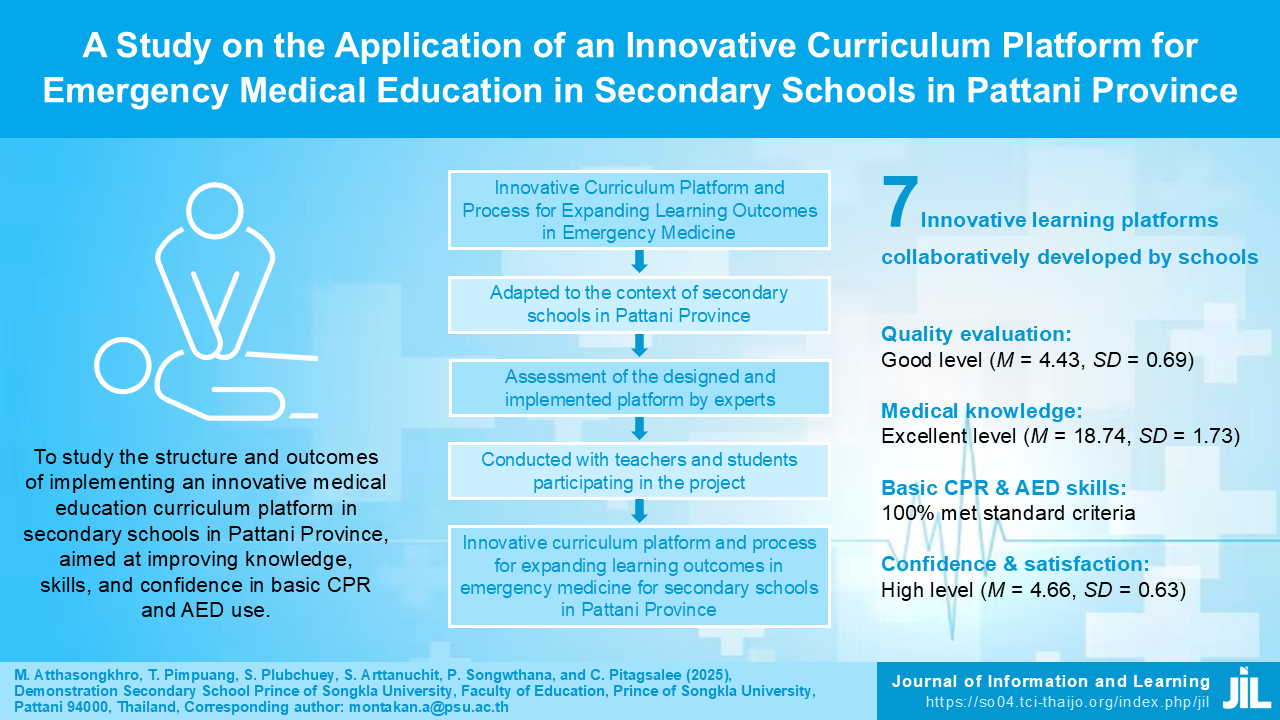
การวิจัยนี้เป็นส่วนหนึ่งของการวิจัยและพัฒนามีวัตถุประสงค์ เพื่อศึกษาโครงสร้างและผลการประยุกต์ใช้นวัตกรรมแพลตฟอร์มหลักสูตรด้านการแพทย์ฉุกเฉินในโรงเรียนมัธยมศึกษาในจังหวัดปัตตานี กลุ่มตัวอย่างคือ ครูและนักเรียนของโรงเรียนที่ยินดีเข้าร่วมโครงการด้วยความสมัครใจจำนวน 2,996 คน จาก 15 โรงเรียน เครื่องมือ ประกอบด้วย เนื้อหาและชุดการเรียนรู้บนแพลตฟอร์มที่ประยุกต์จากต้นแบบหลักสูตรของเชียงใหม่ให้สอดคล้องกับบริบทวัฒนธรรมในพื้นที่ เก็บข้อมูลโดยใช้แบบสอบถามประเมินความรู้ ทักษะการช่วยฟื้นคืนชีพขั้นพื้นฐานและการใช้เครื่องช็อกไฟฟ้าหัวใจแบบอัตโนมัติ (Basic CPR & AED) และสังเกตกระบวนการมีส่วนร่วมในการขยายผลการเรียนรู้ วิเคราะห์ข้อมูลด้วยสถิติเชิงพรรณนา ผลการวิจัยพบว่า 1) โรงเรียนมัธยมศึกษาที่ร่วมโครงการได้ร่วมกันประยุกต์นวัตกรรมแพลตฟอร์มหลักสูตรเพื่อการเรียนรู้ด้านการแพทย์ที่เหมาะสมกับบริบทต่าง ๆ ขึ้นทั้งหมด 7 แพลตฟอร์ม โดยผ่านการประเมินคุณภาพจากผู้ทรงคุณวุฒิ มีคุณภาพอยู่ในระดับดี (M = 4.43, SD = 0.69) 2) ผลการใช้นวัตกรรมแพลตฟอร์มหลักสูตรเพื่อการเรียนรู้ด้านการแพทย์สำหรับโรงเรียนมัธยมศึกษา พบว่า ครูและนักเรียนที่เข้าร่วมโครงการทั้งหมด มีคะแนนความรู้พื้นฐานด้านการแพทย์ฉุกเฉิน การช่วยฟื้นคืนชีพขั้นพื้นฐานและการใช้เครื่อง AED เฉลี่ยรวมอยู่ในระดับดีมาก (M = 18.74, SD = 1.73) ส่วนทักษะการช่วยฟื้นคืนชีพขั้นพื้นฐานและการใช้เครื่องช็อกไฟฟ้าหัวใจแบบอัตโนมัติ (Basic CPR & AED) พบว่า ทำได้ครบผ่านเกณฑ์มาตรฐานทุกข้อ (ร้อยละ 100) และคะแนนความมั่นใจและความพึงพอใจในการช่วยฟื้นคืนชีพขั้นพื้นฐานและการใช้เครื่อง AED ที่ได้รับจากโครงการเฉลี่ยรวมอยู่ในระดับมาก (M = 4.66, SD = 0.63) ดังนั้น ควรนำนวัตกรรมแพลตฟอร์มหลักสูตรเพื่อการเรียนรู้ด้านการแพทย์นี้ไปใช้ในโรงเรียนระดับมัธยมศึกษาทุกแห่ง
เอกสารอ้างอิง
Boonmak, P., Suraseranivongse, S., Pattaravit, N., Boonmak, S., Jirativanont, T., Lertbunnaphong, T., Arora, R., Watcharotayangul, J., Imsuwan, I., Kwangwaropas, P., & Wittayachamnankul, B.(2022). Simulation-based medical education in Thailand: A cross-sectional online national survey. BMC Medical Education, 22, Article 298. https://doi.org/10.1186/s12909-022-03369-9
Borg, W. R., & Gall, M. D. (1989). Educational research: An introduction (5th ed.). Longman.
Buosonte, R. (2019). Kānwičhai læ phatthanā nawattakam kānsưksā [Research and development of educational innovation]. Chulalongkorn University Press.
CPR Birmingham. (2024). Empowering youth: The impact of CPR knowledge on high school students. https://www.cprbirmingham.org/the-impact-of-cpr-knowledge-among-high-school-students
Delungahawatta, T., Dunne, S. S., Hyde, S., Halpenny, L., McGrath, D., O’Regan, A., & Dunne, C. P. (2022). Advances in e-learning in undergraduate clinical medicine: A systematic review. BMC Medical Education, 22(1), Article 711. https://doi.org/10.1186/s12909-022-03773-1
Department of Public Health Emergency Management. (2020). Handbook of standard ambulance, safety patient transfer operation. Department of Permanent Secretariat, Ministry of Public Health.
Diamond, R. M. (1989). Designing and improving courses and curricula in higher education. Jossey-Bass.
Fullan, M. (2001). The new meaning of educational change (3rd ed.). Teachers College Press.
Kemmis, S., & McTaggart, R. (2000). Participatory action research. In N. K. Denzin & Y. S. Lincoln (Eds.), Handbook of qualitative research (2nd ed., pp. 567–605). Sage.
Khuntongkaew, S., & Suankaew, S. (2023). Development model of basic core curriculum on basic life support and automated external defibrillation (AED) for senior high school Ratchaburi Province. Journal of Emergency Medical Services of Thailand, 3(2), 136–147. https://he03.tci-thaijo.org/index.php/Jemst-01JHS/article/view/1645
Leggio, W. J., Grawey, T., Stilley, J., & Dorsett, M. (2021). EMS curriculum should educate beyond a technical scope of practice: Position statement and resource document. Prehospital Emergency Care, 25(5), 724–729. https://doi.org/10.1080/10903127.2021.1925793
Ministry of Education. (2008). Laksūt kǣn klāng kānsưksā naphư̄n thān B.E. 2551 [Basic education core curriculum 2008]. Agricultural Cooperatives Association of Thailand. https://academic.obec.go.th/images/document/1559878925_d_1.pdf
National Institute for Emergency Medicine. (2019). Phǣn lakkān phǣt chukchœ̄n hǣng chāt chabap thī 3.1 B.E. 2562–2564 [National emergency medicine master plan No. 3.1 2019–2021]. https://www.niems.go.th/1/upload/migrate/file/256112221455115037_GWJdMn5ejp3gVAdc.pdf
Pivač, S., Gradišek, P., & Skela-Savič, B. (2020). The impact of cardiopulmonary resuscitation (CPR) training on schoolchildren and their CPR knowledge, attitudes toward CPR, and willingness to help others and to perform CPR: Mixed methods research design. BMC Public Health, 20, Article 915. https://doi.org/10.1186/s12889-020-09072-y
Plant, N., & Taylor, K. (2013). How best to teach CPR to schoolchildren: A systematic review. Resuscitation, 84(4), 415–421. https://doi.org/10.1016/j.resuscitation.2012.12.008
Reder, S., Cummings, P., & Quan, L. (2006). Comparison of three instructional methods for teaching cardiopulmonary resuscitation and use of an automatic external defibrillator to high school students. Resuscitation, 69(3), 443–453. https://doi.org/10.1016/j.resuscitation.2005.08.020
Rogers, E. M. (2003). Diffusion of innovations (5th ed.). Free Press.
Saiyasopon, S., Pakittawichit, T., Chareonvong, C., Chotnok, P. P., Chansungnern, S., Sakolnakorn, T. P. N., Chaiyapong, A., & Dhammassaccakarn, W. (2023). The knowledge management and the guidelines of learning instruction on emergency medical services by local administrative organizations in northeastern Thailand. Asian Journal of Education and Training, 9(4), 108–116. https://doi.org/10.20448/edu.v9i4.5105
Songwathana, P., & Sangchan, H. (2015). Emergency medical service in the unrest area of Three Southern Thai Border Provinces: A literature review. Princess of Naradhiwas University Journal, 7(2). 74–82. https://li01.tci-thaijo.org/index.php/pnujr/article/view/53910
Songwathana, P., Kwanphichit, C., Sea-sia, W., Kitrungrote, L., Damkliang, J., Sandchan, H., Sornsrivichai, V., & Sakunkeaw, W. (2020). Healthcare service providers’ perspective on provision of emergency medical services in security zones: A qualitative study. The Journal of Thailand Nursing and Midwifery Council, 35(3), 17–35. https://he02.tci-thaijo.org/index.php/TJONC/article/view/240639
Swathanan, S., Intasingh, S., Intanate, N., & Aungkasith, K. (2024). Development of curriculum platform innovation and extend process of learning in emergency medicine for educational institutes in Chiang Mai. Journal of Research Methodology, 37(2), 89–108. https://so12.tci-thaijo.org/index.php/jrm/article/view/1066
Taba, H. (1962). Curriculum development: Theory and practice. Harcourt Brace & World.
Tyler, R. W. (1949). Basic principles of curriculum and instruction. University of Chicago Press.
Weerakhachon, P., Chanthamolee, S., Suwan, P., & Srisupanan, M. (2017). Development of emergency operation model for the emergency medical technician in border southern provinces. The Southern College Network Journal of Nursing and Public Health, 4(3), 87–103. https://he01.tci-thaijo.org/index.php/scnet/article/view/102080
Weerakhachon, P., Nuanjaroen, B., Awae, N., & Jinsakul, P. (2023). Competencies of emergency responders in emergency operations of advance emergency operations units in the southern border areas. Journal of Preventive Medicine Association of Thailand, 12(3), 537–551. https://he01.tci-thaijo.org/index.php/JPMAT/article/view/260510
World Health Organization. (2018). Global status report on road safety 2018. https://www.who.int/publications/i/item/9789241565684
World Health Organization Thailand. (2023). A new year’s resolution ‘for life’. https://www.who.int/thailand/news/detail/03-01-2023-a-new-year-s-resolution--for-life
Yigitbas, E., Krois, S., Renzelmann, T., & Engels, G. (2022). Comparative evaluation of AR-based, VR-based, and traditional basic life support training (pp. 1–8). IEEE 10th International Conference on Serious Games and Applications for Health(SeGAH). IEEE. https://doi.org/10.1109/SEGAH54908.2022.9978596
ดาวน์โหลด
ไฟล์ประกอบ
เผยแพร่แล้ว
รูปแบบการอ้างอิง
ฉบับ
ประเภทบทความ
หมวดหมู่
สัญญาอนุญาต
ลิขสิทธิ์ (c) 2025 Journal of Information and Learning [JIL]

อนุญาตภายใต้เงื่อนไข Creative Commons Attribution-NonCommercial-NoDerivatives 4.0 International License.
Journal of Information and Learning ดำเนินการโดยสำนักวิทยบริการ มหาวิทยาลัยสงขลานครินทร์ วิทยาเขตปัตตานี บทความที่ได้รับการตีพิมพ์ในวารสารได้รับความคุ้มครองตามกฎหมายลิขสิทธิ์ โดยเจ้าของลิขสิทธิ์จะมีสิทธิในการทำซ้ำ ดัดแปลง และเผยแพร่งานบทความ ทั้งรูปแบบอิเล็กทรอนิกส์ การทำฉบับสำเนา การแปล และการผลิตซ้ำในรูปแบบต่างๆ ลิขสิทธิ์บทความเป็นของผู้เขียนและสำนักวิทยบริการ มหาวิทยาลัยสงขลานครินทร์ วิทยาเขตปัตตานี วารสารฯ ขอสงวนสิทธิ์ในการพิจารณาตีพิมพ์ตามความเหมาะสม รวมทั้งการตรวจทานแก้ไข การปรับข้อความ หรือขัดเกลาภาษาให้ถูกต้องตามเกณฑ์ที่กำหนด สำหรับผลการวิจัยและความคิดเห็นที่ปรากฏในบทความถือเป็นความคิดเห็นและอยู่ในความรับผิดชอบของผู้เขียน


