
A Knowledge Management Process for Smart Agricultural Learning Center: Rural Wisdom Park, Satun Toward Sustainability
Keywords:
smart farmer, development of farmer, agricultural learning resource, community learning center, sustainable development goalsAbstract
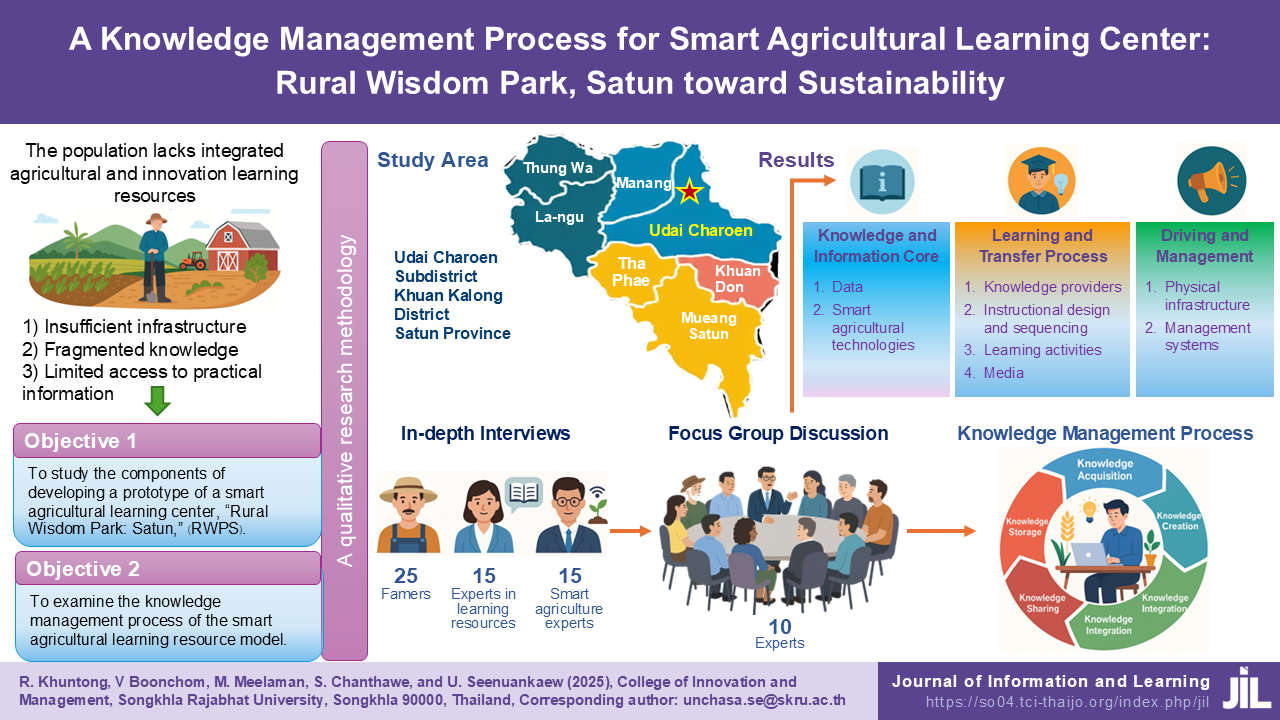
This research aimed 1) to study the components of developing a prototype of a smart agricultural learning center, “Rural Wisdom Park: Satun,” (RWPS) and 2) to examine the knowledge management process of the smart agricultural learning resource model. A qualitative research methodology was applied in Udai Charoen Subdistrict, Khuan Kalong District, Satun Province, where the community faces problems such as the lack of integrated learning resources that combine agricultural knowledge with innovation, inadequate learning infrastructure, fragmented knowledge, and limitations in accessing and applying information to real situations. Data were collected through two methods: 1) in-depth interviews with 25 farmers, 15 experts in learning resources, and 15 smart agriculture experts, and 2) focus group discussions with 10 experts to validate the prototype. Data was then analyzed using content analysis. The findings indicated that the prototype of the smart agricultural learning resource comprised three major characteristics with eight components: (1) the knowledge and Information core, which covers data and smart agricultural technologies; (2) the learning and transfer process, which includes knowledge providers, instructional design and sequencing, learning activities and media; and (3) the driving and management dimension, which consists of physical infrastructure and management systems. Moreover, the knowledge management process was structured into five stages: acquisition, creation, integration, sharing, and storage.
References
Ahmed, M. (2014). Lifelong learning in a learning society: Are community learning centres the vehicle? In Education, learning, training: Critical issues for development (International Development Policy Series No. 5, pp. 102–125). Graduate Institute Publications.
Al Halbusi, H., Pérez-González, D., & Abdullah Alsuwaiket, M. (2025). Exploring the nexus of knowledge management, absorptive capacity and corporate sustainable development: The moderating role of information technology (IT). Business Process Management Journal, 31(5), 1684–1702. https://doi.org/10.1108/BPMJ-08-2024-0679
Areekul, P. (2016). Developing guideline of the military smart organic farm learning center to enhance Thai agriculture from innovation. CRMA Journal, 14, 101–116. https://ph01.tci-thaijo.org/index.php/crma-journal/article/view/243087/165321
Attavanich, W., Chantarat, S., Chenphuengpawn, J., Mahasuweerachai, P., & Thampanishvong, K. (2019, December). Farms, farmers and farming: A perspective through data and behavioral Insights. BOT Symposium Discussion Paper. https://www.pier.or.th/files/dp/pier_dp_122.pdf
Belete S, Duke C, Hinzen H, Owusu-Boampong A, & Khau H. P. (2022). Community learning centres (CLCs) for adult learning and education (ALE): Development in and by communities. International Review of Education, 68, 259–290. https://doi.org/10.1007/s11159-022-09954-w
Boonyeam, P., Yooprasert, B., & Keowan, B. (2023). An extension model of smart farming for vegetable production by young smart farmers in eastern region of Thailand. Journal of MCU Peace Studies, 11(5), 1721–1723. https://so03.tci-thaijo.org/index.php/journal-peace/article/view/262619
Braun, A., Jiggins, J., Roling, N., Van den Berg, H., & Snijders, P. (2006). A global survey and review of farmer field school experiences. International Livestock Research Institute.
Buitendag, A. A. K., & Hattingh, F. G. (2024). A smart agricultural knowledge management framework to support emergent farmers in developmental settings. Interdisciplinary Journal of Information, Knowledge, and Management, 19, 16–29. https://doi.org/10.28945/5315
Community Development Department. (2008). Community learning center... manual. Office of Community Promotion and Development, Community Development Department, Ministry of Interior. https://www.dla.go.th/work/e_book/eb1/stan17/17.htm
Demarest, M. (1997). Understanding knowledge management. Long Range Planning, 30(3), 374–384. https://doi.org/10.1016/S0024-6301(97)90250-8
Department of Local Administration. (n.d.). Standard of community learning centers. http://monnanglocal.go.th/news/doc_download/Binder1_100322_143301.pdf
Dhanaraju, M., Chenniappan, P., Ramalingam, K., Pazhanivelan, S., & Kaliaperumal, R. (2022). Smart farming: Internet of things (IoT)-based sustainable agriculture. Agriculture, 12(10), Article 1745. https://doi.org/10.3390/agriculture12101745
Dilleen, G., Claffey, E., Foley, A., & Doolin, K. (2023). Investigating knowledge dissemination and social media use in the farming network to build trust in smart farming technology adoption. Journal of Business & Industrial Marketing, 38(8), 1754–1765. https://doi.org/10.1108/JBIM-01-2022-0060
Janthakot, P. (2015). Community learning centers: The learning source for community empowerment. RSU Library Journal, 21(2), 122–134. https://rilj.rsu.ac.th/journal/15/article/58
Jayashankar, P., Nilakanta, S., Johnston, W.J., Gill, P. & Burres, R. (2018). IoT adoption in agriculture: The role of trust, perceived value and risk. Journal of Business & Industrial Marketing, 33(6), 804–821. https://doi.org/10.1108/JBIM-01-2018-0023
Marquardt, M. J. (2002). Building the learning organization: Mastering the 5 elements for corporate learning. Davies-Black.
Meher, J. R., Nayak, L., Mishra, R. K., & Patel, G. (2024). Impact of organizational learning culture on organizational effectiveness: A serial mediation analysis with knowledge sharing and employee competencies. VINE Journal of Information and Knowledge Management Systems, 54(2), 324–338. https://doi.org/10.1108/VJIKMS-10-2021-0230
Meshesha, A.T., Birhanu, B.S., & Bezabih Ayele, M. (2022). Effects of perceptions on adoption of climate-smart agriculture innovations: Empirical evidence from the upper Blue Nile Highlands of Ethiopia. International Journal of Climate Change Strategies and Management, 14(3), 293–311. https://doi.org/10.1108/IJCCSM-04-2021-0035
Mishra, B., & Bhaskar, A. U. (2011). Knowledge management process in two learning organisations. Journal of Knowledge Management, 15(2), 344–359. https://doi.org/10.1108/13673271111119736
Naowakate, O., & Sirasoonthorn, P. (2022). Knowledge management in smallholding organic farm for sustainable food security. Journal of Community Development Research (Humanities and Social Sciences, 15(4), 29–42. https://www.journal.nu.ac.th/JCDR/article/view/Vol-15-No-4-2022-29-42
Nawaz, M., & Babar, M. I. K. (2025). IoT and AI for smart agriculture in resource-constrained environments: Challenges, opportunities and solutions. Discover Internet of Things, 5, Article 24. https://doi.org/10.1007/s43926-025-00119-3
Noiwan, P., Supawan, S., & Pathumcharoenwattana, W. (2012). Guidelines for learning resource center management in Sam Khok District, Pathum Thani Province. In The 2nd STOU Graduate Research Conference. https://dric.nrct.go.th/index.php?/Search/SearchDetail/267024
Nonaka, I., & Takeuchi, H. (1995). The knowledge-creating company: How Japanese companies create the dynamics of innovation. Oxford University Press.
Office of the Education Council. (2010). Khūmư̄ kān čhattang sūn kānrīanrū chumchon [Community learning center establishment guide]. Office of the Secretary of the Education Council.
Perez, J. R., & Ordóñez de Pablos, P. (2003). Knowledge management and organizational competitiveness: A framework for human capital analysis. Journal of Knowledge Management, 7(3), 82–91. https://doi.org/10.1108/13673270310485640
Pham, T. K. T. (2024). Linking social capital and knowledge sharing: The moderating role of meaningful work with the mediation of emotional energy. VINE Journal of Information and Knowledge Management Systems, 54(6), 1233–1251. https://doi.org/10.1108/VJIKMS-04-2022-0116
Poapongsakorn, N., & Pantakua, K. (2023, February 5). Kān tang lak mai phāk kasēt Thai nai ʻanākhot [Resetting the future of Thai agriculture]. TDRI: Thailand Development Research Institute. https://tdri.or.th/2023/02/strategy-for-agricultural-growth
Probst, G., Raub, S., & Romhardt, K. (2000). Managing knowledge: Building blocks for success. John Wiley & Sons.
Quy, V. K., Hau, N. V., Anh, D. V., Quy, N. M., Ban, N. T., Lanza, S., Randazzo, G., & Muzirafuti, A. (2022). IoT-enabled smart agriculture: Architecture, applications, and challenges. Applied Sciences, 12(7), Article 3396. https://doi.org/10.3390/app12073396
Rotjanawasuthorn, S., & Sintao, N. (2023). Approaches in promoting the application of smart agriculture and organic agriculture to enhance the food security in Wang Nam Khiao District, Nakhon Ratchasima Province. Procedia of Multidisciplinary Research, 1(7), Article 124. https://so09.tci-thaijo.org/index.php/PMR/article/view/2835
Sompong, N., & Rampai, N. (2015). The development model of knowledge management to strengthen Thai ICT community learning center. Procedia–Social and Behavioral Sciences, 176, 139–147. https://doi.org/10.1016/j.sbspro.2015.01.448
Suebsombut, P., Sureephong, P., Seklouli-Sekhari, A., Chernbumroong, S., & Bouras, A. (2022). Chatbot application to support smart agriculture in Thailand. Proceedings of Joint International Conference on Digital Arts, Media and Technology with ECTI Northern Section Conference on Electrical, Electronics, Computer and Telecommunications Engineering (ECTI DAMT & NCON), Chiang Rai, Thailand, (364–367). https://doi.org/10.1109/ECTIDAMTNCON53731.2022.9720318
UNESCO. (2003). CLC management handbook. United Nations Educational, Scientific and Cultural Organization. UNESCO Digital Library. https://unesdoc.unesco.org/ark:/48223/pf0000139548
UNESCO. (2013). Community learning centres: Asia-Pacific Regional Conference Report 2012. UNESCO Digital Library. https://unesdoc.unesco.org/ark:/48223/pf0000220833
UNESCO (2021). Youth report 2022: Non-state actors in education: Who chooses? Who loses? https://www.unesco.org/gem-report/en/publication/2022-non-state-actors-education-who-chooses-who-loses
Vongpadith, V. V. (2023). Guidelines for development of Thai agriculture to become smart farmer in the era of Thailand 4.0 in Banlamdaeng, Hantaphao Subdistrict, Wang Noi District, Phranakhon Si Ayutthaya Province. Journal of MCU Social Development, 8(1), 70–85. https://so06.tci-thaijo.org/index.php/JMSD/article/view/261775
Wenger, E. (1998). Communities of practice: Learning, meaning, and identity. Cambridge University Press.
Widodo, W. (2019). Models of community learning centre (CLC) management. Proceedings of 5th International Conference on Education and Technology (ICET), Malang, Indonesia, 121–126. https://doi.org/10.1109/ICET48172.2019.8987203
Wiig, K. M. (1993). Knowledge management foundations: Thinking about thinking–how people and organizations create, represent, and use knowledge. Schema
Widtayakornbundit, S., & Luangpituksa, C. (2023). Smart farmers’ knowledge-oriented leadership and innovation performance: The mediating role of knowledge management, business competency, and innovation culture for agritourism. Pakistan Journal of Commerce and Social Sciences, 17(3), 618–645. https://jes.ac.pk/index.php/jes/article/view/74
Yin, J., Li, Y., Ma, Z., Chen, Z. & Guo, G. (2024). Impact of entrepreneurship on technological innovation in the digital age: A knowledge management perspective. Journal of Knowledge Management, 28(9), 2750–2772. https://doi.org/10.1108/JKM-07-2023-0602
Downloads
Additional Files
Published
How to Cite
Issue
Section
Categories
License
Copyright (c) 2025 Journal of Information and Learning [JIL]

This work is licensed under a Creative Commons Attribution-NonCommercial-NoDerivatives 4.0 International License.
The Journal of Information and Learning is operated by the Office of Academic Resources, Prince of Songkla University. All articles published in the journal are protected by Thailand copyright law. This copyright covers the exclusive rights to share, reproduce and distribute the article, including in electronic forms, reprints, translations, photographic reproductions, or similar. Authors own copyrights in the works they have created as well as the Office of Academic Resources. The Journal reserves the right to edit the language of papers accepted for publication for clarity and correctness, as well as to make formal changes to ensure compliance with the journal's guidelines. All authors must take public responsibility for the content of their paper.


