
กระบวนการจัดการความรู้เพื่อการพัฒนาและขับเคลื่อนแหล่งเรียนรู้เกษตรอัจฉริยะ Rural Wisdom Park: Satun สู่ความยั่งยืน
คำสำคัญ:
เกษตรอัจฉริยะ, การพัฒนาเกษตรกร, แหล่งเรียนรู้การเกษตร, แหล่งเรียนรู้ชุมชน, การจัดการความรู้บทคัดย่อ
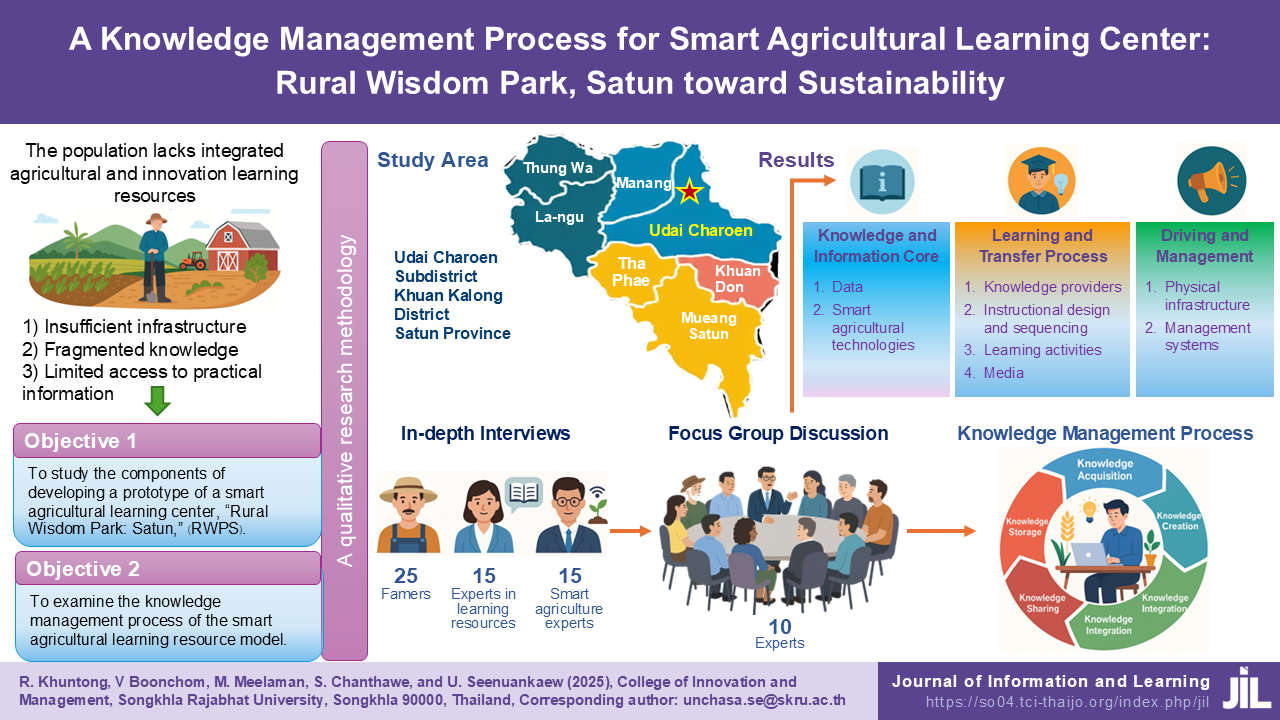
การวิจัยนี้มีวัตถุประสงค์ 1) เพื่อศึกษาองค์ประกอบของการพัฒนาต้นแบบแหล่งเรียนรู้การทำเกษตรอัจฉริยะ “Rural Wisdom Park: Satun” และ 2) เพื่อศึกษากระบวนการจัดการความรู้ของแหล่งเรียนรู้ต้นแบบเกษตรอัจฉริยะฯ ใช้ระเบียบวิธีวิจัยเชิงคุณภาพในพื้นที่ตำบลอุใดเจริญ อ.ควนกาหลง จ.สตูล ซึ่งเผชิญปัญหาขาดแหล่งเรียนรู้ที่มีการบูรณาการความรู้ด้านการเกษตรกับนวัตกรรมเข้าด้วยกัน ขาดโครงสร้างพื้นฐานการเรียนรู้ ความรู้กระจัดกระจาย และมีข้อจำกัดในการเข้าถึงและประยุกต์ใช้ข้อมูลให้ตรงกับสถานการณ์จริง เก็บรวบรวบข้อมูล 2 วิธีการ คือ 1) สัมภาษณ์เชิงลึกกับเกษตรกร 25 คน ผู้เชี่ยวชาญด้านแหล่งเรียนรู้ 15 คน และผู้เชี่ยวชาญด้านเกษตรอัจฉริยะ 15 คน และ 2) สนทนากลุ่มกับผู้เชี่ยวชาญรวม 10 คน เพื่อยืนยันต้นแบบหลังจากนั้นวิเคราะห์ข้อมูลด้วยการวิเคราะห์เนื้อหา ผลการวิจัยพบว่า 1) การพัฒนาต้นแบบแหล่งเรียนรู้เกษตรอัจฉริยะฯ มีคุณลักษณะ 3 ประการ และ 8 องค์ประกอบ ได้แก่ (1) แกนความรู้และสารสนเทศ ประกอบด้วย ข้อมูล และเทคโนโลยีเกษตรอัจฉริยะ (2) กระบวนการเรียนรู้ และการถ่ายทอด ประกอบด้วย ผู้ให้ข้อมูล/ผู้ถ่ายทอด การออกแบบและการจัดลำดับ กิจกรรมและกระบวนการเรียนรู้ และสื่อการเรียนรู้ และ (3) การขับเคลื่อนและการบริหารจัดการ ประกอบด้วย สถานที่และการบริหารจัดการ และ 2) กระบวนการจัดการความรู้ของแหล่งเรียนรู้ต้นแบบเกษตรอัจฉริยะฯ ประกอบด้วย 5 กระบวนการ ได้แก่ การแสวงหาความรู้ การสร้างความรู้ การบูรณาการความรู้ การแบ่งปันความรู้ และการจัดเก็บความรู้
เอกสารอ้างอิง
Ahmed, M. (2014). Lifelong learning in a learning society: Are community learning centres the vehicle? In Education, learning, training: Critical issues for development (International Development Policy Series No. 5, pp. 102–125). Graduate Institute Publications.
Al Halbusi, H., Pérez-González, D., & Abdullah Alsuwaiket, M. (2025). Exploring the nexus of knowledge management, absorptive capacity and corporate sustainable development: The moderating role of information technology (IT). Business Process Management Journal, 31(5), 1684–1702. https://doi.org/10.1108/BPMJ-08-2024-0679
Areekul, P. (2016). Developing guideline of the military smart organic farm learning center to enhance Thai agriculture from innovation. CRMA Journal, 14, 101–116. https://ph01.tci-thaijo.org/index.php/crma-journal/article/view/243087/165321
Attavanich, W., Chantarat, S., Chenphuengpawn, J., Mahasuweerachai, P., & Thampanishvong, K. (2019, December). Farms, farmers and farming: A perspective through data and behavioral Insights. BOT Symposium Discussion Paper. https://www.pier.or.th/files/dp/pier_dp_122.pdf
Belete S, Duke C, Hinzen H, Owusu-Boampong A, & Khau H. P. (2022). Community learning centres (CLCs) for adult learning and education (ALE): Development in and by communities. International Review of Education, 68, 259–290. https://doi.org/10.1007/s11159-022-09954-w
Boonyeam, P., Yooprasert, B., & Keowan, B. (2023). An extension model of smart farming for vegetable production by young smart farmers in eastern region of Thailand. Journal of MCU Peace Studies, 11(5), 1721–1723. https://so03.tci-thaijo.org/index.php/journal-peace/article/view/262619
Braun, A., Jiggins, J., Roling, N., Van den Berg, H., & Snijders, P. (2006). A global survey and review of farmer field school experiences. International Livestock Research Institute.
Buitendag, A. A. K., & Hattingh, F. G. (2024). A smart agricultural knowledge management framework to support emergent farmers in developmental settings. Interdisciplinary Journal of Information, Knowledge, and Management, 19, 16–29. https://doi.org/10.28945/5315
Community Development Department. (2008). Community learning center... manual. Office of Community Promotion and Development, Community Development Department, Ministry of Interior. https://www.dla.go.th/work/e_book/eb1/stan17/17.htm
Demarest, M. (1997). Understanding knowledge management. Long Range Planning, 30(3), 374–384. https://doi.org/10.1016/S0024-6301(97)90250-8
Department of Local Administration. (n.d.). Standard of community learning centers. http://monnanglocal.go.th/news/doc_download/Binder1_100322_143301.pdf
Dhanaraju, M., Chenniappan, P., Ramalingam, K., Pazhanivelan, S., & Kaliaperumal, R. (2022). Smart farming: Internet of things (IoT)-based sustainable agriculture. Agriculture, 12(10), Article 1745. https://doi.org/10.3390/agriculture12101745
Dilleen, G., Claffey, E., Foley, A., & Doolin, K. (2023). Investigating knowledge dissemination and social media use in the farming network to build trust in smart farming technology adoption. Journal of Business & Industrial Marketing, 38(8), 1754–1765. https://doi.org/10.1108/JBIM-01-2022-0060
Janthakot, P. (2015). Community learning centers: The learning source for community empowerment. RSU Library Journal, 21(2), 122–134. https://rilj.rsu.ac.th/journal/15/article/58
Jayashankar, P., Nilakanta, S., Johnston, W.J., Gill, P. & Burres, R. (2018). IoT adoption in agriculture: The role of trust, perceived value and risk. Journal of Business & Industrial Marketing, 33(6), 804–821. https://doi.org/10.1108/JBIM-01-2018-0023
Marquardt, M. J. (2002). Building the learning organization: Mastering the 5 elements for corporate learning. Davies-Black.
Meher, J. R., Nayak, L., Mishra, R. K., & Patel, G. (2024). Impact of organizational learning culture on organizational effectiveness: A serial mediation analysis with knowledge sharing and employee competencies. VINE Journal of Information and Knowledge Management Systems, 54(2), 324–338. https://doi.org/10.1108/VJIKMS-10-2021-0230
Meshesha, A.T., Birhanu, B.S., & Bezabih Ayele, M. (2022). Effects of perceptions on adoption of climate-smart agriculture innovations: Empirical evidence from the upper Blue Nile Highlands of Ethiopia. International Journal of Climate Change Strategies and Management, 14(3), 293–311. https://doi.org/10.1108/IJCCSM-04-2021-0035
Mishra, B., & Bhaskar, A. U. (2011). Knowledge management process in two learning organisations. Journal of Knowledge Management, 15(2), 344–359. https://doi.org/10.1108/13673271111119736
Naowakate, O., & Sirasoonthorn, P. (2022). Knowledge management in smallholding organic farm for sustainable food security. Journal of Community Development Research (Humanities and Social Sciences, 15(4), 29–42. https://www.journal.nu.ac.th/JCDR/article/view/Vol-15-No-4-2022-29-42
Nawaz, M., & Babar, M. I. K. (2025). IoT and AI for smart agriculture in resource-constrained environments: Challenges, opportunities and solutions. Discover Internet of Things, 5, Article 24. https://doi.org/10.1007/s43926-025-00119-3
Noiwan, P., Supawan, S., & Pathumcharoenwattana, W. (2012). Guidelines for learning resource center management in Sam Khok District, Pathum Thani Province. In The 2nd STOU Graduate Research Conference. https://dric.nrct.go.th/index.php?/Search/SearchDetail/267024
Nonaka, I., & Takeuchi, H. (1995). The knowledge-creating company: How Japanese companies create the dynamics of innovation. Oxford University Press.
Office of the Education Council. (2010). Khūmư̄ kān čhattang sūn kānrīanrū chumchon [Community learning center establishment guide]. Office of the Secretary of the Education Council.
Perez, J. R., & Ordóñez de Pablos, P. (2003). Knowledge management and organizational competitiveness: A framework for human capital analysis. Journal of Knowledge Management, 7(3), 82–91. https://doi.org/10.1108/13673270310485640
Pham, T. K. T. (2024). Linking social capital and knowledge sharing: The moderating role of meaningful work with the mediation of emotional energy. VINE Journal of Information and Knowledge Management Systems, 54(6), 1233–1251. https://doi.org/10.1108/VJIKMS-04-2022-0116
Poapongsakorn, N., & Pantakua, K. (2023, February 5). Kān tang lak mai phāk kasēt Thai nai ʻanākhot [Resetting the future of Thai agriculture]. TDRI: Thailand Development Research Institute. https://tdri.or.th/2023/02/strategy-for-agricultural-growth
Probst, G., Raub, S., & Romhardt, K. (2000). Managing knowledge: Building blocks for success. John Wiley & Sons.
Quy, V. K., Hau, N. V., Anh, D. V., Quy, N. M., Ban, N. T., Lanza, S., Randazzo, G., & Muzirafuti, A. (2022). IoT-enabled smart agriculture: Architecture, applications, and challenges. Applied Sciences, 12(7), Article 3396. https://doi.org/10.3390/app12073396
Rotjanawasuthorn, S., & Sintao, N. (2023). Approaches in promoting the application of smart agriculture and organic agriculture to enhance the food security in Wang Nam Khiao District, Nakhon Ratchasima Province. Procedia of Multidisciplinary Research, 1(7), Article 124. https://so09.tci-thaijo.org/index.php/PMR/article/view/2835
Sompong, N., & Rampai, N. (2015). The development model of knowledge management to strengthen Thai ICT community learning center. Procedia–Social and Behavioral Sciences, 176, 139–147. https://doi.org/10.1016/j.sbspro.2015.01.448
Suebsombut, P., Sureephong, P., Seklouli-Sekhari, A., Chernbumroong, S., & Bouras, A. (2022). Chatbot application to support smart agriculture in Thailand. Proceedings of Joint International Conference on Digital Arts, Media and Technology with ECTI Northern Section Conference on Electrical, Electronics, Computer and Telecommunications Engineering (ECTI DAMT & NCON), Chiang Rai, Thailand, (364–367). https://doi.org/10.1109/ECTIDAMTNCON53731.2022.9720318
UNESCO. (2003). CLC management handbook. United Nations Educational, Scientific and Cultural Organization. UNESCO Digital Library. https://unesdoc.unesco.org/ark:/48223/pf0000139548
UNESCO. (2013). Community learning centres: Asia-Pacific Regional Conference Report 2012. UNESCO Digital Library. https://unesdoc.unesco.org/ark:/48223/pf0000220833
UNESCO (2021). Youth report 2022: Non-state actors in education: Who chooses? Who loses? https://www.unesco.org/gem-report/en/publication/2022-non-state-actors-education-who-chooses-who-loses
Vongpadith, V. V. (2023). Guidelines for development of Thai agriculture to become smart farmer in the era of Thailand 4.0 in Banlamdaeng, Hantaphao Subdistrict, Wang Noi District, Phranakhon Si Ayutthaya Province. Journal of MCU Social Development, 8(1), 70–85. https://so06.tci-thaijo.org/index.php/JMSD/article/view/261775
Wenger, E. (1998). Communities of practice: Learning, meaning, and identity. Cambridge University Press.
Widodo, W. (2019). Models of community learning centre (CLC) management. Proceedings of 5th International Conference on Education and Technology (ICET), Malang, Indonesia, 121–126. https://doi.org/10.1109/ICET48172.2019.8987203
Wiig, K. M. (1993). Knowledge management foundations: Thinking about thinking–how people and organizations create, represent, and use knowledge. Schema
Widtayakornbundit, S., & Luangpituksa, C. (2023). Smart farmers’ knowledge-oriented leadership and innovation performance: The mediating role of knowledge management, business competency, and innovation culture for agritourism. Pakistan Journal of Commerce and Social Sciences, 17(3), 618–645. https://jes.ac.pk/index.php/jes/article/view/74
Yin, J., Li, Y., Ma, Z., Chen, Z. & Guo, G. (2024). Impact of entrepreneurship on technological innovation in the digital age: A knowledge management perspective. Journal of Knowledge Management, 28(9), 2750–2772. https://doi.org/10.1108/JKM-07-2023-0602
ดาวน์โหลด
ไฟล์ประกอบ
เผยแพร่แล้ว
รูปแบบการอ้างอิง
ฉบับ
ประเภทบทความ
หมวดหมู่
สัญญาอนุญาต
ลิขสิทธิ์ (c) 2025 Journal of Information and Learning [JIL]

อนุญาตภายใต้เงื่อนไข Creative Commons Attribution-NonCommercial-NoDerivatives 4.0 International License.
Journal of Information and Learning ดำเนินการโดยสำนักวิทยบริการ มหาวิทยาลัยสงขลานครินทร์ วิทยาเขตปัตตานี บทความที่ได้รับการตีพิมพ์ในวารสารได้รับความคุ้มครองตามกฎหมายลิขสิทธิ์ โดยเจ้าของลิขสิทธิ์จะมีสิทธิในการทำซ้ำ ดัดแปลง และเผยแพร่งานบทความ ทั้งรูปแบบอิเล็กทรอนิกส์ การทำฉบับสำเนา การแปล และการผลิตซ้ำในรูปแบบต่างๆ ลิขสิทธิ์บทความเป็นของผู้เขียนและสำนักวิทยบริการ มหาวิทยาลัยสงขลานครินทร์ วิทยาเขตปัตตานี วารสารฯ ขอสงวนสิทธิ์ในการพิจารณาตีพิมพ์ตามความเหมาะสม รวมทั้งการตรวจทานแก้ไข การปรับข้อความ หรือขัดเกลาภาษาให้ถูกต้องตามเกณฑ์ที่กำหนด สำหรับผลการวิจัยและความคิดเห็นที่ปรากฏในบทความถือเป็นความคิดเห็นและอยู่ในความรับผิดชอบของผู้เขียน


