
Trends in International Research Publications and Predatory Publishers in Thailand: Insights From SciVal Data (2020–2024)
Keywords:
predatory publishers, publishing ethics, international research journalsAbstract
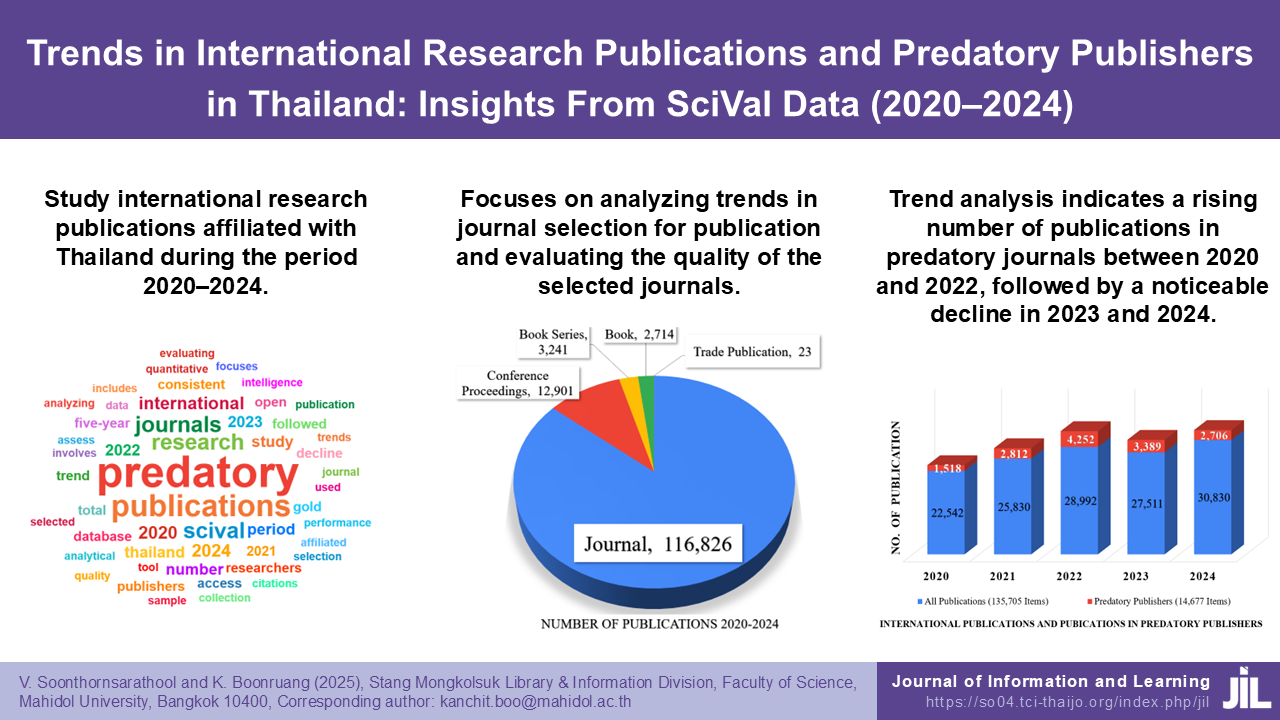
This study is quantitative research that involves data collection from the SciVal database, an analytical research intelligence tool used to assess research performance and citations. The sample for this study includes international research publications affiliated with Thailand during the period 2020-2024. This study focuses on analyzing trends in journal selection for publication and evaluating the quality of selected journals. The findings reveal that the number of international research publications from Thailand has consistently increased. According to the SciVal database, there were 22,542 publications in 2020, 25,830 in 2021, 28,992 in 2022, 27,511 in 2023, and 30,830 in 2024. Over the five-year period, Thailand produced 135,705 international research publications. Most publications appeared in subscription-based journals (67,258 articles or 49.56%), followed by Gold Open Access journals (50,067 articles or 39.89%). Hybrid Gold, Bronze, and Green Open Access formats accounted for smaller proportions. Regarding publications in journals identified as predatory publishers, a consistent presence was observed. In 2020, there were 1,518 such publications (6.73%), increasing to 2,812 (10.89%) in 2021 and 4,252 (14.67%) in 2022. However, the number began to decline with 3,389 publications (12.32%) in 2023 and 2,706 (8.78%) in 2024. In total, there were 14,677 publications in predatory journals over the five-year period, representing 10.82% of all international publications. Trend analysis indicates a rising number of publications in predatory journals between 2020 and 2022, followed by a noticeable decline in 2023 and 2024. This downward trend may reflect increased awareness and greater caution among researchers in selecting reputable and high-quality publishers to disseminate their scholarly work internationally.
References
The Commission on Higher Education Standards. (2022). Prakāt khana kammakān māttrathān kān ʻudomsưksā rư̄ang lakkēn kān tī phim phœ̄iphrǣ phon ngān witthayāniphon rư̄ sō̜ won nưng khō̜ng witthayāniphon nai wārasān radap chāt læ wārasān radap nānā chāt B.E. 2565 [Announcement: Criteria for the publication and dissemination of thesis or parts of a thesis in National and international journals, A.D. 2022. https://www.ops.go.th/en/role/edu-standard/item/7831-2565-9
Cook, F., Govender, R., & Brennan, P. A. (2023). Greetings from your predatory journal! What they are, why they are a problem, how to spot and avoid them. British Journal of Oral and Maxillofacial Surgery, 61(3), 245–247. https://doi.org/10.1016/j.bjoms.2023.02.005
Dadkhah, M., Maliszewski, T., & Jazi, M. D. (2016). Characteristics of hijacked journals and predatory publishers: Our observations in the academic world. Trends in Pharmacological Sciences, 37(6), 415–418. https://doi.org/10.1016/j.tips.2016.04.002
Elsevier. (2025). Scopus: Access and use research metrics to make better decisions. https://www.elsevier.com/products/scopus?dgcid=RN_AGCM_Sourced_300005030
Feldner, D. (2024). Changes to scopus open access (OA) document tagging. Scopus blog. https://blog.scopus.com/changes-to-scopus-open-access-oa-document-tagging
Huang, C. K., Neylon, C., Montgomery, L., Hosking, R., Brookes-Kenworthy, C., Wilson, K. S., & Ozaygen, A. (2024). Open access research outputs receive more diverse citations. Scientometrics, 129(2), 825–845. https://doi.org/10.1007/s11192-023-04894-0
Krawczyk, F., & Kulczycki, E. (2021). How is open access accused of being predatory? The impact of Beall's lists of predatory journals on academic publishing. The Journal of Academic Librarianship, 47(2), Article 102271. https://doi.org/10.1016/j.acalib.2020.102271
National Research Council of Thailand. (2023). Phǣn yutthasāt ʻongkō̜n samnakngān kānwičhai hǣng chāt B.E. 2566-2570 [NRCT strategic plan A.D. 2023-2027). https://nrct.go.th/file/Strategis/Strategis-NRCT66-70.pdf
Nwagwu, W. E. (2023). Nature and characteristics of global attention to research on article processing charges. The Journal of Academic Librarianship, 49(6), Article 102808. https://doi.org/https://doi.org/10.1016/j.acalib.2023.102808
Office of the Higher Education Commission. (2022, January 7). Prakāt kō̜. phō̜. ʻō̜. rư̄ang lakkēn læ withīkān phičhāranā tǣngtang bukkhon hai damrong tamnǣng phūchūai sāttrāčhān rō̜ng sāttrāčhān læ sāttrāčhān B.E. 2564 [Announcement criteria and procedures foracademic appointments of assistant, associate, and professors A.D. 2021. Royal Thai Government Gazette. https://www.ratchakitcha.soc.go.th/DATA/PDF/2565/E/004/T_0022.PDF
Phippen, A. (2025). Open access. In D. Baker, & L. Ellis (Eds.), Encyclopedia of libraries, librarianship, and information science (pp. 408–416). Academic Press. https://doi.org/10.1016/B978-0-323-95689-5.00095-X
Royal Thai Government Gazette. (2022, November 1). Prakāt rư̄ang phǣn phatthanā sētthakit læ sangkhom hǣng chāt chabap thī sipsām (B.E. 2566-2570) [Announcement the 13th national economic and social development plan (A.D. 2023-2027). https://www.ratchakitcha.soc.go.th/DATA/PDF/2565/E/258/T_0001.PDF
Teixeira da Silva, J. A., Moradzadeh, M., Adjei, K. O. K., Owusu-Ansah, C. M., Balehegn, M., Faúndez, E. I., Janodia, M. D., & Al-Khatib, A. (2022). An integrated paradigm shift to deal with ‘predatory publishing’. The Journal of Academic Librarianship, 48(1), Article 102481. https://doi.org/10.1016/j.acalib.2021.102481
Thyo, E. M. (2023). Predatory journals & developing countries. Barw Medical Journal, 1(2). https://doi.org/10.58742/bmj.v1i2.20
Wager, E. (2017). Why we should worry less about predatory publishers and more about the quality of research and training at our academic institutions. Journal of Epidemiology, 27(3), 87–88. https://doi.org/10.1016/j.je.2017.01.001
Walters, W. H. (2022). The citation impact of the open access accounting journals that appear on Beall's List of potentially predatory publishers and journals. The Journal of Academic Librarianship, 48(1), Article 102484. https://doi.org/10.1016/j.acalib.2021.102484
Zhang, L., & Watson, E. M. (2017). Measuring the impact of gold and green open access. The Journal of Academic Librarianship, 43(4), 337–345. https://doi.org/10.1016/j.acalib.2017.06.004
Downloads
Additional Files
Published
How to Cite
Issue
Section
Categories
License
Copyright (c) 2025 Journal of Information and Learning [JIL]

This work is licensed under a Creative Commons Attribution-NonCommercial-NoDerivatives 4.0 International License.
The Journal of Information and Learning is operated by the Office of Academic Resources, Prince of Songkla University. All articles published in the journal are protected by Thailand copyright law. This copyright covers the exclusive rights to share, reproduce and distribute the article, including in electronic forms, reprints, translations, photographic reproductions, or similar. Authors own copyrights in the works they have created as well as the Office of Academic Resources. The Journal reserves the right to edit the language of papers accepted for publication for clarity and correctness, as well as to make formal changes to ensure compliance with the journal's guidelines. All authors must take public responsibility for the content of their paper.


