
ทิศทางการตีพิมพ์ผลงานวิจัยระดับนานาชาติกับแนวโน้ม Predatory Publishers ในประเทศไทยจากฐานข้อมูล Scival ช่วงปี ค.ศ. 2020–2024
คำสำคัญ:
สำนักพิมพ์นักล่า, จริยธรรมการตีพิมพ์, วารสารนานาชาติบทคัดย่อ
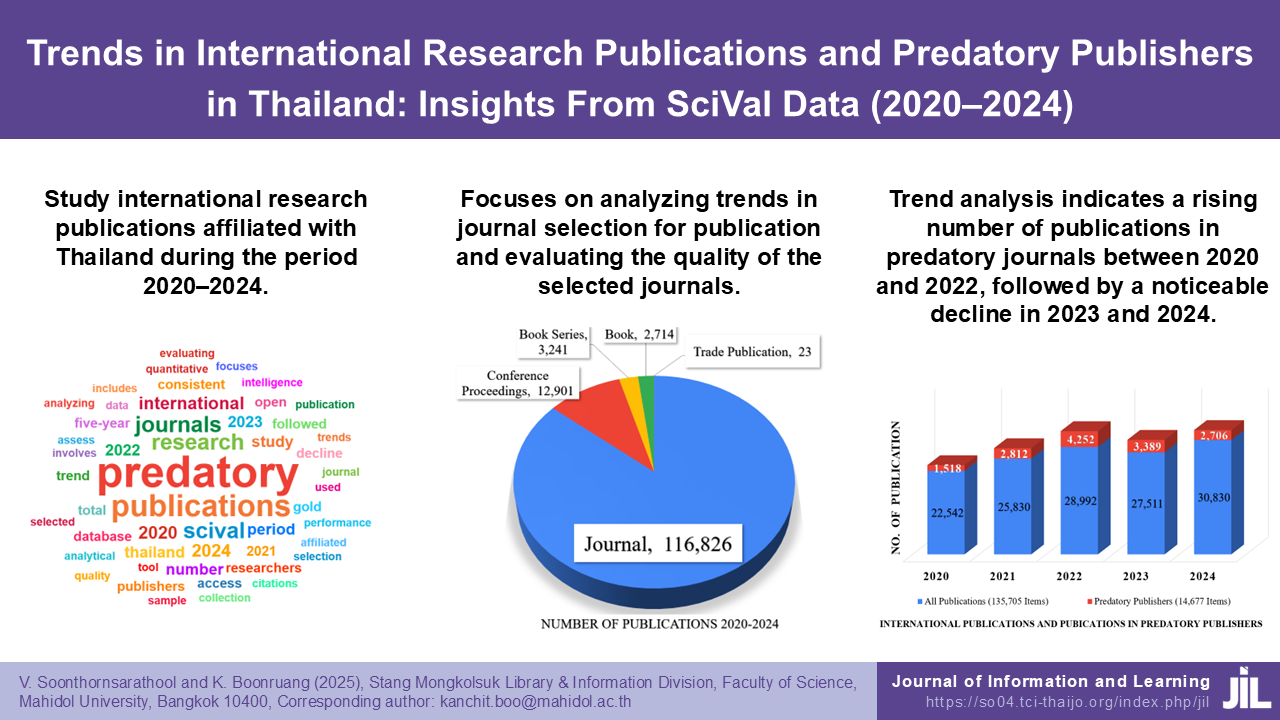
การศึกษาครั้งนี้เป็นการวิจัยเชิงปริมาณ โดยดำเนินการสืบค้นข้อมูลจากฐานข้อมูล SciVal ซึ่งเป็นฐานข้อมูลวิเคราะห์ข้อมูลเกี่ยวกับประสิทธิภาพด้านการวิจัย ความร่วมมือ การอ้างอิง และแนวโน้มต่าง ๆ กลุ่มตัวอย่างที่ใช้ในการศึกษา ได้แก่ ผลงานวิจัยระดับนานาชาติของประเทศไทยในช่วงปี ค.ศ. 2020-2024 โดยมุ่งเน้นการวิเคราะห์แนวโน้มการเลือกวารสารสำหรับการตีพิมพ์ผลงาน รวมถึงการประเมินคุณภาพของวารสารดังกล่าว ผลการศึกษาพบว่า ผลงานวิจัยระดับนานาชาติของประเทศไทยมีแนวโน้มเพิ่มขึ้นอย่างต่อเนื่อง โดยมีจำนวนผลงานที่ปรากฏในฐานข้อมูล SciVal ในปี ค.ศ. 2020 จำนวน 22,542 รายการ ปี 2021 จำนวน 25,830 รายการ ปี 2022 จำนวน 28,992 รายการ ปี 2023 จำนวน 27,511 รายการ และในปี 2024 จำนวน 30,830 รายการ รวมตลอดระยะเวลา 5 ปี ประเทศไทยมีผลงานวิจัยที่เผยแพร่ในระดับนานาชาติรวมทั้งสิ้น 135,705 รายการ นอกจากนี้ นักวิจัยเลือกเผยแพร่ผลงานวิชาการในรูปแบบ Subscription มากที่สุด 67,258 รายการ (ร้อยละ 49.56) รองลงมาคือ รูปแบบ Gold 50,067 รายการ (ร้อยละ 39.89) ขณะที่รูปแบบ Hybrid Gold, Bronze และ Green มีสัดส่วนที่น้อยลงตามลำดับ สำหรับการตีพิมพ์ผลงานในวารสารที่จัดอยู่ในกลุ่ม Predatory publishers พบว่า มีการเผยแพร่อย่างต่อเนื่อง โดยในปี ค.ศ. 2020 มีจำนวน 1,518 รายการ (ร้อยละ 6.73) ปี ค.ศ. 2021 จำนวน 2,812 รายการ (ร้อยละ 10.89) ปี ค.ศ. 2022 จำนวน 4,252 รายการ (ร้อยละ 14.67) ปี ค.ศ. 2023 จำนวน 3,389 รายการ (ร้อยละ 12.32) และในปี ค.ศ. 2024 จำนวน 2,706 รายการ (ร้อยละ 8.78) เมื่อพิจารณาภาพรวมตลอดช่วง 5 ปี พบว่า มีผลงานวิจัยที่ตีพิมพ์ในวารสารกลุ่มดังกล่าวรวมทั้งสิ้น 14,677 รายการ หรือคิดเป็นร้อยละ 10.82 ของผลงานวิจัยทั้งหมด จากการวิเคราะห์แนวโน้ม พบว่า ในช่วงปี ค.ศ. 2020–2022 มีจำนวนผลงานที่เผยแพร่ในกลุ่ม Predatory publishers เพิ่มขึ้น ก่อนที่จะเริ่มลดลงอย่างต่อเนื่องในปี ค.ศ. 2023-2024 ซึ่งอาจสะท้อนถึงความตระหนักรู้และนักวิจัยเพิ่มความระมัดระวังในการคัดเลือกสำนักพิมพ์ที่มีคุณภาพและความน่าเชื่อถือสำหรับการเผยแพร่ผลงานวิชาการในระดับนานาชาติ
เอกสารอ้างอิง
The Commission on Higher Education Standards. (2022). Prakāt khana kammakān māttrathān kān ʻudomsưksā rư̄ang lakkēn kān tī phim phœ̄iphrǣ phon ngān witthayāniphon rư̄ sō̜ won nưng khō̜ng witthayāniphon nai wārasān radap chāt læ wārasān radap nānā chāt B.E. 2565 [Announcement: Criteria for the publication and dissemination of thesis or parts of a thesis in National and international journals, A.D. 2022. https://www.ops.go.th/en/role/edu-standard/item/7831-2565-9
Cook, F., Govender, R., & Brennan, P. A. (2023). Greetings from your predatory journal! What they are, why they are a problem, how to spot and avoid them. British Journal of Oral and Maxillofacial Surgery, 61(3), 245–247. https://doi.org/10.1016/j.bjoms.2023.02.005
Dadkhah, M., Maliszewski, T., & Jazi, M. D. (2016). Characteristics of hijacked journals and predatory publishers: Our observations in the academic world. Trends in Pharmacological Sciences, 37(6), 415–418. https://doi.org/10.1016/j.tips.2016.04.002
Elsevier. (2025). Scopus: Access and use research metrics to make better decisions. https://www.elsevier.com/products/scopus?dgcid=RN_AGCM_Sourced_300005030
Feldner, D. (2024). Changes to scopus open access (OA) document tagging. Scopus blog. https://blog.scopus.com/changes-to-scopus-open-access-oa-document-tagging
Huang, C. K., Neylon, C., Montgomery, L., Hosking, R., Brookes-Kenworthy, C., Wilson, K. S., & Ozaygen, A. (2024). Open access research outputs receive more diverse citations. Scientometrics, 129(2), 825–845. https://doi.org/10.1007/s11192-023-04894-0
Krawczyk, F., & Kulczycki, E. (2021). How is open access accused of being predatory? The impact of Beall's lists of predatory journals on academic publishing. The Journal of Academic Librarianship, 47(2), Article 102271. https://doi.org/10.1016/j.acalib.2020.102271
National Research Council of Thailand. (2023). Phǣn yutthasāt ʻongkō̜n samnakngān kānwičhai hǣng chāt B.E. 2566-2570 [NRCT strategic plan A.D. 2023-2027). https://nrct.go.th/file/Strategis/Strategis-NRCT66-70.pdf
Nwagwu, W. E. (2023). Nature and characteristics of global attention to research on article processing charges. The Journal of Academic Librarianship, 49(6), Article 102808. https://doi.org/https://doi.org/10.1016/j.acalib.2023.102808
Office of the Higher Education Commission. (2022, January 7). Prakāt kō̜. phō̜. ʻō̜. rư̄ang lakkēn læ withīkān phičhāranā tǣngtang bukkhon hai damrong tamnǣng phūchūai sāttrāčhān rō̜ng sāttrāčhān læ sāttrāčhān B.E. 2564 [Announcement criteria and procedures foracademic appointments of assistant, associate, and professors A.D. 2021. Royal Thai Government Gazette. https://www.ratchakitcha.soc.go.th/DATA/PDF/2565/E/004/T_0022.PDF
Phippen, A. (2025). Open access. In D. Baker, & L. Ellis (Eds.), Encyclopedia of libraries, librarianship, and information science (pp. 408–416). Academic Press. https://doi.org/10.1016/B978-0-323-95689-5.00095-X
Royal Thai Government Gazette. (2022, November 1). Prakāt rư̄ang phǣn phatthanā sētthakit læ sangkhom hǣng chāt chabap thī sipsām (B.E. 2566-2570) [Announcement the 13th national economic and social development plan (A.D. 2023-2027). https://www.ratchakitcha.soc.go.th/DATA/PDF/2565/E/258/T_0001.PDF
Teixeira da Silva, J. A., Moradzadeh, M., Adjei, K. O. K., Owusu-Ansah, C. M., Balehegn, M., Faúndez, E. I., Janodia, M. D., & Al-Khatib, A. (2022). An integrated paradigm shift to deal with ‘predatory publishing’. The Journal of Academic Librarianship, 48(1), Article 102481. https://doi.org/10.1016/j.acalib.2021.102481
Thyo, E. M. (2023). Predatory journals & developing countries. Barw Medical Journal, 1(2). https://doi.org/10.58742/bmj.v1i2.20
Wager, E. (2017). Why we should worry less about predatory publishers and more about the quality of research and training at our academic institutions. Journal of Epidemiology, 27(3), 87–88. https://doi.org/10.1016/j.je.2017.01.001
Walters, W. H. (2022). The citation impact of the open access accounting journals that appear on Beall's List of potentially predatory publishers and journals. The Journal of Academic Librarianship, 48(1), Article 102484. https://doi.org/10.1016/j.acalib.2021.102484
Zhang, L., & Watson, E. M. (2017). Measuring the impact of gold and green open access. The Journal of Academic Librarianship, 43(4), 337–345. https://doi.org/10.1016/j.acalib.2017.06.004
ดาวน์โหลด
ไฟล์ประกอบ
เผยแพร่แล้ว
รูปแบบการอ้างอิง
ฉบับ
ประเภทบทความ
หมวดหมู่
สัญญาอนุญาต
ลิขสิทธิ์ (c) 2025 Journal of Information and Learning [JIL]

อนุญาตภายใต้เงื่อนไข Creative Commons Attribution-NonCommercial-NoDerivatives 4.0 International License.
Journal of Information and Learning ดำเนินการโดยสำนักวิทยบริการ มหาวิทยาลัยสงขลานครินทร์ วิทยาเขตปัตตานี บทความที่ได้รับการตีพิมพ์ในวารสารได้รับความคุ้มครองตามกฎหมายลิขสิทธิ์ โดยเจ้าของลิขสิทธิ์จะมีสิทธิในการทำซ้ำ ดัดแปลง และเผยแพร่งานบทความ ทั้งรูปแบบอิเล็กทรอนิกส์ การทำฉบับสำเนา การแปล และการผลิตซ้ำในรูปแบบต่างๆ ลิขสิทธิ์บทความเป็นของผู้เขียนและสำนักวิทยบริการ มหาวิทยาลัยสงขลานครินทร์ วิทยาเขตปัตตานี วารสารฯ ขอสงวนสิทธิ์ในการพิจารณาตีพิมพ์ตามความเหมาะสม รวมทั้งการตรวจทานแก้ไข การปรับข้อความ หรือขัดเกลาภาษาให้ถูกต้องตามเกณฑ์ที่กำหนด สำหรับผลการวิจัยและความคิดเห็นที่ปรากฏในบทความถือเป็นความคิดเห็นและอยู่ในความรับผิดชอบของผู้เขียน


