
A Study of Components and Levels of Nonviolent Communication Competency in a Diverse Society among Undergraduate Students in Higher Education Institutions in Pattani Province
Keywords:
competency components, nonviolent communication, undergraduate students, Southern Border ProvincesAbstract
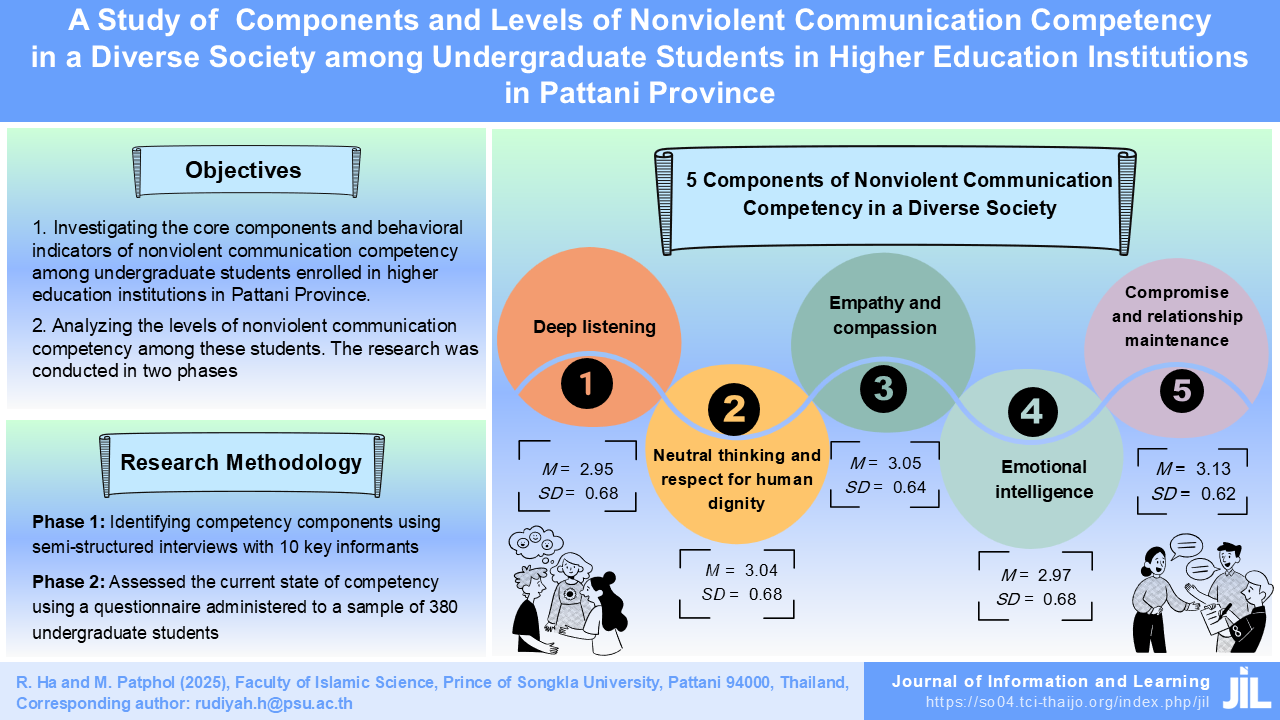
This study employed a mixed-methods research design with the aim of: 1) investigating the core components and behavioral indicators of nonviolent communication competency among undergraduate students enrolled in higher education institutions in Pattani Province, and 2) analyzing the levels of nonviolent communication competency among these students. The research was conducted in two phases. Phase one focused on identifying competency components using semi-structured interviews with ten key informants. Data were analyzed using content analysis. Phase two assessed the current state of competency using a questionnaire administered to a sample of 380 undergraduate students selected through a multistage sampling process. Descriptive statistics were employed for data analysis. The findings revealed five main components: 1) deep listening (seven behavioral indicators), 2) neutral thinking and respect for human dignity (six behavioral indicators), 3) empathy and compassion (six behavioral indicators), 4) emotional intelligence in perception and management (seven behavioral indicators), and 5) compromise and relationship maintenance (seven behavioral indicators). Overall, the level of nonviolent communication competency was relatively high across all the components. Among them, deep listening exhibited the lowest mean score (M = 2.95, SD = 0.68), while compromise and relationship maintenance recorded the highest mean score (M = 3.13, SD = 0.62). The results of this study provide a set of competency components and behavioral indicators aligned with the sociocultural context of the southern border provinces of Thailand. The findings also offer essential insights for the development of learning management programs aimed at enhancing students' nonviolent communication competencies.
References
Alico, J. C., & Guimba, W. D. (2015). Level and causes of pre-university students’ English test anxiety: A case study on Mindanao State University. Research world-Journal of Arts, Science & Commerce, 3(1), 1–10. https://www.researchersworld.com/index.php/rworld/article/view/632
Berlo, D. K. (1960). The Process of communication: An introduction to theory and practice. Holt, Rinehart & Winston.
Bowers, K., & Moffett, N. (2021). Teaching empathy and resilience in higher education: Tools for Compassionate Learning. Routledge.
Burke, K. (2010). Balanced assessment: From formative to summative. Solution Tree Press.
Chotisakulrat, P. (2021). Suea San Sang Santi [Communicating for peace]. (2nd ed.). Institute of Human Rights and Peace Studies, Mahidol University.
Ekwilai, W., Soommat, K., Phansawang, J., & Phongsuwan, R. (2021). Peaceful-Oriented communication for reduction of hate speech abused by Thai youth in the 21st century. Journal of Mahamakut Buddhist University Roi Et Campus, 10(1), 645–655. https://so01.tci-thaijo.org/index.php/AJMBU/article/view/247748
Goleman, D. (1995). Emotional intelligence: Why it can matter more than IQ. Bantam Books.
Guo, W. (2025). Conflict resolution in intercultural communication: Strategies for managing cultural conflicts. Humanities and Social Sciences Communications, 12, Article 73. https://doi.org/10.1057/s41599-025-04391-0
Ha, R., Patphol, M., & Jamjuree, D. (2022). Guidelines for learning management to develop constructive criticism competence in diverse societies for students in the southern border provinces of Thailand. Journal of Graduate Research, 13(1), 13–28. https://so02.tci-thaijo.org/index.php/banditvijai/article/view/251712
Hart, S., & Hodson, V. K. (2006). Respectful parents, respectful kids: 7 keys to turn family conflict into cooperation. PuddleDancer Press.
Imjai, N., Yordudom, T., Usman, B., Swatdikun, T., Meesook, K., & Aujirapongpan, S. (2024). Unlocking accounting student success: The interplay of student activity participation, social skills, and emotional maturity through internships in Thailand. Social Sciences & Humanities Open, 10, Article 100921. https://doi.org/10.1016/j.ssaho.2024.100921
Jamjuree, D. (2023). Kan okbaek kanrianru: Naokhit lae krabuankan [Learning design: Concepts and process]. Graduate School, Srinakharinwirot University.
Jitsaeng, K. (2020). Kan suea san rawang bukkhon: Chak thritsadi su kanprapti [Interpersonal communication: From theory to practice]. Chulalongkorn University.
Julrat, P. (2020). Chitwithaya kan ru khit [Cognitive psychology]. Chulalongkorn University.
Klinkosz, W., Iskra, J., & Artymiak, M. (2021). Interpersonal competences of students, their interpersonal relations, and emotional intelligence. Current Issues in Personality Psychology, 9(2), 125–134. https://doi.org/10.5114/cipp.2021.105733
Kooyai, K., & Nilaphatama, S. (2023). Moral imagination: Roles of creative communication and media for peace in Thailand’s deep south. Conflict and Peace Studies Journal, 2(1), 106–142. https://so07.tci-thaijo.org/index.php/cpsj_psu/article/view/2813
Kundu, V. (2023). Exploring the centrality of nonviolent communication for resolution of conflicts for a culture of peace. CIC. Cuadernos de Información y Comunicación, 28, 37–46. https://doi.org/10.5209/ciyc.88593
McClelland, D. C. (1973). Testing for competence rather than for "Intelligence". American Psychologist, Harvard University, 28(1), 1–14. https://doi.org/10.1037/h0034092
Morin, J., Gill, R., & Leu, L. (2009). Nonviolent communication toolkit for facilitators. Puddle Dancer Press.
Rosenberg, M. (2015). Nonviolent communication (3rd ed.). Puddle Dancer Press.
Sawan, P. S., & Magre, S. (2023). A study of conflict resolution skills and communication skills among degree college students. Educreator Research Journal, 10(6), 46–57. https://doi.org/10.5281/zenodo.10499301
Schwind, J. K., McCay, E., Metersky, K., & Martin, J. (2016). Development and implementation of an advanced therapeutic communication course: An interprofessional collaboration. Journal of Nursing Education, 55(10), 592–597. https://doi.org/10.3928/01484834-20160914-11
Sidhu, S. M. (2022). Introducing nonviolent communication amongst youth of Yemen: An exploration of the impact of the intervention. International Journal of Peace, Education and Development, 10(2), 45–49. https://doi.org/10.30954/2454-9525.02.2022.2
Turner, R. C., & Carlson, L. (2003). Indexes of item-objective congruence for multidimensional items. International Journal of Testing, 3(2), 163–171. https://doi.org/10.1207/S15327574IJT0302_5
Terepyshchyi, S., & Khomenko, H. (2019). Development of methodology for applying nonviolent conflict resolution in academic environments. Future Human Image, 12, 94–103. https://doi.org/10.29202/fhi/12/8
Vazhappilly, J. J., & Reyes, M. E. S. (2017). Non-violent communication and marital relationships: Efficacy of emotion-focused couples' communication program among Filipino Couples. Psychological Studies, 62(3), 275–283. https://doi.org/10.1007/s12646-017-0420-z
Vears, D. F., & Gillam, L. (2021). Inductive content analysis: A guide for beginning qualitative researchers. Focus on Health Professional Education, 23(1), 1–10. https://doi.org/10.11157/fohpe.v23i1.544
Wacker, R., & Dziobek, I. (2018). Preventing empathic distress and social stressors at work through nonviolent communication training: A field study with health professionals. Journal of Occupational Health Psychology, 23(1), 141–150. https://doi.org/10.1037/ocp0000058
Williams, B. A., Simmons, B. A., Ward, M., Beher, J., Dean, A. J., Nou, T., Kenyon, T. M., Davey, M., Melton, C. B., Stewart-Sinclair, P. J., Hammond, N. L., Massingham, E., & Klein, C. J. (2021). The potential for applying “Nonviolent Communication” in conservation science. Conservation Science and Practice, 3(11), Article e540. https://doi.org/10.1111/csp2.540
Yamane, T. (1967). Statistics: An introductory analysis (2nd ed.). Harper and Row.
Zhou, R., Samad, A., & Perinpasingam, T. (2024). A systematic review of cross-cultural communicative competence in EFL teaching: Insights from China. Humanities Social Sciences Communications, 11, Article 1750. https://doi.org/10.1057/s41599-024-04071-5
Downloads
Additional Files
Published
How to Cite
Issue
Section
Categories
License
Copyright (c) 2025 Journal of Information and Learning [JIL]

This work is licensed under a Creative Commons Attribution-NonCommercial-NoDerivatives 4.0 International License.
The Journal of Information and Learning is operated by the Office of Academic Resources, Prince of Songkla University. All articles published in the journal are protected by Thailand copyright law. This copyright covers the exclusive rights to share, reproduce and distribute the article, including in electronic forms, reprints, translations, photographic reproductions, or similar. Authors own copyrights in the works they have created as well as the Office of Academic Resources. The Journal reserves the right to edit the language of papers accepted for publication for clarity and correctness, as well as to make formal changes to ensure compliance with the journal's guidelines. All authors must take public responsibility for the content of their paper.


