
การศึกษาองค์ประกอบและระดับสมรรถนะการสื่อสารไร้ความรุนแรงในสังคมที่หลากหลายของนักศึกษาปริญญาตรีสถาบันอุดมศึกษาจังหวัดปัตตานี
คำสำคัญ:
สมรรถนะ, การสื่อสารไร้ความรุนแรง, นักศึกษาปริญญาตรี, จังหวัดชายแดนใต้บทคัดย่อ
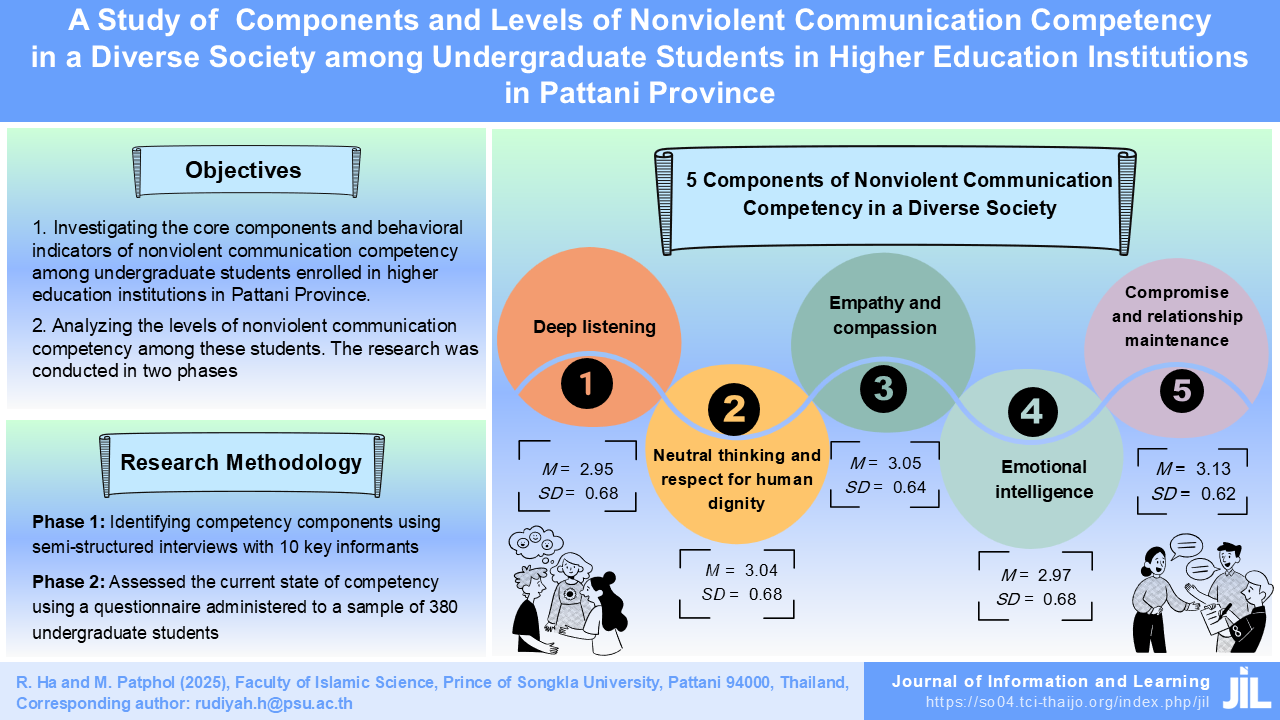
การวิจัยนี้เป็นการวิจัยแบบผสานวิธีมีวัตถุประสงค์เพื่อ 1) ศึกษาองค์ประกอบและพฤติกรรมบ่งชี้สมรรถนะการสื่อสารไร้ความรุนแรงของนักศึกษาระดับปริญญาตรีในสถาบันอุดมศึกษาจังหวัดปัตตานี และ 2) วิเคราะห์ระดับสมรรถนะการสื่อสารไร้ความรุนแรงของนักศึกษาระดับปริญญาตรีในสถาบันอุดมศึกษาจังหวัดปัตตานี โดยแบ่งการวิจัยออกเป็น 2 ระยะ คือ ระยะที่ 1 ศึกษาองค์ประกอบสมรรถนะโดยใช้แบบสัมภาษณ์กึ่งโครงสร้างสัมภาษณ์ผู้ให้ข้อมูลสำคัญ จำนวน 10 คน วิเคราะห์ข้อมูลด้วยวิธีการวิเคราะห์เชิงเนื้อหา และระยะที่ 2 ศึกษาระดับสมรรถนะการสื่อสารไร้ความรุนแรงโดยใช้แบบสอบถาม เก็บข้อมูลจากกลุ่มตัวอย่างนักศึกษาปริญญาตรีในจังหวัดปัตตานี จำนวน 380 คน โดยใช้การสุ่มตัวอย่างแบบหลายขั้นตอน วิเคราะห์ข้อมูลโดยใช้สถิติเชิงบรรยาย ผลการศึกษาพบว่า องค์ประกอบที่ 1 การฟังอย่างลึกซึ้ง (7 พฤติกรรมบ่งชี้) องค์ประกอบที่ 2 การคิดเป็นกลางเคารพในความเป็นมนุษย์ (6 พฤติกรรมบ่งชี้) องค์ประกอบที่ 3 ความเอาใจใส่และเห็นอกเห็นใจ (6 พฤติกรรมบ่งชี้) องค์ประกอบที่ 4 ความฉลาดในการรับรู้และจัดการอารมณ์ (7 พฤติกรรมบ่งชี้) และองค์ประกอบที่ 5 ความประนีประนอมรักษาสัมพันธ์กับผู้คน (7 พฤติกรรมบ่งชี้) โดยผลศึกษาระดับสมรรถนะการสื่อสารไร้ความรุนแรง ในภาพรวมอยู่ในระดับค่อนข้างสูงทุกองค์ประกอบโดยองค์ประกอบที่ 1 การฟังอย่างลึกซึ้ง มีค่าเฉลี่ยพฤติกรรมการแสดงออกน้อยที่สุด (M = 2.95, SD = 0.68) และองค์ประกอบที่ 5 การประนีประนอมรักษาสัมพันธ์กับผู้คนมีค่าเฉลี่ยพฤติกรรมการแสดงออกสูงที่สุด (M = 3.13, SD = 0.62) ผลการวิจัยนี้ได้องค์ประกอบและพฤติกรรมบ่งชี้สมรรถนะที่สอดคล้องกับบริบทชายแดนใต้ ได้ข้อมูลสภาพในปัจจุบันเพื่อไปเป็นแนวทางในการพัฒนาหลักสูตรหรือโปรแกรมการจัดการเรียนรู้ที่เสริมสร้างสมรรถนะการสื่อสารไร้ความรุนแรงต่อไป
เอกสารอ้างอิง
Alico, J. C., & Guimba, W. D. (2015). Level and causes of pre-university students’ English test anxiety: A case study on Mindanao State University. Research world-Journal of Arts, Science & Commerce, 3(1), 1–10. https://www.researchersworld.com/index.php/rworld/article/view/632
Berlo, D. K. (1960). The Process of communication: An introduction to theory and practice. Holt, Rinehart & Winston.
Bowers, K., & Moffett, N. (2021). Teaching empathy and resilience in higher education: Tools for Compassionate Learning. Routledge.
Burke, K. (2010). Balanced assessment: From formative to summative. Solution Tree Press.
Chotisakulrat, P. (2021). Suea San Sang Santi [Communicating for peace]. (2nd ed.). Institute of Human Rights and Peace Studies, Mahidol University.
Ekwilai, W., Soommat, K., Phansawang, J., & Phongsuwan, R. (2021). Peaceful-Oriented communication for reduction of hate speech abused by Thai youth in the 21st century. Journal of Mahamakut Buddhist University Roi Et Campus, 10(1), 645–655. https://so01.tci-thaijo.org/index.php/AJMBU/article/view/247748
Goleman, D. (1995). Emotional intelligence: Why it can matter more than IQ. Bantam Books.
Guo, W. (2025). Conflict resolution in intercultural communication: Strategies for managing cultural conflicts. Humanities and Social Sciences Communications, 12, Article 73. https://doi.org/10.1057/s41599-025-04391-0
Ha, R., Patphol, M., & Jamjuree, D. (2022). Guidelines for learning management to develop constructive criticism competence in diverse societies for students in the southern border provinces of Thailand. Journal of Graduate Research, 13(1), 13–28. https://so02.tci-thaijo.org/index.php/banditvijai/article/view/251712
Hart, S., & Hodson, V. K. (2006). Respectful parents, respectful kids: 7 keys to turn family conflict into cooperation. PuddleDancer Press.
Imjai, N., Yordudom, T., Usman, B., Swatdikun, T., Meesook, K., & Aujirapongpan, S. (2024). Unlocking accounting student success: The interplay of student activity participation, social skills, and emotional maturity through internships in Thailand. Social Sciences & Humanities Open, 10, Article 100921. https://doi.org/10.1016/j.ssaho.2024.100921
Jamjuree, D. (2023). Kan okbaek kanrianru: Naokhit lae krabuankan [Learning design: Concepts and process]. Graduate School, Srinakharinwirot University.
Jitsaeng, K. (2020). Kan suea san rawang bukkhon: Chak thritsadi su kanprapti [Interpersonal communication: From theory to practice]. Chulalongkorn University.
Julrat, P. (2020). Chitwithaya kan ru khit [Cognitive psychology]. Chulalongkorn University.
Klinkosz, W., Iskra, J., & Artymiak, M. (2021). Interpersonal competences of students, their interpersonal relations, and emotional intelligence. Current Issues in Personality Psychology, 9(2), 125–134. https://doi.org/10.5114/cipp.2021.105733
Kooyai, K., & Nilaphatama, S. (2023). Moral imagination: Roles of creative communication and media for peace in Thailand’s deep south. Conflict and Peace Studies Journal, 2(1), 106–142. https://so07.tci-thaijo.org/index.php/cpsj_psu/article/view/2813
Kundu, V. (2023). Exploring the centrality of nonviolent communication for resolution of conflicts for a culture of peace. CIC. Cuadernos de Información y Comunicación, 28, 37–46. https://doi.org/10.5209/ciyc.88593
McClelland, D. C. (1973). Testing for competence rather than for "Intelligence". American Psychologist, Harvard University, 28(1), 1–14. https://doi.org/10.1037/h0034092
Morin, J., Gill, R., & Leu, L. (2009). Nonviolent communication toolkit for facilitators. Puddle Dancer Press.
Rosenberg, M. (2015). Nonviolent communication (3rd ed.). Puddle Dancer Press.
Sawan, P. S., & Magre, S. (2023). A study of conflict resolution skills and communication skills among degree college students. Educreator Research Journal, 10(6), 46–57. https://doi.org/10.5281/zenodo.10499301
Schwind, J. K., McCay, E., Metersky, K., & Martin, J. (2016). Development and implementation of an advanced therapeutic communication course: An interprofessional collaboration. Journal of Nursing Education, 55(10), 592–597. https://doi.org/10.3928/01484834-20160914-11
Sidhu, S. M. (2022). Introducing nonviolent communication amongst youth of Yemen: An exploration of the impact of the intervention. International Journal of Peace, Education and Development, 10(2), 45–49. https://doi.org/10.30954/2454-9525.02.2022.2
Turner, R. C., & Carlson, L. (2003). Indexes of item-objective congruence for multidimensional items. International Journal of Testing, 3(2), 163–171. https://doi.org/10.1207/S15327574IJT0302_5
Terepyshchyi, S., & Khomenko, H. (2019). Development of methodology for applying nonviolent conflict resolution in academic environments. Future Human Image, 12, 94–103. https://doi.org/10.29202/fhi/12/8
Vazhappilly, J. J., & Reyes, M. E. S. (2017). Non-violent communication and marital relationships: Efficacy of emotion-focused couples' communication program among Filipino Couples. Psychological Studies, 62(3), 275–283. https://doi.org/10.1007/s12646-017-0420-z
Vears, D. F., & Gillam, L. (2021). Inductive content analysis: A guide for beginning qualitative researchers. Focus on Health Professional Education, 23(1), 1–10. https://doi.org/10.11157/fohpe.v23i1.544
Wacker, R., & Dziobek, I. (2018). Preventing empathic distress and social stressors at work through nonviolent communication training: A field study with health professionals. Journal of Occupational Health Psychology, 23(1), 141–150. https://doi.org/10.1037/ocp0000058
Williams, B. A., Simmons, B. A., Ward, M., Beher, J., Dean, A. J., Nou, T., Kenyon, T. M., Davey, M., Melton, C. B., Stewart-Sinclair, P. J., Hammond, N. L., Massingham, E., & Klein, C. J. (2021). The potential for applying “Nonviolent Communication” in conservation science. Conservation Science and Practice, 3(11), Article e540. https://doi.org/10.1111/csp2.540
Yamane, T. (1967). Statistics: An introductory analysis (2nd ed.). Harper and Row.
Zhou, R., Samad, A., & Perinpasingam, T. (2024). A systematic review of cross-cultural communicative competence in EFL teaching: Insights from China. Humanities Social Sciences Communications, 11, Article 1750. https://doi.org/10.1057/s41599-024-04071-5
ดาวน์โหลด
ไฟล์ประกอบ
เผยแพร่แล้ว
รูปแบบการอ้างอิง
ฉบับ
ประเภทบทความ
หมวดหมู่
สัญญาอนุญาต
ลิขสิทธิ์ (c) 2025 Journal of Information and Learning [JIL]

อนุญาตภายใต้เงื่อนไข Creative Commons Attribution-NonCommercial-NoDerivatives 4.0 International License.
Journal of Information and Learning ดำเนินการโดยสำนักวิทยบริการ มหาวิทยาลัยสงขลานครินทร์ วิทยาเขตปัตตานี บทความที่ได้รับการตีพิมพ์ในวารสารได้รับความคุ้มครองตามกฎหมายลิขสิทธิ์ โดยเจ้าของลิขสิทธิ์จะมีสิทธิในการทำซ้ำ ดัดแปลง และเผยแพร่งานบทความ ทั้งรูปแบบอิเล็กทรอนิกส์ การทำฉบับสำเนา การแปล และการผลิตซ้ำในรูปแบบต่างๆ ลิขสิทธิ์บทความเป็นของผู้เขียนและสำนักวิทยบริการ มหาวิทยาลัยสงขลานครินทร์ วิทยาเขตปัตตานี วารสารฯ ขอสงวนสิทธิ์ในการพิจารณาตีพิมพ์ตามความเหมาะสม รวมทั้งการตรวจทานแก้ไข การปรับข้อความ หรือขัดเกลาภาษาให้ถูกต้องตามเกณฑ์ที่กำหนด สำหรับผลการวิจัยและความคิดเห็นที่ปรากฏในบทความถือเป็นความคิดเห็นและอยู่ในความรับผิดชอบของผู้เขียน


