
Factors Influencing User Satisfaction and Operational Efficiency of the Prince of Songkla University Management Accounting System (PSU MAS): Perspectives from Financial and Accounting Officers at Prince of Songkla University
Keywords:
PSU MAS, user satisfaction, operational efficiency, U-DO, GROW–WISEAbstract
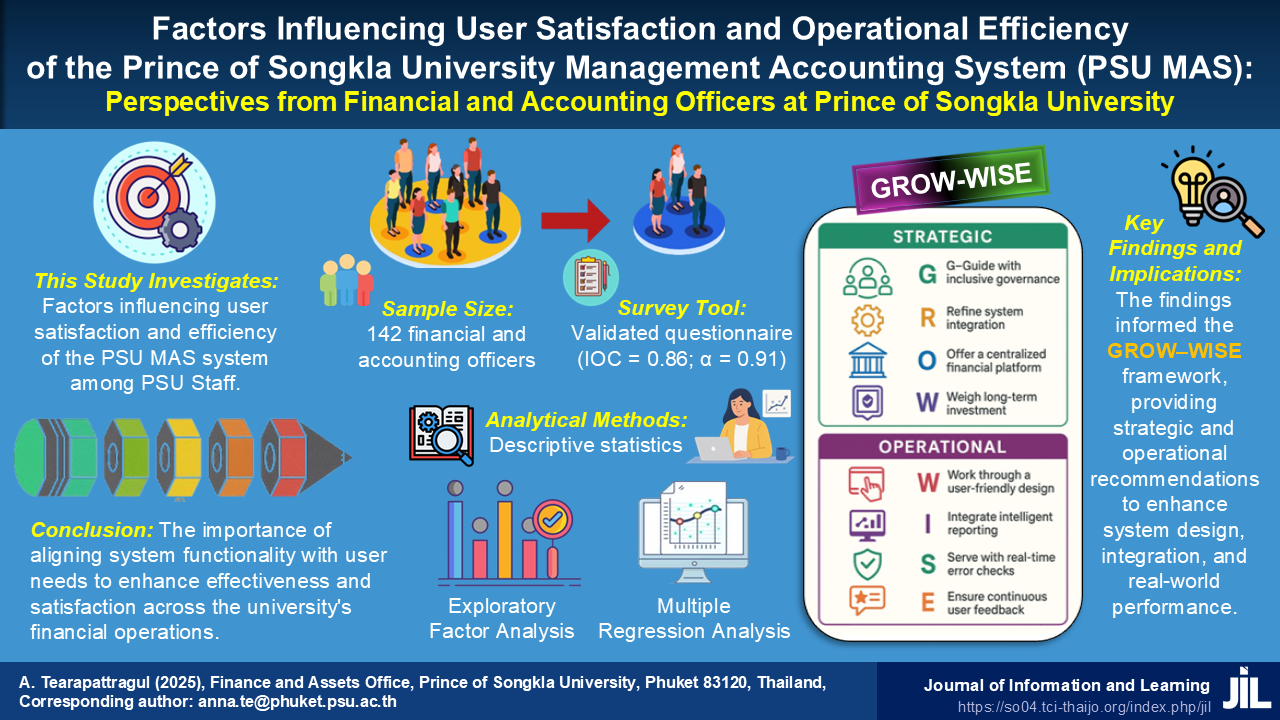
This study aims to examine the factors influencing user satisfaction and operational efficiency of the PSU MAS from the perspectives of financial and accounting officers at Prince of Songkla University. A quantitative approach using survey research was employed. The sample consisted of 142 financial and accounting officers from five campuses. The research instrument was a questionnaire validated by experts (IOC = 0.86) and demonstrated high reliability (Cronbach's alpha = 0.91). Data were analyzed using Exploratory Factor Analysis (EFA) and Multiple Regression Analysis. The findings revealed three key factors affecting system performance: decision support capability, data accuracy, and operational error checking. Among these, decision support capability had the most significant influence on system efficiency. These findings were interpreted through the U-DO framework, which emphasizes user-centered evaluation, decision support functionality, and operational error management, highlighting the practical needs of end users in the university context. Based on the results, strategic and operational recommendations were developed under the GROW–WISE framework. The GROW component offers university-level strategic guidance, including inclusive governance, system integration, centralized financial platforms, and long-term investments. The WISE component focuses on operational-level improvements, such as user-friendly interface design, intelligent reporting, real-time error checking, and continuous user feedback. These insights have practical implications for enhancing PSU MAS to better align with real-world usage and strengthen its role as a strategic decision-making tool for higher education institutions in Thailand.
References
Aboagye-Otchere, F., Nartey, E., Enusah, A., & Aboagye, A. A. (2023). Do accountants' participation in accounting information systems design enhance perceived accounting information quality: Evidence from Ghana. The Electronic Journal of Information Systems in Developing Countries, 89(5), Article e12269. https://doi.org/10.1002/isd2.12269
Al-Hiyari, A., Al-Mashregy, M. H. H., Mat, N. K., & Alekam, J. M. (2013). Factors that affect accounting information system implementation and accounting information quality: A survey in University Utara Malaysia. American Journal of Economics, 3(1), 27–31. http://article.sapub.org/10.5923.j.economics.20130301.06.html
Alhumoudi, H., & Johri, A. (2024). Examining the role of accounting information systems on a firm’s performance: A technology acceptance model approach. Edelweiss Applied Science and Technology, 8(5), 1831–1842. https://doi.org/10.55214/25768484.v8i5.1917
Al-Okaily, M., Al-Kofahi, M., Shiyyab, F. S., & Al-Okaily, A. (2025). Determinants of user satisfaction with financial information systems in the digital transformation era: Insights from emerging markets. Global Knowledge, Memory and Communication, 74(3-4), 1171–1190. https://doi.org/10.1108/GKMC-12-2022-0285
Al-Okaily, M. (2024). Assessing the effectiveness of accounting information systems in the era of COVID-19 pandemic. VINE Journal of Information and Knowledge Management Systems, 54(1), 157–175. https://doi.org/10.1108/VJIKMS-08-2021-0148
Al-Sammarraee, A., & Alshareeda, N. (2021). The role of artificial intelligence by using automatic accounting information system in supporting the quality of financial statement. Information Sciences Letters, 10(2), 223–254. https://digitalcommons.aaru.edu.jo/isl/vol10/iss2/8
Andini, N. A. M., Dellia, P., Ferdiansyah, F., Ghaffar, A., & Rohimah, S. (2024). Analysis of user satisfaction with the Dana application using the technology acceptance model (TAM) method. Journal of Artificial Intelligence and Engineering Applications (Ioinformatic), 3(3), 824–828. https://doi.org/10.59934/jaiea.v3i3.519
Anggraeni, A. F., Priatna, D. K., Roswinna, W., & Zai, E. (2023). How to increase the quality of accounting information system and accounting information quality in Bandung’s higher educations? Greenation International Journal of Economics and Accounting, 1(3), 294–308. https://doi.org/10.38035/gijea.v1i3.81
Ariestya, R. I., & Purwanda, E. (2024). Pengaruh TAM dan perceived enjoyment terhadap kepuasan dan loyalitas siswa kepada LMS SMP Juara Bandung. Jurnal Ilmiah Ilmu Pendidikan, 7(10), 11571–11578. https://doi.org/10.54371/jiip.v7i10.6015
Davis, F. D. (1989). Perceived usefulness, perceived ease of use, and user acceptance of information technology. MIS Quarterly, 13(3), 319–340. https://doi.org/10.2307/249008
DeLone, W. H. & McLean, E. R. (2003). The DeLone and McLean Model of information systems success: A ten-year update. Journal of Management Information Systems, 19(4), 9–30. https://doi.org/10.1080/07421222.2003.11045748
Ganyam, A. I., & Ivungu, J. A. (2019). Effect of accounting information system on financial performance of firms: A review of literature. Journal of Business and Management, 21(5), 39–49. https://www.iosrjournals.org/iosr-jbm/papers/Vol21-issue5/Series-7/F2105073949.pdf
Görgens, M., & Kusek, J. Z. (2009). Making monitoring and evaluation systems work: A capacity development toolkit. World Bank. https://documents1.worldbank.org/curated/en/708391468331216900/pdf/533030PUB0moni101Official0Use0Only1.pdf
Horngren, C. T., Datar, S. M., & Rajan, M. V. (2014). Cost accounting: A managerial emphasis (15th ed.). Pearson.
Kalankesh, L. R., Nasiry, Z., Fein, R. A., & Damanabi, S. (2020). Factors influencing user satisfaction with information systems: A systematic review. Galen Medical Journal, 9, Article e1686. https://pmc.ncbi.nlm.nih.gov/articles/PMC8343607
Karthikeyan, M. V., & Saraswathy, C. (2024). A study on impact of accounting information system in financial performance. ComFin Research, 12(Special Issue 1), 33–38. https://doi.org/10.34293/commerce.v12iS1-May.7806
Klungthong, S., Chaisiripaibool, S., & Chotipurk, A. (2020). Causal factors, for accounting data quality, Accounting information system quality, e-services quality, Perceived value of e-accounting, and user satisfaction of e-accounting affecting the efficiency ofe-accounting for small and medium enterprises (SMEs) in Thailand. Journal of Accountancy and Management Mahasarakham Business School, Mahasarakham University, 12(2), 100–116. https://so02.tci-thaijo.org/index.php/mbs/article/view/224496
Lestari, A. W., Mukti, A. H., & Christiningrum, M. F. (2023). The effect of information system quality, perceived usability, and information quality on user satisfaction of finance management system (FMS) applications. Basic and Applied Accounting Research Journal, 3(1), 5–11. https://www.baarjournal.org/index.php/baarj/article/view/24
Mahidol University. (2020). Recording accounting entries in the MU-ERP system. Finance Division, Mahidol University. https://op.mahidol.ac.th/fa/wp-admin/all_doc/training_doc/การบันทึกรายการบัญชีในระบบ%20MU-ERP.pdf
Muqorobin, M. (2021). Analysis of fee accounting information systems lecture at ITB AAS Indonesia in the pandemic time of COVID-19. International Journal of Economics, Business and Accounting Research, 5(3), 1994–2007. https://jurnal.stie-aas.ac.id/index.php/IJEBAR/article/view/2358
Nuanlert, W. (2021). Satisfaction with the use of the PSU Management Accounting System (PSU-MAS) payment system of personnel of the finance division, Prince of Songkla University. Journal of PACMU, 10(3), 195–203. https://www.council-uast.com/journal/dl-file.php?id=244
Patchruch, S. (2022). User satisfaction in using the Prince of Songkla Management Accounting System for cash receipts and funds transmittals. Journal of PACMU, 10(3), 88–95. https://council-uast.com/journal/dl-file.php?id=330
Radzi, S. N. J. M., Shabri, S. M., Asari, N. H. A. H., Rani, M. J. A., Kasim, A. N. C., & Shaari, M. S. (2024). Accounting information system usefulness for effective performance of small and medium-sized enterprises. International Journal of Business and Technology, 14(2), 161–172. https://doi.org/10.58915/ijbt.v14i2.607
Rovinelli, R. J., & Hambleton, R. K. (1977). On the use of content specialists in the assessment of criterion-referenced test item validity. Tijdschrift voor Onderwijsresearch, 2(2), 49–60. https://objects.library.uu.nl/reader/index.php?obj=1874-208332
Rukrod, S., Leakpai, K., & Krongten. M. (2024). The influence of accounting skills and digital accounting systems on the work efficiency of accountants in the upper southern region. Journal of Roi Kaensarn Academi, 9(12), 687–703. https://so02.tci-thaijo.org/index.php/JRKSA/article/view/271190
Sanguanhong, A., & Mokkhavesa. B. (2021). Financial and accounting management that affects operational efficiency of finance and accounting personnel under the Ministry of Commerce. Journal of Multidisciplinary in Humanities and Social Sciences, 4(3), 1013–1026. https://so04.tci-thaijo.org/index.php/jmhs1_s/article/view/253230
Saosawang, S. (2017). The study of financial and accounting performance of the Faculty of Mass Communication Technology, Rajamangala University of Technology Thanyaburi. Rajamangala University of Technology Thanyaburi.
Siagian, G. A. J. (2024). The effect of implementing accounting information systems on company operational efficiency. The American Journal of Interdisciplinary Innovations and Research, (Special Issue) 36–45. https://doi.org/10.37547/tajiir/NICSPEEP-2024-01-04
Silpakorn University. (2017). SU-ERP implementation 4-10 October 2017 SAP AP overview training. https://www.su.ac.th/th/su_erp/pdf/SU_AP_Overview_Training_vF_Final.pdf
Sudinpreeda, H. (2020). Problems and obstacles of the application of accounting software package for the cooperative education program [Conference proceeding]. The 13th Hat Yai National and International Conference, 2789–2802. https://www.hu.ac.th/Conference/conference2022/proceedings/doc/Proceeding%20HU%20Conference13.pdf
Thammasorn, D., & Sripaisanlert, P. (2018). Work manual: Process of creating vendor master data in the CU-ERP system. Finance and Supplies Division, Faculty of Arts, Chulalongkorn University. https://www.arts.chula.ac.th/doc/duanghathai_pongsri_manual_2561.pdf
Widodo, D. M., Sutrisno, T., & Baridwan, Z. (2023). Financial information system user satisfaction and its impact on organizational performance: Modified information system success model. International Journal of Business, Economics and Management, 6(2), 134–147. https://doi.org/10.21744/ijbem.v6n2.2137
Wakum, I. Y., Ramadanis, T., & Supratikta, H. (2024). Implementation of financial management accounting information system. Multidisciplinary Indonesian Center Journal, 1(3), 1248–1253. https://doi.org/10.62567/micjo.v1i3.148
W. K. Kellogg Foundation. (2004). Logic model development guide. https://wkkf.issuelab.org/resource/logic-model-development-guide.html
Yamane, T. (1973). Statistics: An introductory analysis (3rd ed.). Harper & Row.
Zohry, A. F., & Al-Dhubaibi, A. A. S. (2024). Optimizing business performance through effective accounting information systems: The role of system competence and information quality. Journal of Risk and Financial Management, 17(11), Article 515. https://doi.org/10.3390/jrfm17110515
Downloads
Additional Files
Published
How to Cite
Issue
Section
Categories
License
Copyright (c) 2025 Journal of Information and Learning [JIL]

This work is licensed under a Creative Commons Attribution-NonCommercial-NoDerivatives 4.0 International License.
Free access to published articles. Current licensing policy: CC BY-NC 4.0 from Volume 37, Issue 2 (2026). For earlier articles, consult the rights information on the individual article page. See our Open Access, Copyright and Licensing policy.


