
The Development of Critical Thinking of Grade 9 Students Learning With Constructivist Web Based Learning Environment Integrated With Artificial Intelligence in Computing Science
Keywords:
critical thinking, web-based learning environment, constructivist theory, artificial intelligenceAbstract
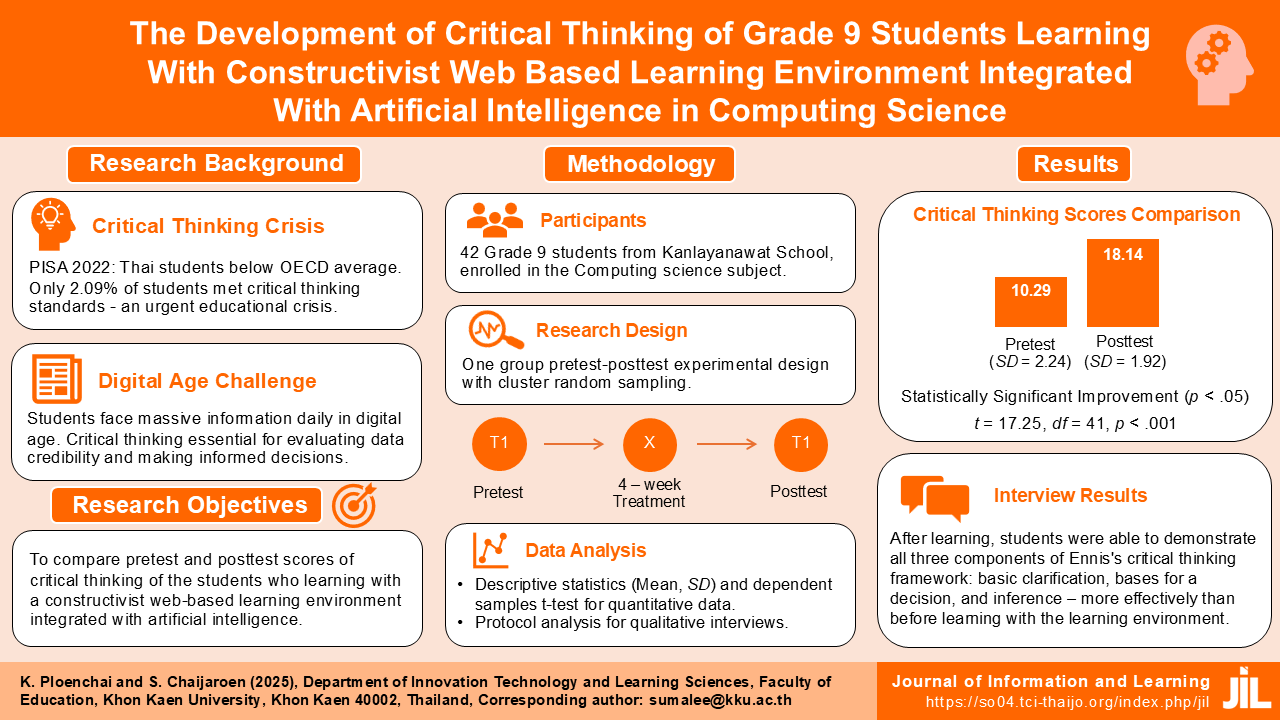
Critical thinking is of great importance in today's world. This study aimed to compare critical thinking of students before and after learning in a constructivist web-based learning environment integrated with artificial intelligence designed to enhance critical thinking. The sample group consisted of 42 grade 9 students enrolling in the computing science subject in the second semester of the academic year 2024 at Kanlayanawat school, Mueang Khon Kaen district, Khon Kaen province, which were selected by cluster random sampling. One group pretest-posttest design was employed in this study. The research instruments included a constructivist web-based learning environment integrated with AI to enhance critical thinking, a critical thinking test, and an interview form for students. Descriptive statistics, mean, standard deviation, and inferential statistics, dependent samples t-test were used to analyze data. The results revealed as follows: 1) The comparison of pretest and posttest scores of critical thinking of the students showed that posttest scores were significantly higher than pretest scores at the .05 level. 2) The comparison of the students’ critical thinking based on the interviews indicated that after learning in the organized learning environment, students were able to demonstrate all three main components of critical thinking – basic clarification, bases for decision making, and inference – more effectively than before learning in the provided environment.
References
Buckle, J. (2024, July 17). A comprehensive guide to 21st century skills. Panorama Education. https://www.panoramaed.com/blog/comprehensive-guide-21st-century-skills
Chaijaroen, S. (Ed.). (2016). Instructional design: Principles and theories to practices (2nd ed.). Penprinting.
Changwong, K., Sukkamart, A., & Sisan, B. (2018). Critical thinking skill development: Analysis of a new learning-management model for Thai high schools. Journal of International Studies, 11(2), 37–48. https://doi.org/10.14254/2071-8330.2018/11-2/3
Ennis, R. H. (2011). Critical thinking: Reflection and perspective. Inquiry: Critical Thinking Across the Disciplines, 26(1), 4–18. https://doi.org/10.5840/inquiryctnews20112613
Giannakos, M., Azevedo, R., Brusilovsky, P., Cukurova, M., Dimitriadis, Y., & Hernandez-Leo, D. (2024). The promise and challenges of generative AI in education. Behaviour & Information Technology, 44(11), 2518–2544. https://doi.org/10.1080/0144929X.2024.2394886
Komany, K., & Chaijaroen, S. (2023). Designing and development of constructivist learning environment model to enhance creative thinking and creative expression of science for medical graphic design. Journal of Education Khon Kaen University, 46(2), 88–107. https://so02.tci-thaijo.org/index.php/EDKKUJ/article/view/262460
Kuhail, M. A., Alturki, N., Alramlawi, S., & Alhejori, K. (2023). Interacting with educational chatbots: A systematic review. Education and Information Technologies, 28, 973–1018. https://doi.org/10.1007/s10639-022-11177-3
Labadze, L., Grigolia, M., & Machaidze, L. (2023). Role of AI chatbots in education: Systematic literature review. International Journal of Educational Technology in Higher Education, 20, Article 56. https://doi.org/10.1186/s41239-023-00426-1
Le, H. V., & Nguyen, L. Q. (2024). Promoting L2 learners' critical thinking skills: The role of social constructivism in reading class. Frontiers in Education, 9, Article 1241973. https://doi.org/10.3389/feduc.2024.1241973
Lertdechapat, K., Faikhamta, C., & Ketsing, J. (2022). Assessment of critical thinking skills of lower secondary students. Journal of Education Naresuan University, 24(1), 56–65. https://so06.tci-thaijo.org/index.php/edujournal_nu/article/view/193217
Lohamat, J., & Samat, C. (2018). The effect of constructivist knowledge construction packages to enhance the critical thinking on topic health care for diabetes patients. Journal of Education Graduate Studies Research, 12(2), 21–32. https://so02.tci-thaijo.org/index.php/EDGKKUJ/article/view/242772
McGrath, C., Farazouli, A., & Cerratto-Pargman, T. (2024). Generative AI chatbots in higher education: A review of an emerging research area. Higher Education, 89, 1533–1549. https://doi.org/10.1007/s10734-024-01288-w
Nunthaitaweekul, P., Chaijaroen, S., & Gamlunglert, R. (2023). Development of constructivist web based learning environment model to enhance critical thinking: Integration between pedagogy and neuroscience topic on everyday substance for Grade 6 students. Journal of Education Khon Kaen University, 16(1), 15–31. https://so02.tci-thaijo.org/index.php/EDGKKUJ/article/view/261184
Organisation for Economic Co-operation and Development. (2021). 21st-century readers: Developing literacy skills in a digital world. OECD Publishing. https://doi.org/10.1787/a83d84cb-en
Organisation for Economic Co-operation and Development. (2023). PISA 2022 results (Volume I): The state of learning and equity in education. OECD Publishing. https://doi.org/10.1787/53f23881-en
Panich, V. (2017). Withī sā ngō̜kān rīanrū phư̄a sit nai satawat thī yīsipʻet [Ways to create learning for students in the 21st century]. Walailak Journal of Learning Innovations, 1(2), 3–14. https://so03.tci-thaijo.org/index.php/jliwu/article/view/95054
Sadoo, S., Nandapañño, P. S., Theerangkuro, P. W., Uthaisa, P., & Tenissara, S. (2023). Developing critical thinking skills through social studies education in Thai classrooms. Journal of Buddhist Education and Research, 9(1), 375–383. https://so06.tci-thaijo.org/index.php/jber/article/view/278749
Saengmala, N., Charoensap, T., Uesakchai, S., & Musikacharoen, V. (2024). The trend of critical thinking. Journal of Roi Kaensarn Academi, 9(4), 838–853. https://so02.tci-thaijo.org/index.php/JRKSA/article/view/266706
Saiyot, L., & Saiyot, A. (1995). Theknik kānwičhai thāngkān sưksā [Educational research techniques] (5th ed.). Suweerivasarn.
Santos-Meneses, L. F., & Drugova, E. A. (2023). Trends in critical thinking instruction in 21st-century research and practice: Upgrading instruction in digital environments. Thinking Skills and Creativity, 49, Article 101383. https://doi.org/10.1016/j.tsc.2023.101383
Schei, O. M., Møgelvang, A., & Ludvigsen, K. (2024). Perceptions and use of AI chatbots among students in higher education: A scoping review of empirical studies. Education Sciences, 14(8), Article 922. https://doi.org/10.3390/educsci14080922
Suwannari, J. (2016). The effect of multimedia learning environment to enhance critical thinking on title label food and health products for grade 4 students. Journal of Education Graduate Studies Research, 11(2), 22–30. https://so02.tci-thaijo.org/index.php/EDGKKUJ/article/view/113101
Tempornsin, J., Chaichroen, S., & Somabut, A. (2023). The development of web-based learning environment model based on constructivist theory to enhance digital literacy for higher education students. Journal of Education Khon Kaen University, 46(2), 1–18. https://so02.tci-thaijo.org/index.php/EDKKUJ/article/view/260804
UNESCO. (2025, April 12). Media and information literacy and digital competencies. https://www.unesco.org/en/articles/media-and-information-literacy-and-digital-competencies
Vincent-Lancrin, S. (2021). Skills for life: Fostering critical thinking. Inter-American Development Bank. https://doi.org/10.18235/0003743
Yalcinalp, S., Türkoğlu, H., Koç, S. E., & Ersoy, H. (2024). Utilization of artificial intelligence in education: A perspective on learning strategies. In S. Kadry (Ed.), Artificial intelligence and education-Shaping the future of learning. IntechOpen. https://doi.org/10.5772/intechopen.1005086
Downloads
Additional Files
Published
How to Cite
Issue
Section
Categories
License
Copyright (c) 2025 Journal of Information and Learning [JIL]

This work is licensed under a Creative Commons Attribution-NonCommercial-NoDerivatives 4.0 International License.
The Journal of Information and Learning is operated by the Office of Academic Resources, Prince of Songkla University. All articles published in the journal are protected by Thailand copyright law. This copyright covers the exclusive rights to share, reproduce and distribute the article, including in electronic forms, reprints, translations, photographic reproductions, or similar. Authors own copyrights in the works they have created as well as the Office of Academic Resources. The Journal reserves the right to edit the language of papers accepted for publication for clarity and correctness, as well as to make formal changes to ensure compliance with the journal's guidelines. All authors must take public responsibility for the content of their paper.


