
การพัฒนาการคิดอย่างมีวิจารณญาณของผู้เรียนที่เรียนด้วยสิ่งแวดล้อมทางการเรียนรู้บนเครือข่ายตามแนวทฤษฎีคอนสตรัคติวิสต์ที่บูรณาการปัญญาประดิษฐ์ในรายวิชาวิทยาการคำนวณ สำหรับนักเรียนชั้นมัธยมศึกษาปีที่ 3
คำสำคัญ:
การคิดอย่างมีวิจารณญาณ, สิ่งแวดล้อมทางการเรียนรู้บนเครือข่าย, ทฤษฎีคอนสตรัคติวิสต์, ปัญญาประดิษฐ์บทคัดย่อ
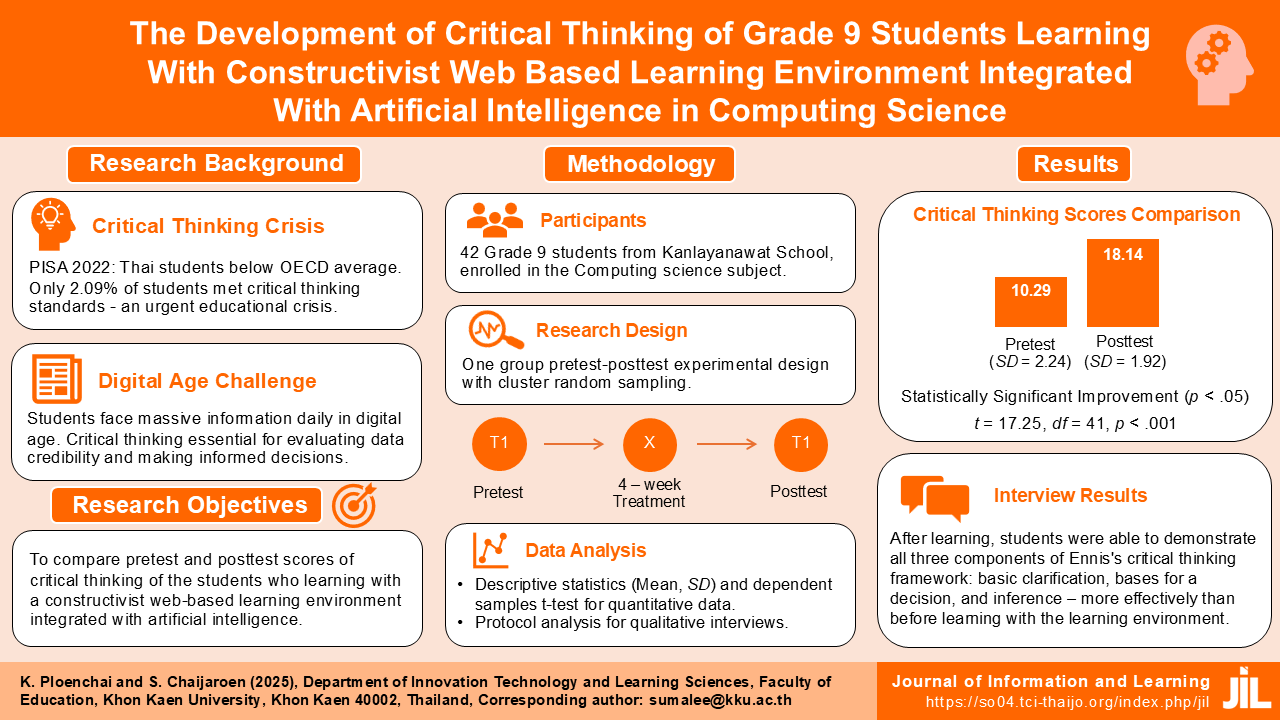
การคิดอย่างมีวิจารณญาณมีความสำคัญเป็นอย่างมากในปัจจุบัน การศึกษาครั้งนี้มีวัตถุประสงค์เพื่อเปรียบเทียบการคิดอย่างมีวิจารณญาณของผู้เรียนก่อนเรียนและหลังเรียนด้วยสิ่งแวดล้อมทางการเรียนรู้บนเครือข่ายตามแนวทฤษฎีคอนสตรัคติวิสต์ที่บูรณาการปัญญาประดิษฐ์เพื่อส่งเสริมการคิดอย่างมีวิจารณญาณฯ กลุ่มตัวอย่างที่ใช้ในการศึกษาครั้งนี้เป็นนักเรียนชั้นมัธยมศึกษาปีที่ 3 จำนวน 42 คน ที่เรียนในรายวิชาวิทยาการคำนวณ ในภาคเรียนที่ 2 ปีการศึกษา 2567 โรงเรียนกัลยาณวัตร อำเภอเมืองขอนแก่น จังหวัดขอนแก่น ซึ่งได้มาจากการสุ่มตัวอย่างแบบกลุ่ม จำนวน 1 ห้องเรียน รูปแบบการวิจัยที่ใช้ในการศึกษาครั้งนี้ คือ การวิจัยเชิงทดลองแบบกลุ่มเดียว ที่มีการทดสอบก่อนและหลังเรียน เครื่องมือที่ใช้ในการวิจัย ประกอบด้วย สิ่งแวดล้อมทางการเรียนรู้บนเครือข่ายตามแนวทฤษฎีคอนสตรัคติวิสต์ที่บูรณาการปัญญาประดิษฐ์เพื่อส่งเสริมการคิดอย่างมีวิจารณญาณฯ แบบวัดการคิดอย่างมีวิจารณญาณ และแบบสัมภาษณ์ผู้เรียนเกี่ยวกับการคิดอย่างมีวิจารณญาณ สถิติที่ใช้ในการวิเคราะห์ข้อมูล คือ ค่าเฉลี่ย ค่าเบี่ยงเบนมาตรฐานและการทดสอบค่าทีแบบกลุ่มตัวอย่างที่สัมพันธ์กันผลการวิจัย 1) ผลการเปรียบเทียบการคิดอย่างมีวิจารณญาณของผู้เรียนที่ได้จากการทำแบบวัดการคิดอย่างมีวิจารณญาณ พบว่า ค่าคะแนนหลังเรียน (M = 18.14, SD = 1.92) สูงกว่าก่อนเรียน (M = 10.29, SD = 2.24) อย่างมีนัยสำคัญทางสถิติที่ระดับ .05 2) ผลการเปรียบเทียบการคิดอย่างมีวิจารณญาณที่ได้จากการสัมภาษณ์ผู้เรียน พบว่า หลังเรียนผู้เรียนสามารถคิดอย่างมีวิจารณญาณได้ครบทั้ง 3 องค์ประกอบหลัก คือ การทำให้กระจ่างขั้นพื้นฐาน พื้นฐานสำหรับการตัดสินใจ และการอ้างอิงเพื่อนำไปสู่ข้อสรุป มากกว่าก่อนเรียนด้วยสิ่งแวดล้อมทางการเรียนรู้ฯ
เอกสารอ้างอิง
Buckle, J. (2024, July 17). A comprehensive guide to 21st century skills. Panorama Education. https://www.panoramaed.com/blog/comprehensive-guide-21st-century-skills
Chaijaroen, S. (Ed.). (2016). Instructional design: Principles and theories to practices (2nd ed.). Penprinting.
Changwong, K., Sukkamart, A., & Sisan, B. (2018). Critical thinking skill development: Analysis of a new learning-management model for Thai high schools. Journal of International Studies, 11(2), 37–48. https://doi.org/10.14254/2071-8330.2018/11-2/3
Ennis, R. H. (2011). Critical thinking: Reflection and perspective. Inquiry: Critical Thinking Across the Disciplines, 26(1), 4–18. https://doi.org/10.5840/inquiryctnews20112613
Giannakos, M., Azevedo, R., Brusilovsky, P., Cukurova, M., Dimitriadis, Y., & Hernandez-Leo, D. (2024). The promise and challenges of generative AI in education. Behaviour & Information Technology, 44(11), 2518–2544. https://doi.org/10.1080/0144929X.2024.2394886
Komany, K., & Chaijaroen, S. (2023). Designing and development of constructivist learning environment model to enhance creative thinking and creative expression of science for medical graphic design. Journal of Education Khon Kaen University, 46(2), 88–107. https://so02.tci-thaijo.org/index.php/EDKKUJ/article/view/262460
Kuhail, M. A., Alturki, N., Alramlawi, S., & Alhejori, K. (2023). Interacting with educational chatbots: A systematic review. Education and Information Technologies, 28, 973–1018. https://doi.org/10.1007/s10639-022-11177-3
Labadze, L., Grigolia, M., & Machaidze, L. (2023). Role of AI chatbots in education: Systematic literature review. International Journal of Educational Technology in Higher Education, 20, Article 56. https://doi.org/10.1186/s41239-023-00426-1
Le, H. V., & Nguyen, L. Q. (2024). Promoting L2 learners' critical thinking skills: The role of social constructivism in reading class. Frontiers in Education, 9, Article 1241973. https://doi.org/10.3389/feduc.2024.1241973
Lertdechapat, K., Faikhamta, C., & Ketsing, J. (2022). Assessment of critical thinking skills of lower secondary students. Journal of Education Naresuan University, 24(1), 56–65. https://so06.tci-thaijo.org/index.php/edujournal_nu/article/view/193217
Lohamat, J., & Samat, C. (2018). The effect of constructivist knowledge construction packages to enhance the critical thinking on topic health care for diabetes patients. Journal of Education Graduate Studies Research, 12(2), 21–32. https://so02.tci-thaijo.org/index.php/EDGKKUJ/article/view/242772
McGrath, C., Farazouli, A., & Cerratto-Pargman, T. (2024). Generative AI chatbots in higher education: A review of an emerging research area. Higher Education, 89, 1533–1549. https://doi.org/10.1007/s10734-024-01288-w
Nunthaitaweekul, P., Chaijaroen, S., & Gamlunglert, R. (2023). Development of constructivist web based learning environment model to enhance critical thinking: Integration between pedagogy and neuroscience topic on everyday substance for Grade 6 students. Journal of Education Khon Kaen University, 16(1), 15–31. https://so02.tci-thaijo.org/index.php/EDGKKUJ/article/view/261184
Organisation for Economic Co-operation and Development. (2021). 21st-century readers: Developing literacy skills in a digital world. OECD Publishing. https://doi.org/10.1787/a83d84cb-en
Organisation for Economic Co-operation and Development. (2023). PISA 2022 results (Volume I): The state of learning and equity in education. OECD Publishing. https://doi.org/10.1787/53f23881-en
Panich, V. (2017). Withī sā ngō̜kān rīanrū phư̄a sit nai satawat thī yīsipʻet [Ways to create learning for students in the 21st century]. Walailak Journal of Learning Innovations, 1(2), 3–14. https://so03.tci-thaijo.org/index.php/jliwu/article/view/95054
Sadoo, S., Nandapañño, P. S., Theerangkuro, P. W., Uthaisa, P., & Tenissara, S. (2023). Developing critical thinking skills through social studies education in Thai classrooms. Journal of Buddhist Education and Research, 9(1), 375–383. https://so06.tci-thaijo.org/index.php/jber/article/view/278749
Saengmala, N., Charoensap, T., Uesakchai, S., & Musikacharoen, V. (2024). The trend of critical thinking. Journal of Roi Kaensarn Academi, 9(4), 838–853. https://so02.tci-thaijo.org/index.php/JRKSA/article/view/266706
Saiyot, L., & Saiyot, A. (1995). Theknik kānwičhai thāngkān sưksā [Educational research techniques] (5th ed.). Suweerivasarn.
Santos-Meneses, L. F., & Drugova, E. A. (2023). Trends in critical thinking instruction in 21st-century research and practice: Upgrading instruction in digital environments. Thinking Skills and Creativity, 49, Article 101383. https://doi.org/10.1016/j.tsc.2023.101383
Schei, O. M., Møgelvang, A., & Ludvigsen, K. (2024). Perceptions and use of AI chatbots among students in higher education: A scoping review of empirical studies. Education Sciences, 14(8), Article 922. https://doi.org/10.3390/educsci14080922
Suwannari, J. (2016). The effect of multimedia learning environment to enhance critical thinking on title label food and health products for grade 4 students. Journal of Education Graduate Studies Research, 11(2), 22–30. https://so02.tci-thaijo.org/index.php/EDGKKUJ/article/view/113101
Tempornsin, J., Chaichroen, S., & Somabut, A. (2023). The development of web-based learning environment model based on constructivist theory to enhance digital literacy for higher education students. Journal of Education Khon Kaen University, 46(2), 1–18. https://so02.tci-thaijo.org/index.php/EDKKUJ/article/view/260804
UNESCO. (2025, April 12). Media and information literacy and digital competencies. https://www.unesco.org/en/articles/media-and-information-literacy-and-digital-competencies
Vincent-Lancrin, S. (2021). Skills for life: Fostering critical thinking. Inter-American Development Bank. https://doi.org/10.18235/0003743
Yalcinalp, S., Türkoğlu, H., Koç, S. E., & Ersoy, H. (2024). Utilization of artificial intelligence in education: A perspective on learning strategies. In S. Kadry (Ed.), Artificial intelligence and education-Shaping the future of learning. IntechOpen. https://doi.org/10.5772/intechopen.1005086
ดาวน์โหลด
ไฟล์ประกอบ
เผยแพร่แล้ว
รูปแบบการอ้างอิง
ฉบับ
ประเภทบทความ
หมวดหมู่
สัญญาอนุญาต
ลิขสิทธิ์ (c) 2025 Journal of Information and Learning [JIL]

อนุญาตภายใต้เงื่อนไข Creative Commons Attribution-NonCommercial-NoDerivatives 4.0 International License.
Journal of Information and Learning ดำเนินการโดยสำนักวิทยบริการ มหาวิทยาลัยสงขลานครินทร์ วิทยาเขตปัตตานี บทความที่ได้รับการตีพิมพ์ในวารสารได้รับความคุ้มครองตามกฎหมายลิขสิทธิ์ โดยเจ้าของลิขสิทธิ์จะมีสิทธิในการทำซ้ำ ดัดแปลง และเผยแพร่งานบทความ ทั้งรูปแบบอิเล็กทรอนิกส์ การทำฉบับสำเนา การแปล และการผลิตซ้ำในรูปแบบต่างๆ ลิขสิทธิ์บทความเป็นของผู้เขียนและสำนักวิทยบริการ มหาวิทยาลัยสงขลานครินทร์ วิทยาเขตปัตตานี วารสารฯ ขอสงวนสิทธิ์ในการพิจารณาตีพิมพ์ตามความเหมาะสม รวมทั้งการตรวจทานแก้ไข การปรับข้อความ หรือขัดเกลาภาษาให้ถูกต้องตามเกณฑ์ที่กำหนด สำหรับผลการวิจัยและความคิดเห็นที่ปรากฏในบทความถือเป็นความคิดเห็นและอยู่ในความรับผิดชอบของผู้เขียน


