
Development of an Augmented Reality Game Application for Public Relations at the Faculty of Informatics, Mahasarakham University
Keywords:
augmented reality, gamification, game application, interactive public relations, user satisfactionAbstract
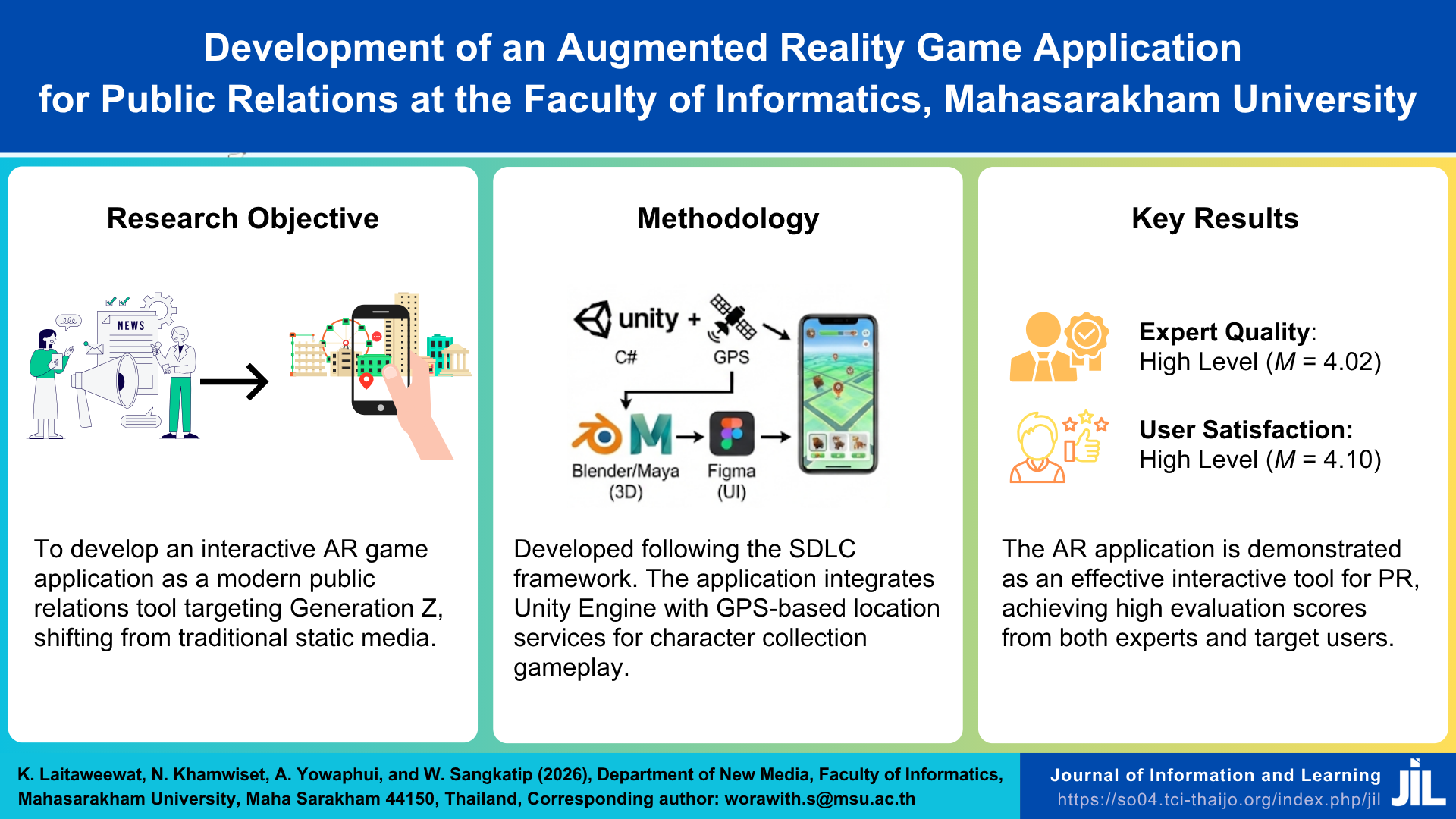
This study aims to develop an augmented reality (AR) game application for public relations at the Faculty of Informatics, Mahasarakham University. The objectives were: 1) to develop an AR game application as a modern communication medium that aligns with the behaviors of Generation Z, 2) to evaluate the quality of the AR game application, and 3) to measure user satisfaction with the application. The research instruments consisted of an expert evaluation form for assessing application quality and a user satisfaction questionnaire. The samples comprised 67 high school students (Grade 12) and 41 undergraduate students from the Faculty of Informatics, totaling 108 participants. Data were analyzed using mean (M) and standard deviation (SD). The findings revealed that the developed AR game application functioned effectively which met, which met the research objectives. The expert evaluation indicated a high level of quality (M = 4.02, SD = 0.54), while user satisfaction was also at a high level (M = 4.10, SD = 0.94). The results demonstrated that the AR game application served as an effective interactive public relations tool that could effectively attract attention and fostered an engagement of new-generation target groups.
References
Ang Wei Liang, A., Wahid, N., & Gusman, T. (2021). Virtual campus tour application through markerless augmented reality approach. International Journal on Informatics Visualization, 5(4), 354–359. http://dx.doi.org/10.30630/joiv.5.4.743
Arena, F., Collotta, M., Pau, G., & Termine, F. (2022). An overview of augmented reality. Computers, 11(2), Article 28. https://doi.org/10.3390/computers11020028
Davis, F. D. (1989). Perceived usefulness, perceived ease of use, and user acceptance of information technology. MIS Quarterly, 13(3), 319–340. https://doi.org/10.2307/249008
Du, Z., Liu, J., & Wang, T. (2022). Augmented reality marketing: A systematic literature review and an agenda for future inquiry. Frontiers in Psychology, 13, Article 925963. https://doi.org/10.3389/fpsyg.2022.925963
Homhual, P., Narkphum, Y., & Chanudom, A. (2024). Development of public relations media with augmented reality to promote tourism in Chang Klang District, Nakhon Si Thammarat Province, Thailand. Kurdish Studies, 12(2), 3290–3298. https://kurdishstudies.net/menu-script/index.php/KS/article/view/2438
Jattamart, A., Plangdecha, P., Sawatpakdee, T., Pungpang, S., & Kwangsawad, A. (2023). Integrating augmented reality and geographic information technology to promote tourist attractions in Hua-Hin District, Prachuap Khiri Khan Province. Journal of Applied Informatics and Technology, 5(2), 145–164. https://doi.org/10.14456/jait.2023.11
Jiang, H., Zhu, D., Chugh, R., Turnbull, D., & Wu, J. (2025). Virtual reality and augmented reality-supported K-12 STEM learning: Trends, advantages and challenges. Education and Information Technologies, 30, 12827–12863. https://doi.org/10.1007/s10639-024-13210-z
Keowsawat, P. (2022). Development of public relations media for tourism in Phetchaburi Province with augmented reality technology. DEC Journal: Art and Design, 1(1), 50–75. https://so07.tci-thaijo.org/index.php/decorativeartsJournal/article/view/530
Khaldi, A., Bouzidi, R., & Nader, F. (2023). Gamification of e-learning in higher education: A systematic literature review. Smart Learning Environments, 10, Article 10. https://doi.org/10.1186/s40561-023-00227-z
Koumpouros, Y. (2024). Revealing the true potential and prospects of augmented reality in education. Smart Learning Environments, 11, Article 2. https://doi.org/10.1186/s40561-023-00288-0
Kuş, Ö. A., & Başer, B. (2023). A study on the digital game addiction tendency of generation z individuals. In R. Sine Nazlı & G. Sari (Eds.), Handbook of research on perspectives on society and technology addiction (pp. 344–356). IGI Global Scientific Publishing. https://doi.org/10.4018/978-1-6684-8397-8.ch022
Lampropoulos, G. (2025). Combining artificial intelligence with augmented reality and virtual reality in education: Current trends and future perspectives. Multimodal Technologies and Interaction, 9(2), Article 11. https://doi.org/10.3390/mti9020011
Likert, R. (1932). A technique for the measurement of attitudes. Archives of Psychology, 22(140), Article 55. https://psycnet.apa.org/record/1933-01885-001
Lubis, M., Oktarina Handayani, D., Ridho Lubis, A., & Jafar Adrian, Q. (2022). Using augmented reality (AR) to educate the student: Bridging the communication for internet addiction [Conference presentation]. Proceedings of the 2022 5th international conference on electronics, communications and control engineering, Higashi-ku, Japan. https://doi.org/10.1145/3531028.3531033
Mendoza-Ramírez, C. E., Tudon-Martinez, J. C., Félix-Herrán, L. C., Lozoya-Santos, J. de J., & Vargas-Martínez, A. (2023). Augmented reality: Survey. Applied Sciences, 13(18), Article 10491. https://doi.org/10.3390/app131810491
Pelizzari, F. (2024). Gamification in higher education. A systematic literature review. Italian Journal of Educational Technology, 31(3), 21–43. https://doi.org/10.17471/2499-4324/1335
Peter, K., Auala, S., & Winschiers-Theophilus, H. (2023). An AR game for primary learners to safeguard intangible cultural heritage of the Ovahimba tribe [Conference presentation]. Proceedings of the 2023 ACM international conference on interactive media experiences, Nantes, France. https://doi.org/10.1145/3573381.3597230
Sangchai, J., Maunsaiyat, S., & Supavarasuwat, P. (2024). Supplementary learning media using microcontroller and augmented reality technology on smart farm. Journal of Industrial Education, 23(1), 24–32. https://doi.org/10.55003/JIE.23106
Sarkar, S., S, A., V, A., & K, D. (2022). Exploration and aspects on augmented reality [Conference presentation]. Proceedings of the 2022 Power, Energy, Control and Transmission Systems (ICPECTS), Chennai, India. https://doi.org/10.1109/ICPECTS56089.2022.10047434
Schmiedinger, T., Petke, M., von Czettritz, L., Wohlschläger, B., & Adam, M. (2020). Augmented reality as a tool for providing informational content in different production domains. Procedia Manufacturing, 45, 423–428. https://doi.org/10.1016/J.PROMFG.2020.04.047
Sharma, M., Kaushal, D., & Joshi, S. (2023). Adverse effect of social media on generation Z user’s behavior: Government information support as a moderating variable. Journal of Retailing and Consumer Services, 72, Article 103256. https://doi.org/10.1016/j.jretconser.2023.103256
Sirapanuwat, N., Satiman, A., Thammetar, T., & Ruangrit, N. (2022). The development of a blended instructional model using augmented reality and innovative design based learning to enhance undergraduate students’ ability in creative jewelry design. Journal of Information and Learning, 33(3), 12–21. https://so04.tci-thaijo.org/index.php/jil/article/view/257918
Venkatesh, V., & Davis, F. D. (2000). A theoretical extension of the technology acceptance model: Four longitudinal field studies. Management Science, 46(2), 186–204. https://doi.org/10.1287/mnsc.46.2.186.11926
Downloads
Additional Files
Published
How to Cite
Issue
Section
Categories
License
Copyright (c) 2026 Journal of Information and Learning

This work is licensed under a Creative Commons Attribution-NonCommercial-NoDerivatives 4.0 International License.
Free access to published articles. Current licensing policy: CC BY-NC 4.0 from Volume 37, Issue 2 (2026). For earlier articles, consult the rights information on the individual article page. See our Open Access, Copyright and Licensing policy.


