
การพัฒนาแอปพลิเคชันเกมความเป็นจริงเสริมสำหรับประชาสัมพันธ์ คณะวิทยาการสารสนเทศ มหาวิทยาลัยมหาสารคาม
คำสำคัญ:
ความเป็นจริงเสริม, เกมมิฟิเคชัน, แอปพลิเคชันเกม, การประชาสัมพันธ์เชิงโต้ตอบ, ความพึงพอใจของผู้ใช้บทคัดย่อ
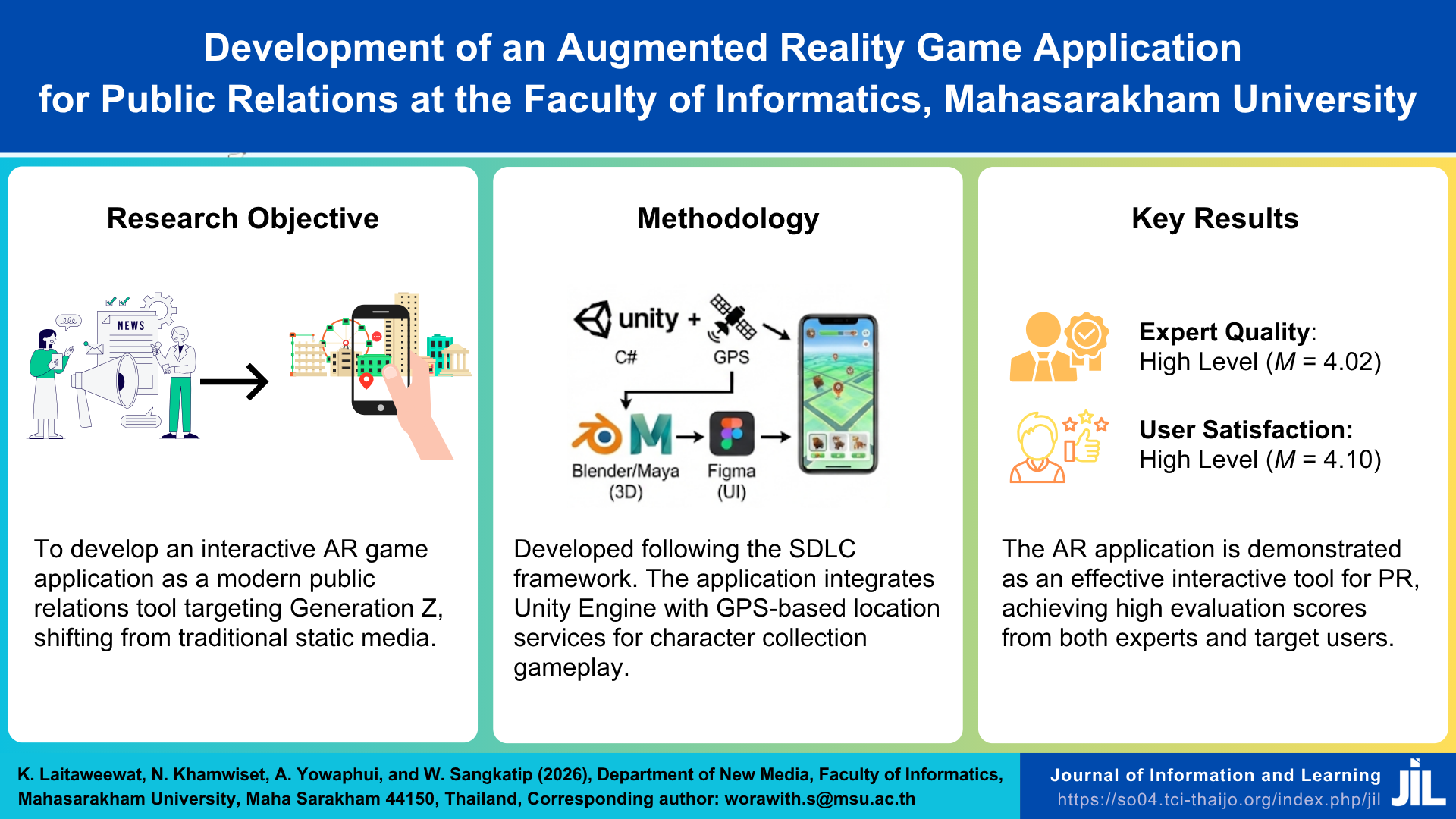
งานวิจัยนี้มุ่งเน้นการพัฒนาแอปพลิเคชันเกมความเป็นจริงเสริมสำหรับประชาสัมพันธ์ คณะวิทยาการสารสนเทศ มหาวิทยาลัยมหาสารคาม มีวัตถุประสงค์เพื่อ 1) พัฒนาแอปพลิเคชันเกมความเป็นจริงเสริมเพื่อเป็นสื่อประชาสัมพันธ์ที่ทันสมัยและตอบโจทย์พฤติกรรมของกลุ่มเป้าหมาย Generation Z 2) ประเมินคุณภาพของแอปพลิเคชันเกม และ 3) ศึกษาความพึงพอใจของผู้ใช้งานแอปพลิเคชันเกม เครื่องมือที่ใช้ในการวิจัย คือ แบบประเมินคุณภาพโดยผู้เชี่ยวชาญ และแบบสอบถามความพึงพอใจโดยกลุ่มตัวอย่าง กลุ่มตัวอย่างที่ใช้ในการวิจัย คือ นักเรียนชั้นมัธยมศึกษาปีที่ 6 จำนวน 67 คน และนิสิตคณะวิทยาการสารสนเทศ 41 คน รวมทั้งสิ้น 108 คน สถิติที่ใช้วิเคราะห์ข้อมูล คือ ค่าเฉลี่ยและส่วนเบี่ยงเบนมาตรฐาน ผลการวิจัยพบว่า แอปพลิเคชันเกมที่พัฒนาขึ้นสามารถทำงานได้ตามวัตถุประสงค์ โดยผลการประเมินคุณภาพจากผู้เชี่ยวชาญอยู่ในระดับมาก (M = 4.02, SD = 0.54) และผลการศึกษาความพึงพอใจของผู้ใช้งานอยู่ในระดับมาก (M = 4.10, SD = 0.94) สรุปผลการวิจัยชี้ให้เห็นว่า แอปพลิเคชันเกมความเป็นจริงเสริมเป็นสื่อประชาสัมพันธ์เชิงโต้ตอบที่สามารถดึงดูดความสนใจและสร้างการมีส่วนร่วมกับกลุ่มเป้าหมายยุคใหม่ได้อย่างมีประสิทธิภาพ
เอกสารอ้างอิง
Ang Wei Liang, A., Wahid, N., & Gusman, T. (2021). Virtual campus tour application through markerless augmented reality approach. International Journal on Informatics Visualization, 5(4), 354–359. http://dx.doi.org/10.30630/joiv.5.4.743
Arena, F., Collotta, M., Pau, G., & Termine, F. (2022). An overview of augmented reality. Computers, 11(2), Article 28. https://doi.org/10.3390/computers11020028
Davis, F. D. (1989). Perceived usefulness, perceived ease of use, and user acceptance of information technology. MIS Quarterly, 13(3), 319–340. https://doi.org/10.2307/249008
Du, Z., Liu, J., & Wang, T. (2022). Augmented reality marketing: A systematic literature review and an agenda for future inquiry. Frontiers in Psychology, 13, Article 925963. https://doi.org/10.3389/fpsyg.2022.925963
Homhual, P., Narkphum, Y., & Chanudom, A. (2024). Development of public relations media with augmented reality to promote tourism in Chang Klang District, Nakhon Si Thammarat Province, Thailand. Kurdish Studies, 12(2), 3290–3298. https://kurdishstudies.net/menu-script/index.php/KS/article/view/2438
Jattamart, A., Plangdecha, P., Sawatpakdee, T., Pungpang, S., & Kwangsawad, A. (2023). Integrating augmented reality and geographic information technology to promote tourist attractions in Hua-Hin District, Prachuap Khiri Khan Province. Journal of Applied Informatics and Technology, 5(2), 145–164. https://doi.org/10.14456/jait.2023.11
Jiang, H., Zhu, D., Chugh, R., Turnbull, D., & Wu, J. (2025). Virtual reality and augmented reality-supported K-12 STEM learning: Trends, advantages and challenges. Education and Information Technologies, 30, 12827–12863. https://doi.org/10.1007/s10639-024-13210-z
Keowsawat, P. (2022). Development of public relations media for tourism in Phetchaburi Province with augmented reality technology. DEC Journal: Art and Design, 1(1), 50–75. https://so07.tci-thaijo.org/index.php/decorativeartsJournal/article/view/530
Khaldi, A., Bouzidi, R., & Nader, F. (2023). Gamification of e-learning in higher education: A systematic literature review. Smart Learning Environments, 10, Article 10. https://doi.org/10.1186/s40561-023-00227-z
Koumpouros, Y. (2024). Revealing the true potential and prospects of augmented reality in education. Smart Learning Environments, 11, Article 2. https://doi.org/10.1186/s40561-023-00288-0
Kuş, Ö. A., & Başer, B. (2023). A study on the digital game addiction tendency of generation z individuals. In R. Sine Nazlı & G. Sari (Eds.), Handbook of research on perspectives on society and technology addiction (pp. 344–356). IGI Global Scientific Publishing. https://doi.org/10.4018/978-1-6684-8397-8.ch022
Lampropoulos, G. (2025). Combining artificial intelligence with augmented reality and virtual reality in education: Current trends and future perspectives. Multimodal Technologies and Interaction, 9(2), Article 11. https://doi.org/10.3390/mti9020011
Likert, R. (1932). A technique for the measurement of attitudes. Archives of Psychology, 22(140), Article 55. https://psycnet.apa.org/record/1933-01885-001
Lubis, M., Oktarina Handayani, D., Ridho Lubis, A., & Jafar Adrian, Q. (2022). Using augmented reality (AR) to educate the student: Bridging the communication for internet addiction [Conference presentation]. Proceedings of the 2022 5th international conference on electronics, communications and control engineering, Higashi-ku, Japan. https://doi.org/10.1145/3531028.3531033
Mendoza-Ramírez, C. E., Tudon-Martinez, J. C., Félix-Herrán, L. C., Lozoya-Santos, J. de J., & Vargas-Martínez, A. (2023). Augmented reality: Survey. Applied Sciences, 13(18), Article 10491. https://doi.org/10.3390/app131810491
Pelizzari, F. (2024). Gamification in higher education. A systematic literature review. Italian Journal of Educational Technology, 31(3), 21–43. https://doi.org/10.17471/2499-4324/1335
Peter, K., Auala, S., & Winschiers-Theophilus, H. (2023). An AR game for primary learners to safeguard intangible cultural heritage of the Ovahimba tribe [Conference presentation]. Proceedings of the 2023 ACM international conference on interactive media experiences, Nantes, France. https://doi.org/10.1145/3573381.3597230
Sangchai, J., Maunsaiyat, S., & Supavarasuwat, P. (2024). Supplementary learning media using microcontroller and augmented reality technology on smart farm. Journal of Industrial Education, 23(1), 24–32. https://doi.org/10.55003/JIE.23106
Sarkar, S., S, A., V, A., & K, D. (2022). Exploration and aspects on augmented reality [Conference presentation]. Proceedings of the 2022 Power, Energy, Control and Transmission Systems (ICPECTS), Chennai, India. https://doi.org/10.1109/ICPECTS56089.2022.10047434
Schmiedinger, T., Petke, M., von Czettritz, L., Wohlschläger, B., & Adam, M. (2020). Augmented reality as a tool for providing informational content in different production domains. Procedia Manufacturing, 45, 423–428. https://doi.org/10.1016/J.PROMFG.2020.04.047
Sharma, M., Kaushal, D., & Joshi, S. (2023). Adverse effect of social media on generation Z user’s behavior: Government information support as a moderating variable. Journal of Retailing and Consumer Services, 72, Article 103256. https://doi.org/10.1016/j.jretconser.2023.103256
Sirapanuwat, N., Satiman, A., Thammetar, T., & Ruangrit, N. (2022). The development of a blended instructional model using augmented reality and innovative design based learning to enhance undergraduate students’ ability in creative jewelry design. Journal of Information and Learning, 33(3), 12–21. https://so04.tci-thaijo.org/index.php/jil/article/view/257918
Venkatesh, V., & Davis, F. D. (2000). A theoretical extension of the technology acceptance model: Four longitudinal field studies. Management Science, 46(2), 186–204. https://doi.org/10.1287/mnsc.46.2.186.11926
ดาวน์โหลด
ไฟล์ประกอบ
เผยแพร่แล้ว
รูปแบบการอ้างอิง
ฉบับ
ประเภทบทความ
หมวดหมู่
สัญญาอนุญาต
ลิขสิทธิ์ (c) 2026 Journal of Information and Learning

อนุญาตภายใต้เงื่อนไข Creative Commons Attribution-NonCommercial-NoDerivatives 4.0 International License.
เข้าถึงบทความได้โดยไม่เสียค่าใช้จ่าย นโยบายสัญญาอนุญาตปัจจุบัน CC BY-NC 4.0 ตั้งแต่ปีที่ 37 ฉบับที่ 2 (2569) สำหรับบทความก่อนหน้านี้ โปรดตรวจเงื่อนไขสิทธิบนหน้าบทความแต่ละเรื่อง ดูนโยบายการเข้าถึงแบบเปิดและสัญญาอนุญาต


