
The Development of an Online Training Management System Integrating Artificial Intelligence Tools and Gamification Concepts for Teachers under the Ministry of Education
Keywords:
online training management system, artificial intelligence, gamification, chatbotAbstract
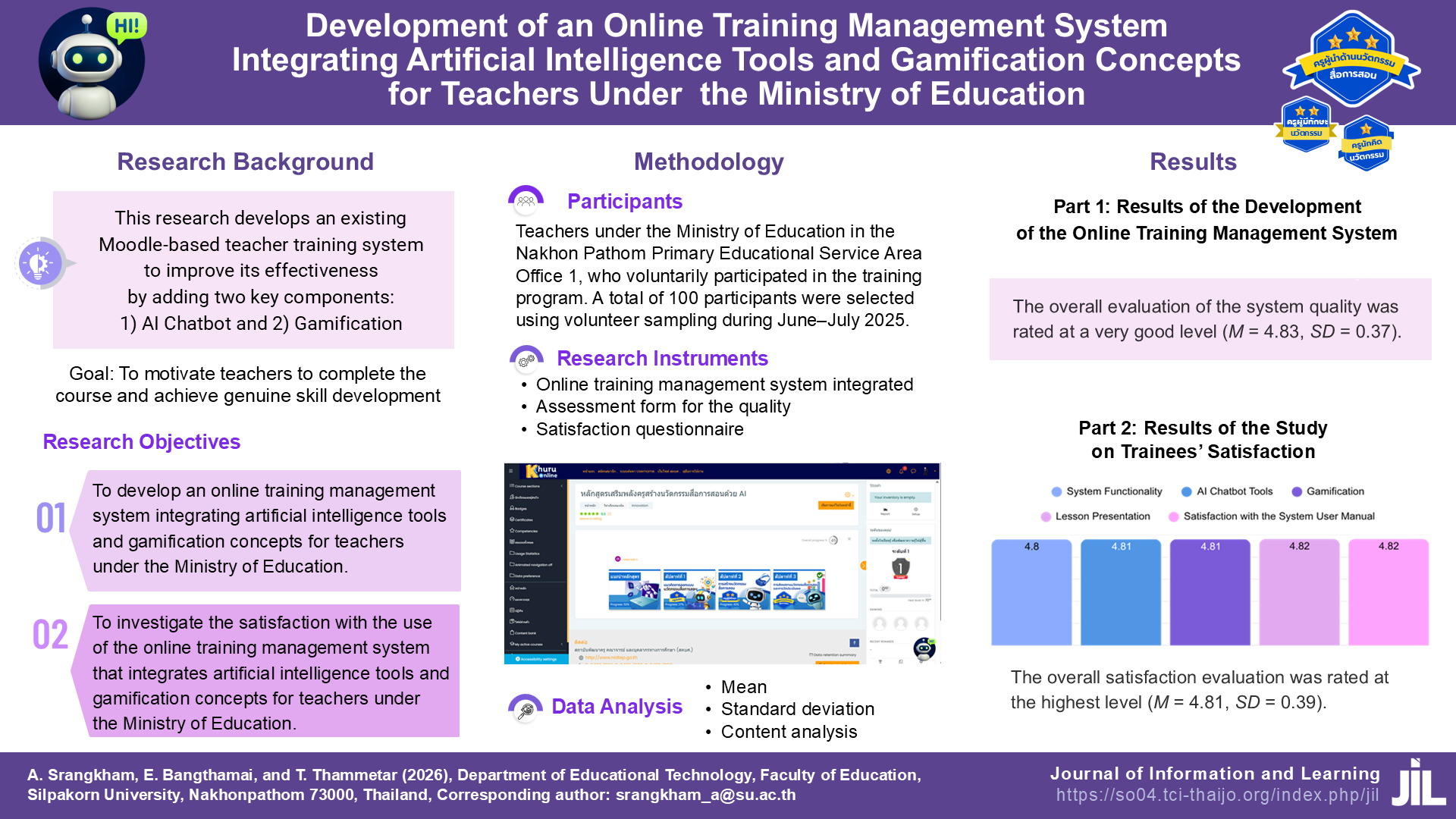
The objectives of this research were 1) to develop an online training management system that integrates artificial intelligence tools and gamification concepts for teachers under the Ministry of Education, and 2) to examine users’ satisfaction with the system. The sample comprised 100 teachers under the Nakhon Pathom Primary Educational Service Area Office 1 who voluntarily participated in the training and were selected using volunteer sampling. The research instruments consisted of the developed online training management system with integrated artificial intelligence and gamification components, a system quality evaluation form, and a user satisfaction questionnaire. Data were analyzed using percentage, mean, standard deviation, and content analysis. The results revealed that: 1) the developed online training management system integrating artificial intelligence tools and gamification for teachers under the Ministry of Education consisted of five components: (1) user management, (2) content management, (3) progress tracking and assessment, (4) an AI-driven chatbot system, and (5) gamification system. The system quality was rated at a very high level (M = 4.83, SD = 0.37); and 2) the participants reported the highest level of satisfaction with the system (M = 4.81, SD = 0.39). The research results showed that the developed online training management system can be effectively used for training purposes.
References
Al-Nabhani, B. K. S., & Pulparambil, S. (2024). Smart learning environments: A comprehensive review on artificial intelligence and learning theories. International Journal of Research and Scientific Innovation, 11(14), 96–103. https://doi.org/10.51244/IJRSI.2024.1114SDAICO11
Amornrit, P., & Insaard, S. (2020). Gamification and distance learning system design. Journal of Educational Technology and Communications, 15(18), 34–44. https://so01.tci-thaijo.org/index.php/ectstou/article/view/225066
Boudadi , N. A., Gutiérrez-Colón, M., & Rodríguez, M. U. (2024). A gamified learning environment (Moodle) to enhance English language learning at university level. International Journal of Instruction, 17(4), 483–502. https://e-iji.net/ats/index.php/pub/article/view/665
Gómez Niño, J. R., Árias Delgado, L. P., Chiappe, A., & Ortega González, E. (2025). Gamifying learning with AI: A pathway to 21st-century skills. Journal of Research in Childhood Education, 39(4), 735–750. https://doi.org/10.1080/02568543.2024.2421974
Kummanee, J., & Wannapiroon, P. (2018). Development STEAM gamification for vocational innovators’ creativity and innovation skills. UMT Poly Journal, 15(2), 162–176. https://so06.tci-thaijo.org/index.php/umt-poly/article/view/159015
Krstić, L., Aleksić, V., & Krstić, M. (2022). Artificial intelligence in education: A review. Technics and Informatics in Education, 9, 223–228. https://doi.org/10.46793/TIE22.223K
Maneehaed, S., & Wannapiroon, P. (2019). A digital learning ecosystem with artificial intelligence for smart learning. Journal of MCU Humanities Review, 9(2), 329–339. https://so06.tci-thaijo.org/index.php/edujournal_nu/article/view/159123
Ministry of Education. (2024). Nayōbāi læ čhut nēn khō̜ng krasūang sưksāthikān pračham pīngoppramān B.E. 2567 [Policies and priorities of the Ministry of Education for fiscal year 2024]. https://www.moe.go.th/360policy-and-focus-moe-fiscal-year-2024
Mungai, B. K., Omieno, K. K., Egessa, M., & Manyara, P. N. (2024). AI chatbots in LMS: A pedagogical review of cognitive, constructivist, and adaptive principles. Engineering and Technology Journal, 9(8), 4709–4715. https://doi.org/10.47191/etj/v9i08.15
Nenkov, N., Dimitrov, G., Dyachenko, Y., & Koeva, K. (2016). Artificial intelligence technologies for personnel learning management systems [Conference presentation]. IEEE 8th International Conference on Intelligent Systems, Sofia, Bulgaria. https://doi.org/10.1109/IS.2016.7737420
Office of the Education Council (2019). Rāingān kānsưksā nǣo patibat khō̜ng kānsāng læ songsœ̄m kān rūdi čhi than samrap khrū [Guidelines for creating and promoting digital literacy for teachers]. Prikwan Graphic. https://backoffice.onec.go.th/uploads/Book/1653-file.pdf
Ortega-Ochoa, E., Quiroga Pérez, J., Arguedas, M., Daradoumis, T., & Marquès Puig, J. M. (2024). The effectiveness of empathic chatbot feedback for developing learning skills and engagement. Computers and Education: Artificial Intelligence, 5, Article 100156. https://doi.org/10.1016/j.caeai.2024.100156
Qaddumi, H., & Smith, M. (2024). Implementation of learning management systems (Moodle): Effects on students' language acquisition and attitudes towards learning English as a foreign language. Trends in Higher Education, 3(2), 260–272. https://doi.org/10.3390/higheredu3020016
Ruankum, N., & Suthasinobol, K. (2022). Enhancement of Thai teachers’ competencies in Thai education 4.0. Journal of Liberal Art of Rajamangala University of Technology Suvarnabhumi, 4(1), 128–142. https://so03.tci-thaijo.org/index.php/art/article/view/254881
Rungchareankiat, D. (2023). The development of online learning management model based on the concept of gamification for elementary school teachers. Rajapark Journal, 17(55), 283–300. https://so05.tci-thaijo.org/index.php/RJPJ/article/view/268426
Saenboonsong, S. (2019). Development of a learning management system on a computer network at the Faculty of Education, Phranakhon Si Ayutthaya Rajabhat University. Journal of Industrial Education, King Mongkut’s University of Technology North Bangkok, 10(2), 218–226. http://journal.fte.kmutnb.ac.th/download/v10n2/journalFTE-Fulltext-2019-10-2-23.pdf
Sohaib, S. S. A. U., Khan, M. N., Quadri, S. H., & Yasmin, H. (2025). Learning management system. International Journal of Information Technology & Computer Engineering, 13(2s), 139–145. https://doi.org/10.62647/IJITCE2025V13I2sPP139-145
Stryker, C., & Kavlakoglu, E. (2024). What is artificial intelligence (AI)? IBM. https://www.ibm.com/think/topics/artificial-intelligence
Suartama, I. K., Setyosari, P., Sulthoni, & Ulfa, S. (2019). Development of an instructional design model for mobile blended learning in higher education. International Journal of Emerging Technologies in Learning, 14(16), 4–22. https://doi.org/10.3991/ijet.v14i16.10633
Teeravech, N., & Whattananarong, K. (2021). Development of a learning management system for supporting the teaching and learning by using questioning method. Rajapark Journal, 15(42), 286–298. https://so05.tci-thaijo.org/index.php/RJPJ/article/view/253092
Thilagam, K., & Barathi, C. (2025). Learning management systems. Stallion Journal for Multidisciplinary Associated Research Studies, 1(1), 66–71. https://doi.org/10.55544/sjmars.icmri.11
Zawacki-Richter, O., Marín, V. I., Bond, M., & Gouverneur, F. (2019). Systematic review of research on artificial intelligence applications in higher education – where are the educators? International Journal of Educational Technology in Higher Education, 16, Article 39. https://doi.org/10.1186/s41239-019-0171-0
Downloads
Additional Files
Published
How to Cite
Issue
Section
Categories
License
Copyright (c) 2026 Journal of Information and Learning

This work is licensed under a Creative Commons Attribution-NonCommercial-NoDerivatives 4.0 International License.
The Journal of Information and Learning is operated by the Office of Academic Resources, Prince of Songkla University. All articles published in the journal are protected by Thailand copyright law. This copyright covers the exclusive rights to share, reproduce and distribute the article, including in electronic forms, reprints, translations, photographic reproductions, or similar. Authors own copyrights in the works they have created as well as the Office of Academic Resources. The Journal reserves the right to edit the language of papers accepted for publication for clarity and correctness, as well as to make formal changes to ensure compliance with the journal's guidelines. All authors must take public responsibility for the content of their paper.


