
การพัฒนาระบบบริหารจัดการฝึกอบรมออนไลน์ที่มีเครื่องมือปัญญาประดิษฐ์ร่วมกับแนวคิดเกมมิฟิเคชันสำหรับครู สังกัดกระทรวงศึกษาธิการ
คำสำคัญ:
ระบบบริหารจัดการฝึกอบรมออนไลน์, ปัญญาประดิษฐ์, เกมมิฟิเคชัน, แชตบอทบทคัดย่อ
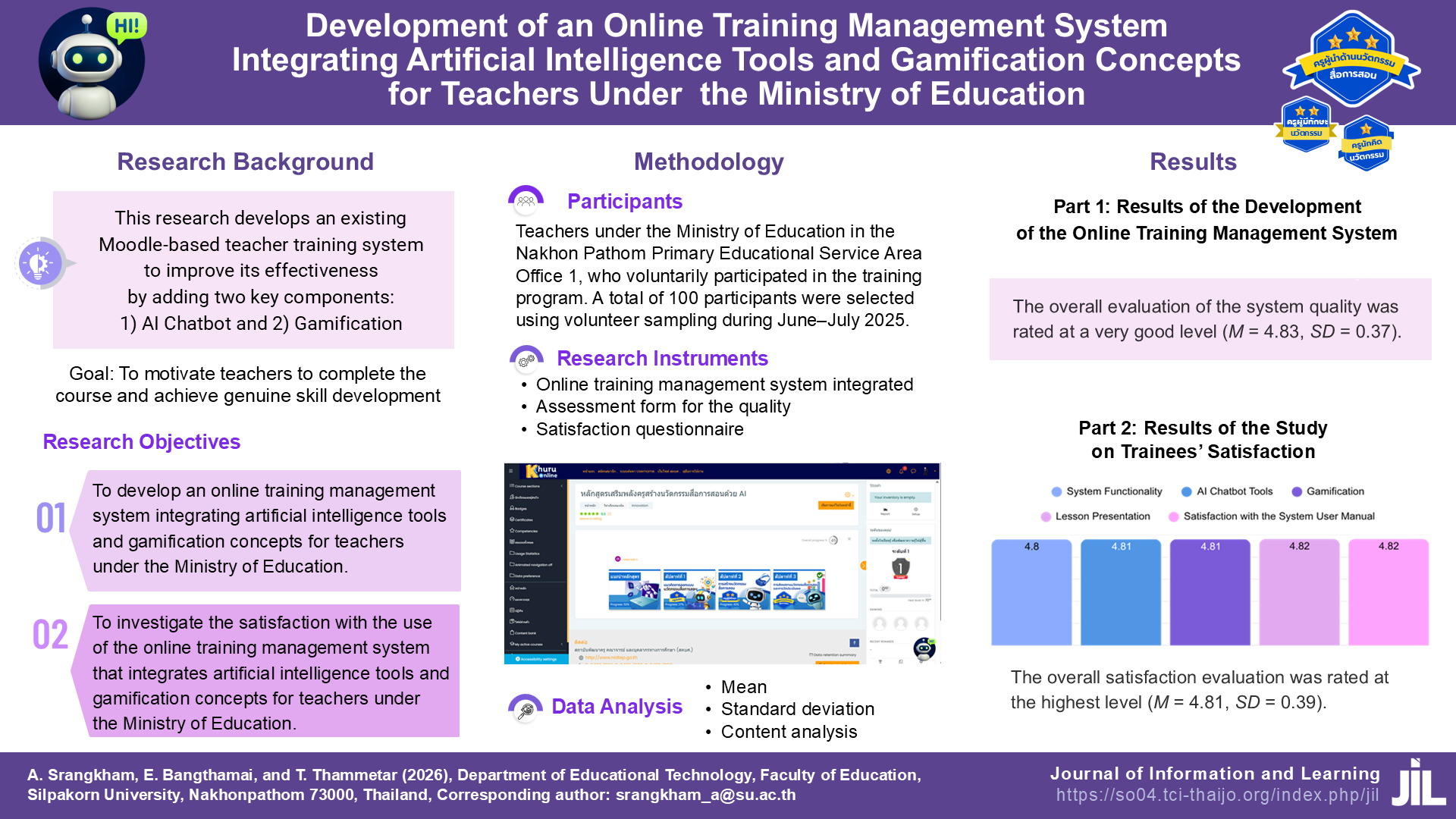
การวิจัยในครั้งนี้มีวัตถุประสงค์เพื่อ 1) พัฒนาระบบบริหารจัดการฝึกอบรมออนไลน์ที่มีเครื่องมือปัญญาประดิษฐ์ร่วมกับแนวคิดเกมมิฟิเคชันสำหรับครู สังกัดกระทรวงศึกษาธิการ 2) ศึกษาความพึงพอใจที่มีต่อการใช้งานระบบฯ กลุ่มตัวอย่างในการวิจัยครั้งนี้คือ ครู สำนักงานเขตพื้นที่การศึกษาประถมศึกษานครปฐม เขต 1 ที่สมัครใจเข้ารับการฝึกอบรม จำนวน 100 คน ได้จากการสุ่มกลุ่มตัวอย่างแบบอาสาสมัคร เครื่องมือวิจัย ได้แก่ ระบบบริหารจัดการฝึกอบรมออนไลน์ที่มีเครื่องมือปัญญาประดิษฐ์ร่วมกับแนวคิดเกมมิฟิเคชันสำหรับครู สังกัดกระทรวงศึกษาธิการ แบบประเมินคุณภาพของระบบ และแบบสอบถามความพึงพอใจ สถิติที่ใช้ในการวิเคราะห์ข้อมูล ได้แก่ ค่าร้อยละ ค่าเฉลี่ย และส่วนเบี่ยงเบนมาตรฐาน และการวิเคราะห์เนื้อหา ผลการวิจัยพบว่า 1) ระบบบริหารจัดการฝึกอบรมออนไลน์ที่มีเครื่องมือปัญญาประดิษฐ์ร่วมกับแนวคิดเกมมิฟิเคชันสำหรับครู สังกัดกระทรวงศึกษาธิการ ที่พัฒนาขึ้นมีองค์ประกอบ 5 ส่วน คือ (1) ระบบจัดการผู้ใช้ (2) ระบบจัดการเนื้อหา (3) ระบบติดตามความก้าวหน้าและประเมินผล (4) ระบบปัญญาประดิษฐ์แชทบอท และ (5) ระบบเกมมิฟิเคชัน ซึ่งมีผลการประเมินคุณภาพอยู่ในระดับดีมาก (M = 4.83, SD = 0.37) 2) ผู้เข้ารับการฝึกอบรมมีความพึงพอใจต่อการใช้งานระบบอยู่ในระดับมากที่สุด (M = 4.81, SD = 0.39) จากผลการวิจัยแสดงให้เห็นว่า ระบบบริหารจัดการฝึกอบรมออนไลน์ที่พัฒนาขึ้นสามารถนำไปใช้ในการฝึกอบรมได้อย่างมีประสิทธิภาพ
เอกสารอ้างอิง
Al-Nabhani, B. K. S., & Pulparambil, S. (2024). Smart learning environments: A comprehensive review on artificial intelligence and learning theories. International Journal of Research and Scientific Innovation, 11(14), 96–103. https://doi.org/10.51244/IJRSI.2024.1114SDAICO11
Amornrit, P., & Insaard, S. (2020). Gamification and distance learning system design. Journal of Educational Technology and Communications, 15(18), 34–44. https://so01.tci-thaijo.org/index.php/ectstou/article/view/225066
Boudadi , N. A., Gutiérrez-Colón, M., & Rodríguez, M. U. (2024). A gamified learning environment (Moodle) to enhance English language learning at university level. International Journal of Instruction, 17(4), 483–502. https://e-iji.net/ats/index.php/pub/article/view/665
Gómez Niño, J. R., Árias Delgado, L. P., Chiappe, A., & Ortega González, E. (2025). Gamifying learning with AI: A pathway to 21st-century skills. Journal of Research in Childhood Education, 39(4), 735–750. https://doi.org/10.1080/02568543.2024.2421974
Kummanee, J., & Wannapiroon, P. (2018). Development STEAM gamification for vocational innovators’ creativity and innovation skills. UMT Poly Journal, 15(2), 162–176. https://so06.tci-thaijo.org/index.php/umt-poly/article/view/159015
Krstić, L., Aleksić, V., & Krstić, M. (2022). Artificial intelligence in education: A review. Technics and Informatics in Education, 9, 223–228. https://doi.org/10.46793/TIE22.223K
Maneehaed, S., & Wannapiroon, P. (2019). A digital learning ecosystem with artificial intelligence for smart learning. Journal of MCU Humanities Review, 9(2), 329–339. https://so06.tci-thaijo.org/index.php/edujournal_nu/article/view/159123
Ministry of Education. (2024). Nayōbāi læ čhut nēn khō̜ng krasūang sưksāthikān pračham pīngoppramān B.E. 2567 [Policies and priorities of the Ministry of Education for fiscal year 2024]. https://www.moe.go.th/360policy-and-focus-moe-fiscal-year-2024
Mungai, B. K., Omieno, K. K., Egessa, M., & Manyara, P. N. (2024). AI chatbots in LMS: A pedagogical review of cognitive, constructivist, and adaptive principles. Engineering and Technology Journal, 9(8), 4709–4715. https://doi.org/10.47191/etj/v9i08.15
Nenkov, N., Dimitrov, G., Dyachenko, Y., & Koeva, K. (2016). Artificial intelligence technologies for personnel learning management systems [Conference presentation]. IEEE 8th International Conference on Intelligent Systems, Sofia, Bulgaria. https://doi.org/10.1109/IS.2016.7737420
Office of the Education Council (2019). Rāingān kānsưksā nǣo patibat khō̜ng kānsāng læ songsœ̄m kān rūdi čhi than samrap khrū [Guidelines for creating and promoting digital literacy for teachers]. Prikwan Graphic. https://backoffice.onec.go.th/uploads/Book/1653-file.pdf
Ortega-Ochoa, E., Quiroga Pérez, J., Arguedas, M., Daradoumis, T., & Marquès Puig, J. M. (2024). The effectiveness of empathic chatbot feedback for developing learning skills and engagement. Computers and Education: Artificial Intelligence, 5, Article 100156. https://doi.org/10.1016/j.caeai.2024.100156
Qaddumi, H., & Smith, M. (2024). Implementation of learning management systems (Moodle): Effects on students' language acquisition and attitudes towards learning English as a foreign language. Trends in Higher Education, 3(2), 260–272. https://doi.org/10.3390/higheredu3020016
Ruankum, N., & Suthasinobol, K. (2022). Enhancement of Thai teachers’ competencies in Thai education 4.0. Journal of Liberal Art of Rajamangala University of Technology Suvarnabhumi, 4(1), 128–142. https://so03.tci-thaijo.org/index.php/art/article/view/254881
Rungchareankiat, D. (2023). The development of online learning management model based on the concept of gamification for elementary school teachers. Rajapark Journal, 17(55), 283–300. https://so05.tci-thaijo.org/index.php/RJPJ/article/view/268426
Saenboonsong, S. (2019). Development of a learning management system on a computer network at the Faculty of Education, Phranakhon Si Ayutthaya Rajabhat University. Journal of Industrial Education, King Mongkut’s University of Technology North Bangkok, 10(2), 218–226. http://journal.fte.kmutnb.ac.th/download/v10n2/journalFTE-Fulltext-2019-10-2-23.pdf
Sohaib, S. S. A. U., Khan, M. N., Quadri, S. H., & Yasmin, H. (2025). Learning management system. International Journal of Information Technology & Computer Engineering, 13(2s), 139–145. https://doi.org/10.62647/IJITCE2025V13I2sPP139-145
Stryker, C., & Kavlakoglu, E. (2024). What is artificial intelligence (AI)? IBM. https://www.ibm.com/think/topics/artificial-intelligence
Suartama, I. K., Setyosari, P., Sulthoni, & Ulfa, S. (2019). Development of an instructional design model for mobile blended learning in higher education. International Journal of Emerging Technologies in Learning, 14(16), 4–22. https://doi.org/10.3991/ijet.v14i16.10633
Teeravech, N., & Whattananarong, K. (2021). Development of a learning management system for supporting the teaching and learning by using questioning method. Rajapark Journal, 15(42), 286–298. https://so05.tci-thaijo.org/index.php/RJPJ/article/view/253092
Thilagam, K., & Barathi, C. (2025). Learning management systems. Stallion Journal for Multidisciplinary Associated Research Studies, 1(1), 66–71. https://doi.org/10.55544/sjmars.icmri.11
Zawacki-Richter, O., Marín, V. I., Bond, M., & Gouverneur, F. (2019). Systematic review of research on artificial intelligence applications in higher education – where are the educators? International Journal of Educational Technology in Higher Education, 16, Article 39. https://doi.org/10.1186/s41239-019-0171-0
ดาวน์โหลด
ไฟล์ประกอบ
เผยแพร่แล้ว
รูปแบบการอ้างอิง
ฉบับ
ประเภทบทความ
หมวดหมู่
สัญญาอนุญาต
ลิขสิทธิ์ (c) 2026 Journal of Information and Learning

อนุญาตภายใต้เงื่อนไข Creative Commons Attribution-NonCommercial-NoDerivatives 4.0 International License.
Journal of Information and Learning ดำเนินการโดยสำนักวิทยบริการ มหาวิทยาลัยสงขลานครินทร์ วิทยาเขตปัตตานี บทความที่ได้รับการตีพิมพ์ในวารสารได้รับความคุ้มครองตามกฎหมายลิขสิทธิ์ โดยเจ้าของลิขสิทธิ์จะมีสิทธิในการทำซ้ำ ดัดแปลง และเผยแพร่งานบทความ ทั้งรูปแบบอิเล็กทรอนิกส์ การทำฉบับสำเนา การแปล และการผลิตซ้ำในรูปแบบต่างๆ ลิขสิทธิ์บทความเป็นของผู้เขียนและสำนักวิทยบริการ มหาวิทยาลัยสงขลานครินทร์ วิทยาเขตปัตตานี วารสารฯ ขอสงวนสิทธิ์ในการพิจารณาตีพิมพ์ตามความเหมาะสม รวมทั้งการตรวจทานแก้ไข การปรับข้อความ หรือขัดเกลาภาษาให้ถูกต้องตามเกณฑ์ที่กำหนด สำหรับผลการวิจัยและความคิดเห็นที่ปรากฏในบทความถือเป็นความคิดเห็นและอยู่ในความรับผิดชอบของผู้เขียน


