
The Misinformation Ecosystem on Social Media: Its Spread, Impacts, and the Roles of the Southern Consumer Network
Keywords:
misinformation, consumer rights, Southern Consumer Network, media literacyAbstract
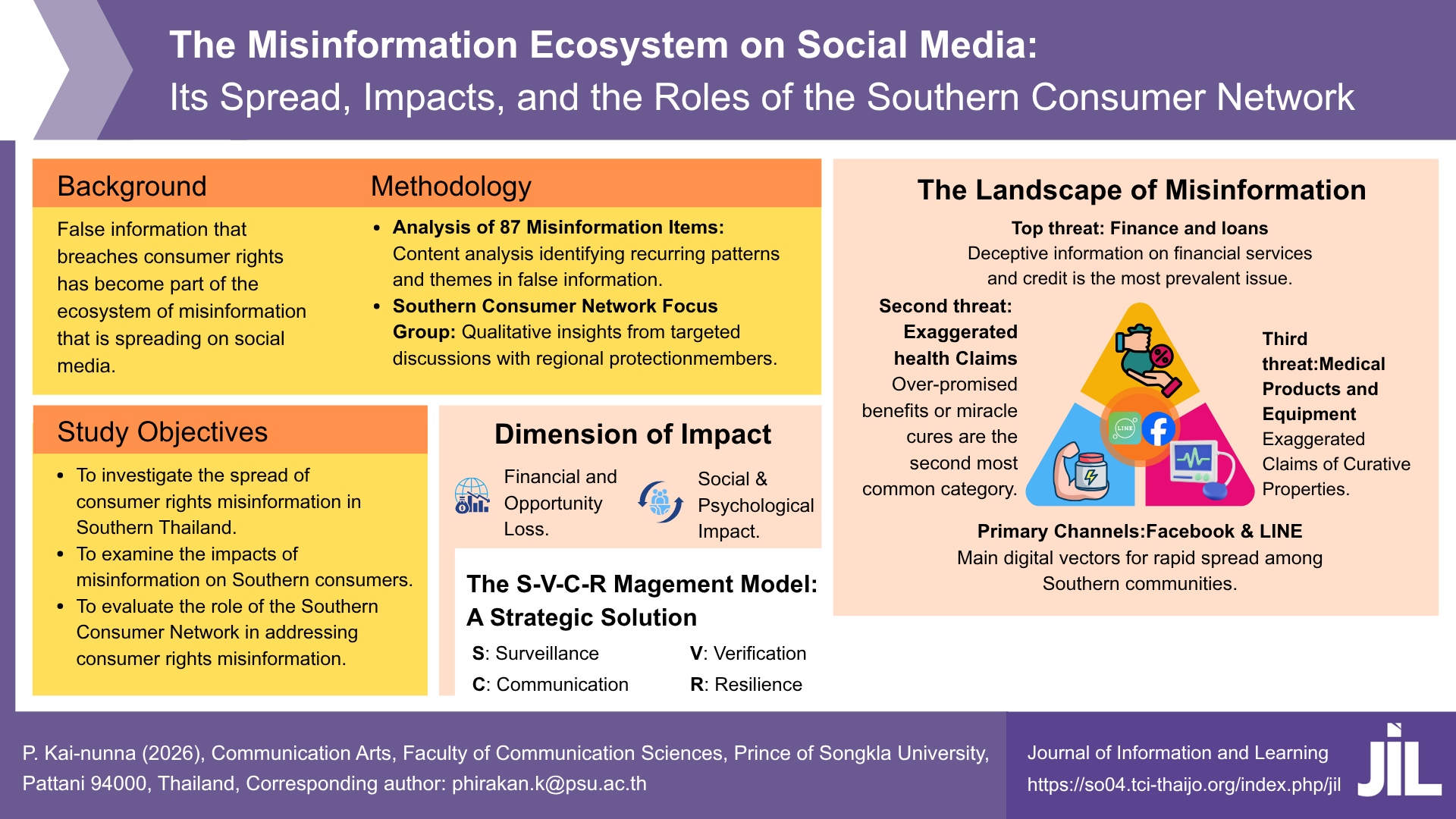
This research aims to investigate the situation regarding the spread of misinformation and its impacts, as well as the role of the Southern Consumer Network (SCN). The study employed a mixed-methods approach, including content analysis of 87 misinformation items and focus group discussions with SCN members selected via purposive sampling, followed by thematic analysis to identify key issues. The study found that although most misinformation concerned general issues, financial and loan problems were the most prevalent among the cases violating consumer rights, followed by exaggerated claims about health products. The impacts of misinformation were found in three dimensions: financial impacts, loss of opportunity, and social and psychological impacts. Regarding its operational role, the SCN uses surveillance mechanisms in social media spaces, data verification, and communication to debunk information and reduce conflict in social media groups. Based on these findings, a problem management model was synthesized as the S-V-C-R Model to strengthen the network in managing misinformation problems, consisting of Surveillance, Verification, Communication, and Resilience building for community members.
References
Department of Consumer Affairs, Govt. of India. (2025, March 28). Consumer rights. https://consumeraffairs.gov.in/pages/consumer-rights
Ekaphet, K. (2025, November 25). Kār ḳhos̄ʹṇā kein cring s̄̀ng p̄hl s̄eīy xỳāngrị b̂āng? [What are the negative consequences of exaggerated advertising?]. Office of The Consumer Protection Board. https://www.ocpb.go.th/images/article/article_20251125093809.pdf
Foundation for Consumers. (2017, May 25). Rū̂thạn khả to k̄hxngḳhos̄ʹṇā kein cring [Be aware of exaggerated advertising]. https://consumerthai.org/goods-and-services/3923-600525_howto.html
Kozyreva, A., Wineburg, S., Lewandowsky, S., Hertwig, R. (2023). Critical Ignoring as a core competence for digital citizens. Current Directions in Psychological Science, 32(1), 81–88. https://doi.org/10.1177/09637214221121570
LONGMAN. (n.d.). True. Longman Dictionary of Contemporary English Online. https://www.ldoceonline.com/dictionary/true
Office of Health Risk Factor Control Support. (2021). Kẁā ca pĕn s̄p̣hā xngkh̒kr k̄hxng p̄hū̂ brip̣hokh [The making of the Thailand Consumer Council]. ThaiHealth Promotion Foundation.
Office of NBTC. (n.d.). Kār khûmkhrxng p̄hū̂ brip̣hokh nı kickār kracāy s̄eīyng læa kickār thorthạṣ̄n̒: Bth wikherāah̄̒ khwām cảpĕn t̀x kār kảkạb dūlæ kārk ra thả thī̀ pĕnkār xeā perīyb p̄hū̂ brip̣hokh cāk kārḳhos̄ʹṇā p̄hlitp̣hạṇṯh̒ s̄uk̄hp̣hāph [Consumer protection in broadcasting and television: An analysis of the need to regulate unfair advertising practices for health products]. https://broadcast.nbtc.go.th/data/academic/file/661200000005.pdf
Office of The Consumer Protection Board. (2026, January 5). phrarātchabanyat khumkhrō̜ng phūbō̜riphōk B.E. 2522 [Consumer protection A.D. 1979]. https://www.ocpb.go.th/download/article/article_20200221144401.pdf
Organisation for Economic Co-operation and Development. (2023, December 14). OECD/INFE 2023 international survey of adult financial literacy. OECD. https://www.oecd.org/content/dam/oecd/en/publications/reports/2023/12/oecd-infe-2023-international-survey-of-adult-financial-literacy_8ce94e2c/56003a32-en.pdf
Sharma, R. R., & Chander, S. (2011). What's wrong with misleading advertising? — An empirical investigation. Asia-Pacific Journal of Management Research and Innovation, 7(1), 191–205. https://journals.sagepub.com/doi/10.1177/097324701100700116
Songkhla Consumer Association. (2021). Khū̀mụ̄x p̄hū̂ brip̣hokh thèā thạn s̄ụ̄̀x [Guideline of consumer media literacy]. Songkhla Consumer Association.
Sorensen, A. (2020, October 13). Fake COVID-19 news makes you want to treat yourself on the cheap. University of Colorado Boulder. https://www.colorado.edu/today/2020/10/13/fake-covid-19-news-makes-you-want-treat-yourself-cheap
Thailand Consumers Council. (2021, June 28). 8 nāthī lak "saphā ongkō̜n khō̜ng phūbō̜riphōk" khumkhrō̜ng læ phithak sitthi phūbō̜riphōk [8 key functions of the consumer organizations council: Protecting and safeguarding consumer rights]. https://www.tcc.or.th/tcc_media/28062564_info-tcc-duty
Thailand Consumers Council. (2023, August 9). Phō̜.Ra.Bō̜. kān čhattang saphā ʻongkō̜n khō̜ng phūbō̜riphōk B.E. 2562 [Consumer council act A.D. 2019]. https://www.tcc.or.th/tcc_media/act-tcc
Wardle, C., & Derakhshan, H. (2017). Information disorder: Toward an interdisciplinary framework for research and policy making. Council of Europe. https://rm.coe.int/information-disorder-toward-an-interdisciplinary-framework-for-researc/168076277c
Wimonkunarak, S., & Muangtham, W. (2022). The implementation problems of the establishment of the consumers council act B.E.2562. Journal of Thai Justice System, 15(1), 177–204. https://so04.tci-thaijo.org/index.php/JTJS/article/view/256586
Downloads
Additional Files
Published
How to Cite
Issue
Section
Categories
License
Copyright (c) 2026 Journal of Information and Learning

This work is licensed under a Creative Commons Attribution-NonCommercial-NoDerivatives 4.0 International License.
The Journal of Information and Learning is operated by the Office of Academic Resources, Prince of Songkla University. All articles published in the journal are protected by Thailand copyright law. This copyright covers the exclusive rights to share, reproduce and distribute the article, including in electronic forms, reprints, translations, photographic reproductions, or similar. Authors own copyrights in the works they have created as well as the Office of Academic Resources. The Journal reserves the right to edit the language of papers accepted for publication for clarity and correctness, as well as to make formal changes to ensure compliance with the journal's guidelines. All authors must take public responsibility for the content of their paper.


