
A Study of Consumer Behavior and Expectations on Information Reception on Facebook
Keywords:
information behavior, media exposure, Facebook, expectations, technology acceptanceAbstract
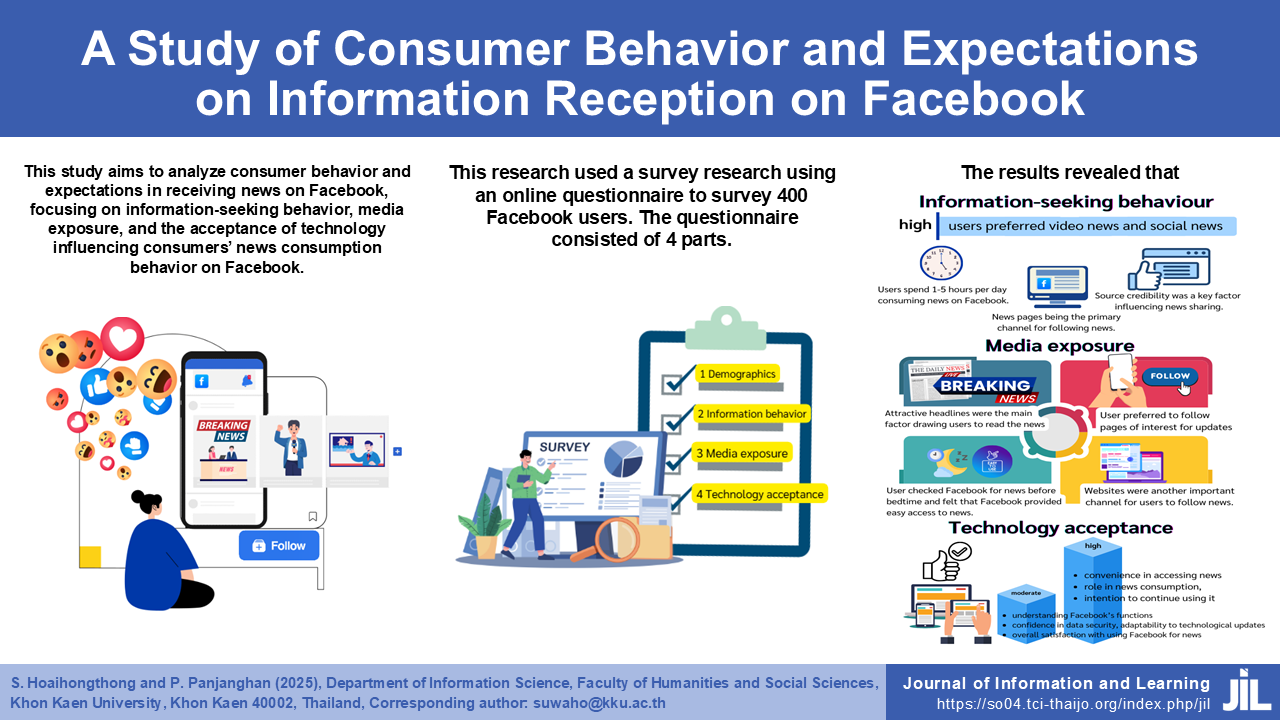
This study aims to analyze consumer behavior and expectations towards news reception on Facebook, focusing on information-seeking behavior, media exposure, and the acceptance of technology influencing consumers’ news consumption behavior on Facebook. An online questionnaire was used to survey 400 Facebook users. The results were as follows. 1) Regarding information-seeking behavior, most users spent 1-5 hours per day consuming news on Facebook, with news pages being the primary channel for following news. The reliability of the sources was a key factor influencing news sharing, video reports and social news were the most popular. 2) Regarding media exposure, websites were another important channel for users to follow news. Attractive headlines were the main factor drawing users to the news, and pages of the users’ interests were followed for updates. Most users checked Facebook for news before bedtime and felt that Facebook provided easy access to news. 3) Concerning technology acceptance, users rated Facebook at the high level for its convenience in accessing news, its role in news exposure, and their intention to continue using it. However, the understanding of functions on Facebook, confidence in data security, adaptability to technological updates, and overall satisfaction with using Facebook for news updates were rated at the moderate level. These findings can be utilized to develop communication strategies on Facebook that align with consumer behavior and to enhance confidence in personal data security on the platform.
References
Adisa, D. (2023). Everything you need to know about social media algorithms. Sprout Social. https://sproutsocial.com/insights/social-media-algorithms
Agarwal, V., Singhal, S., & Verma, R. (2023). Effect of Facebook news use on political attitudes and participation. Multidisciplinary Science Journal, 5, e2023ss0212. https://doi.org/10.31893/multiscience.2023ss0212
Al-Azawei, A. (2018). Predicting the adoption of social media: An integrated model and empirical study on Facebook usage. Interdisciplinary Journal of Information, Knowledge, and Management, 13, 233–258. https://doi.org/10.28945/4106
Ali, K., Li, C., Zain-ul-abdin, K., & Zaffar, M. A. (2021). Fake news on Facebook: Examining the impact of heuristic cues on perceived credibility and sharing intention. Internet Research, 32(1), 379–397. https://doi.org/10.1108/intr-10-2019-0442
Allam, H., Akre, V., Blustein, J., Toze, S., & Kalota, F. (2022). Factors affecting people’s adoption of Facebook: A UAE case study. 2022 8th International Conference on Information Technology Trends (ITT), Dubai, United Arab Emirates. https://doi.org/10.1109/itt56123.2022.9863947
Baştürk, E. Ş. (2024). Creating value for the digital reader in the context of sustainable journalism. Akdeniz Üniversitesi Iletişim Fakültesi Dergisi, 44, 31–44. https://doi.org/10.31123/akil.1349657
Camara, C. E., Lim, R. L., Natanauan, F. S., & Pascual, J. S. (2018). Measuring the effectiveness of the Facebook content orientations of chosen social enterprises. animo repository. https://animorepository.dlsu.edu.ph/etd_bachelors/7996
Carmen, M., Amo, A., Carlota, L.-R., Ángel, M., & Borja, G. (2012). Analysis of acceptance of social networking sites. African Journal of Business Management, 6(29), 8609–8619. https://www.researchgate.net/publication/269673201_Analysis_of_acceptance_of_social_networking_sites
Chandramouli, A. (2022). Enhancing digital user experiences through personalized interfaces and predictive modelling. Journal of Artificial Intelligence & Cloud Computing, 2(4), 1–6. https://doi.org/10.47363/JAICC/2023(2)265
Chanvisetlak, P., & Nedpogaeo, A. (2020). Facebook Page: Communication from television to social media on ThairathTV. Journal of Communication Arts, 38(2), 1–15. https://so02.tci-thaijo.org/index.php/jcomm/article/view/235778
Chomborisut, N., & Srisornkompon, P. (2019). Media exposure behavior and news perception on Khaosod Facebook of population in Bangkok metropolitan. Journal of Graduate School Sakon Nakhon Rajabhat University, 16(73), 196–202. https://so02.tci-thaijo.org/index.php/SNGSJ/article/view/112006
Cinelli, M., Brugnoli, E., Schmidt, A. L., Zollo, F., Quattrociocchi, W., & Scala, A. (2020). Selective exposure shapes the Facebook news diet. PLOS ONE, 15(3), e0229129. https://doi.org/10.1371/journal.pone.0229129
Gottfried, J., & Shearer, E. (2016). News use across social media platforms 2016. Pew Research Center.
Happer, C., & Philo, G. (2016). New approaches to understanding the role of the news media in the formation of public attitudes and behaviours on climate change. European Journal of Communication, 31(2), 136–151. https://doi.org/10.1177/0267323115612213
Kunviroteluck, B., Issadisa, S., & Tubtiang, A. (2020). Factors reducing the spread of fake news on social media. Journal of Humanities and Social Sciences, Rajapruk University, 6(2), 196-213. https://so03.tci-thaijo.org/index.php/rpu/article/view/246227
Lee, L., Ocepek, M. G., & Makri, S. (2021). Information behavior patterns: A new theoretical perspective from an empirical study of naturalistic information acquisition. Journal of the Association for Information Science and Technology, 73, 594–608. https://doi.org/10.1002/asi.24595
Loecherbach, F. (2023). Diversity of news consumption in a digital information environment [Doctoral dissertation, Vrije Universiteit Amsterdam]. Research and Graduation Internal. https://doi.org/10.5463/thesis.165
Lysyniuk, M., & Baida, I. (2024). Transformation of media consumption culture in the conditions of digitalization of society. National Academy of Managerial Staff of Culture and Arts Herald, 2. https://doi.org/10.32461/2226-3209.2.2024.308260
Metzger, M. J. (2007). Making sense of credibility on the web: Models for evaluating online information and recommendations for future research. Journal of the American Society for Information Science and Technology, 58(13), 2078–2091. https://doi.org/10.1002/asi.20672
Prasitrittichai, P., Bhibulbhanuvat, S., & Boonrugsa, T. (2024). Controversial content sharing behavior on Facebook of undergraduates in Bangkok. Journal of Communication and Management NIDA (E-Journal), 10(2), 80–94. https://so12.tci-thaijo.org/index.php/jcmn/article/view/1198
Prathum, S., & U-senyang, S. (2022). Information technology acceptance in the new normal. Journal of Lawasri, 6(1), 1–18. https://so04.tci-thaijo.org/index.php/lawasrijo/article/view/257078
Praveena, K. P., & Thomas, S. (2014). Continuance intention to use Facebook: A study of perceived enjoyment and TAM. Bonfring International Journal of Industrial Engineering and Management Science, 4(1), 24–29. https://doi.org/10.9756/bijiems.4794
Raharjo, J. S. D., Kholil, K., & Sunuantari, M. (2021). Acceptance and behavior of social media use: Causality analysis of media needs, media choice and intervening characteristics of social media innovations. South Asian Journal of Social Studies and Economics, 10(4), 36–58. https://doi.org/10.9734/sajsse/2021/v10i430272
Rauniar, R., Rawski, G., Yang, J., & Johnson, B. (2014). Technology acceptance model (TAM) and social media usage: An empirical study on Facebook. Journal of Enterprise Information Management, 27(1), 6–30. https://doi.org/10.1108/jeim-04-2012-0011
Rudposhti, Z. N., Zahedfar, K., & Abadi, R. (2016). Formation of the attitude and behavioral intention to use of social network users by their experience: From the perspective of technology acceptance model. International Journal of Humanities and Social Sciences, 794–818. https://api.semanticscholar.org/CorpusID:56326022
Ruthven, I. (2021). An information behavior theory of transitions. Journal of the Association for Information Science and Technology, 73(4), 579–593. https://doi.org/10.1002/asi.24588
Saima, A., Iqbal, N., & Ishaq, R. (2022). Social media as a news source: An analysis of Facebook. Global Multimedia Review, 5(1), 24–46. https://doi.org/10.31703/gmmr.2022(v-i).03
Schmidt, F., Mangold, F., Stier, S., & Ulloa, R. (2024). Facebook as an avenue to news: A comparison and validation of approaches to identify Facebook referrals. Political Communication, 41(6), 1–23. https://doi.org/10.1080/10584609.2024.2342983
Schmidt, A. L., Zollo, F., Del Vicario, M., Bessi, A., Scala, A., Caldarelli, G., Stanley, H. E., & Quattrociocchi, W. (2017). Anatomy of news consumption on Facebook. Proceedings of the National Academy of Sciences, 114(12), 3035–3039. https://doi.org/10.1073/pnas.1617052114
Sinsuk, P. (2024, July 7). Digital fatigue saphāwa khwām nư̄ai lā thā ngō̜di čhi than nưng nai hētphon yai tham Khon Thai Burnout [Digital fatigue, the state of digital fatigue, one of the biggest reasons why Thai people burnout]. Bangkokbiznews. https://www.bangkokbiznews.com/tech/gadget/1134685
Weeks, B. E., & Holbert, R. L. (2013). Predicting dissemination of news content in social media: A focus on reception, friending, and partisanship. Journalism & Mass Communication Quarterly, 90(2), 212–232. https://doi.org/10.1177/1077699013482906
Wilson, T. D. (2000). Human information behavior. Informing Science: The International Journal of an Emerging Transdiscipline, 3(2), 49–56. https://doi.org/10.28945/576
Yamane, T. (1973). Statistics: An introductory analysis. Harper & Row.
Yin, L. (2023). The changing landscape of media communication: An analysis of the impact of new media marketing on news consumption and consumer behavior. International Journal of Education and Humanities, 11(3), 9–12. https://doi.org/10.54097/ijeh.v11i3.14436
Downloads
Additional Files
Published
How to Cite
Issue
Section
Categories
License
Copyright (c) 2025 Journal of Information and Learning [JIL]

This work is licensed under a Creative Commons Attribution-NonCommercial-NoDerivatives 4.0 International License.
The Journal of Information and Learning is operated by the Office of Academic Resources, Prince of Songkla University. All articles published in the journal are protected by Thailand copyright law. This copyright covers the exclusive rights to share, reproduce and distribute the article, including in electronic forms, reprints, translations, photographic reproductions, or similar. Authors own copyrights in the works they have created as well as the Office of Academic Resources. The Journal reserves the right to edit the language of papers accepted for publication for clarity and correctness, as well as to make formal changes to ensure compliance with the journal's guidelines. All authors must take public responsibility for the content of their paper.


