
Design of a Virtual Learning System Enhanced With Artificial Intelligence for Training Lighting and Shading Skills in 3D Design
Keywords:
virtual platform, artificial intelligence, 3D work, lighting and shading, human-centered designAbstract
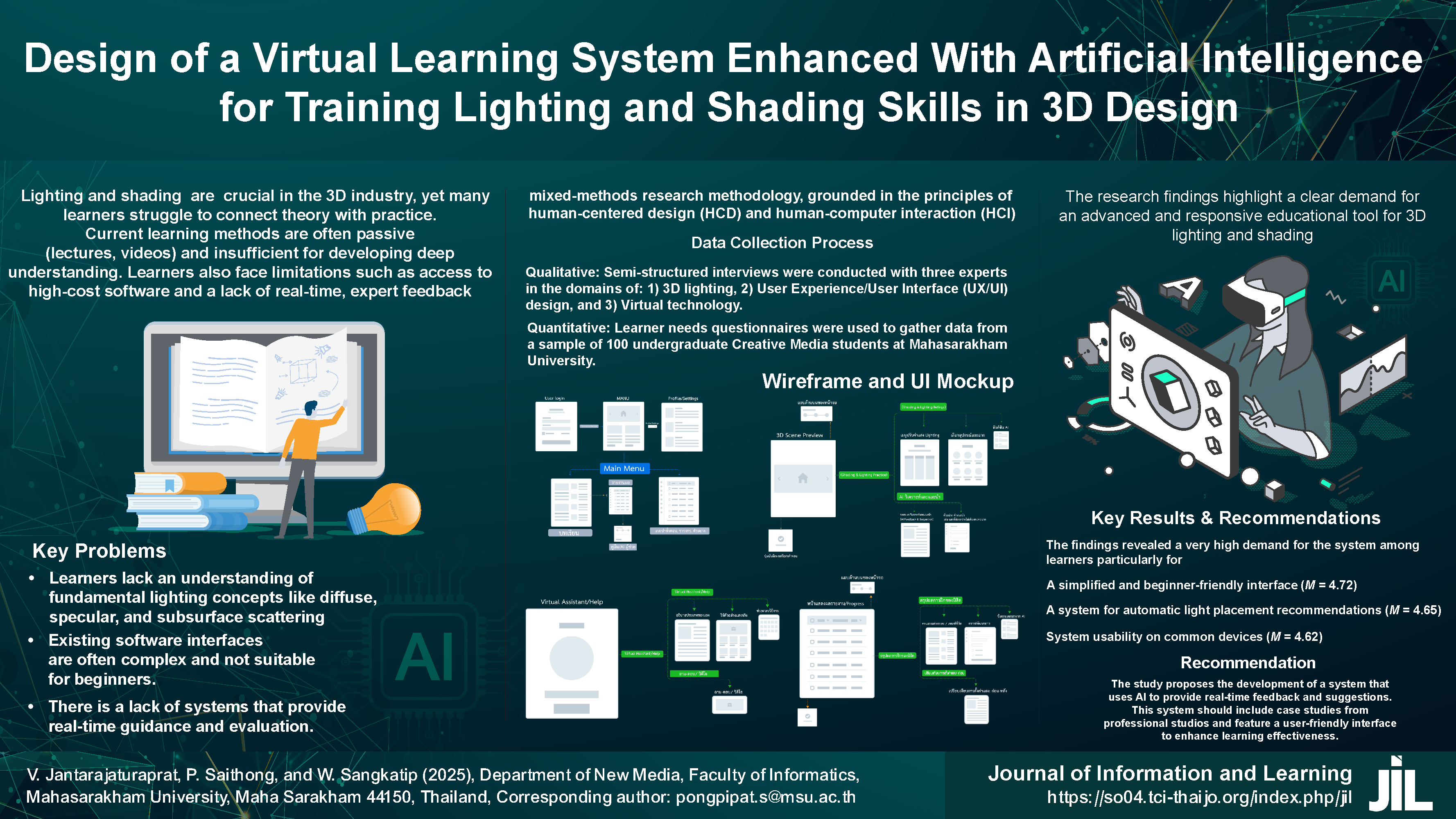
This research aimed to design a virtual platform integrated with artificial intelligence (AI) for learning lighting and shading in three-dimensional (3D) work. The objectives were: 1) to analyze the problems and learning needs related to lighting and shading in 3D environments, and 2) to design a virtual platform architecture with AI integration to enhance the learning experience. A mixed-method was employed in this study, grounded in the principles of human-centered design (HCD) and human-computer interaction (HCI). Qualitative data was collected through semi-structured interviews with experts in three areas of expertise: 3D lighting, user experience and interface design (UX/UI), and virtual technology. Quantitative data were obtained from 100 undergraduate students majoring in Creative Media at Mahasarakham University. The research instruments included semi-structured interview forms and learners’ need assessment questionnaires. The findings revealed that 1) students lacked understanding of fundamental lighting concepts such as diffuse, specular, and subsurface scattering, indicating the necessity of a system capable of analyzing and providing real-time AI-based feedback; and 2) students reported a very high demand for such a system (M = 4.52, SD = 0.54), particularly in terms of a simplified and beginner-friendly interface (M = 4.72, SD = 0.45). The research proposed a prototype platform architecture comprising four key components: a scene selection interface, a lighting training module, a result comparison module, and a virtual assistant interface. The design emphasized usability, multi-device compatibility, and clear visual communication. The results indicated that this platform design aligned with the needs of both students and experts and demonstrated strong potential for development as an effective educational tool for enhancing shading and lighting skills in 3D media production.
References
Ayeni, A. O., Ovbiye, R. E., Onayemi, A. S., & Ojedele, K. E. (2024). AI-driven adaptive learning platforms: Enhancing educational outcomes for students with special needs through user-centric, tailored digital tools. World Journal of Advanced Research and Reviews, 22(3), 2253–2265. https://doi.org/10.30574/wjarr.2024.22.3.0843
Birn, J. (2017). Digital lighting and rendering (3rd ed.). New Riders.
Braun, V., & Clarke, V. (2006). Using thematic analysis in psychology. Qualitative Research in Psychology, 3(2), 77–101. https://doi.org/10.1191/1478088706qp063oa
Card, S. K., Moran, T. P., & Newell, A. (1983). The psychology of human-computer interaction. Lawrence Erlbaum Associates.
Chatwattana, P., Saisong, P., Rojanapasnichwong, K., & Khiankhokkruad, W. (2023). The Virtual laboratory learning environment: VLLE on metaverse for university in Thailand. International Journal of Engineering Pedagogy, 13(5), 30–41. https://doi.org/10.3991/ijep.v13i5.38565
Dihlmann, D., Majumdar, A., Engelhardt, K., Braun, M., & Lensch, H. P. A. (2024). Subsurface scattering for 3D gaussian splatting. The 38th Conference on Neural Information Processing Systems (NeurIPS 2024). https://arxiv.org/abs/2408.12282
Guettala, M., Bourekkache, S., Kazar, O., & Harous, S. (2024). Generative artificial intelligence in education: Advancing adaptive and personalized learning. Acta Informatica Pragensia, 13(3), 460–489. https://doi.org/10.18267/j.aip.235
Gupta, T., Kumar, A., Roy, B. K., & Saini, S. (2024). Adaptive learning systems: Harnessing AI to personalize educational outcomes. International Journal for Research in Applied Science and Engineering Technology, 12(5), Article 65088. https://doi.org/10.22214/ijraset.2024.65088
Kollerup, N. K., Johansen, S. S., Tolsgaard, M. G., Friis, M. L., Skov, M. B., & van Berkel, N. (2024). Clinical needs and preferences for AI-based explanations in clinical simulation training. Computer Supported Cooperative Work, 33(6), 954–974. https://doi.org/10.1080/0144929X.2024.2334852
Likert, R. (1932). A technique for the measurement of attitudes. Archives of Psychology, 22(140), 5–55. https://legacy.voteview.com/pdf/Likert_1932.pdf
Mou, T. -Y. (2024). The practice of visual storytelling in STEM: Influence of creative thinking training on design students’ creative self-efficacy and motivation. Thinking Skills and Creativity, 51, Article 101459. https://doi.org/10.1016/j.tsc.2023.101459
Munshi, A., Biswas, G., Davalos, E., Logan, O., Narasimham, G., & Rushdy, M. (2022, November 28). Adaptive scaffolding to support strategic learning in an open-ended learning environment [Conference presentation]. The 30th International Conference on Computers in Education, Kuala Lumpur, Malaysia. https://library.apsce.net/index.php/ICCE/article/view/4471
Norman, D. A. (2013). The design of everyday things: Revised and expanded edition. Basic Books.
Pharr, M., Jakob, W., & Humphreys, G. (2023). Physically based rendering: From theory to implementation (3rd ed.). Morgan Kaufmann. https://cw.fel.cvut.cz/b221/_media/courses/b4m39rso/lectures/physically_based_rendering_third_edition.pdf
Ruokamo, H., Kangas, M., Vuojärvi, H., Sun, L., & Qvist, P. (2023). AI-supported simulation-based learning: Learners' emotional experiences and self-regulation in challenging situations. In H. Niemi, A. Kallioniemi, & A. Toom (Eds.), AI in learning: Designing the future (pp. 175–194). Springer Nature Switzerland AG. https://doi.org/10.1007/978-3-031-09687-7_11
Soodtoetong, N., & Rattanasiriwongwut, M. (2024). A virtual reality model for STEM education in Thailand. The 2024 AI-SIPM Conference, Phuket, Thailand. https://doi.org/10.1145/3643487.3662170
Tanasirathum, P., Chaisena, N., Pasawapa, W., & Sangkatip, W. (2024). The development of chatbot system for cooperative and work-integrated education using machine learning method. Journal of Information and Learning, 35(2), 142–155. https://so04.tci-thaijo.org/index.php/jil/article/view/271130
Topalli, P., Ortega Arranz, A., Rodríguez Triana, M. J., Er, E., Khalil, M., & Akçapınar, G. (2024). Designing human centered learning analytics and artificial intelligence in education solutions: A systematic literature review. Behaviour & Information Technology, 44(5), 1071–1098. https://doi.org/10.1080/0144929X.2024.2345295
Yaseen, H., Mohammad, A. S., Ashal, N., Abusaimeh, H., Ali, A., & Sharabati, A.-A. A. (2025). The impact of adaptive learning technologies, personalized feedback, and interactive AI tools on student engagement: The moderating role of digital literacy. Sustainability, 17(3), Article 1133. https://doi.org/10.3390/su17031133
Zhu, H., Saito, S., Bozic, A., Aliaga, D. G., Darrell, T., & Lassner, C. (2023). Neural relighting with subsurface scattering by learning the radiance transfer gradient. arXiv. https://arxiv.org/abs/2306.09322
Downloads
Additional Files
Published
How to Cite
Issue
Section
Categories
License
Copyright (c) 2025 Journal of Information and Learning [JIL]

This work is licensed under a Creative Commons Attribution-NonCommercial-NoDerivatives 4.0 International License.
The Journal of Information and Learning is operated by the Office of Academic Resources, Prince of Songkla University. All articles published in the journal are protected by Thailand copyright law. This copyright covers the exclusive rights to share, reproduce and distribute the article, including in electronic forms, reprints, translations, photographic reproductions, or similar. Authors own copyrights in the works they have created as well as the Office of Academic Resources. The Journal reserves the right to edit the language of papers accepted for publication for clarity and correctness, as well as to make formal changes to ensure compliance with the journal's guidelines. All authors must take public responsibility for the content of their paper.


