
Analysis and Lessons Learned From Information Systems Failures: A Case Study of the Major Flood Disaster in Hat Yai District, Songkhla Province Using Tan’s IS Failure Framework and the DeLone & McLean IS Success Model
Keywords:
disaster management, lessons learned, flood event, information failure, blueprint for changesAbstract
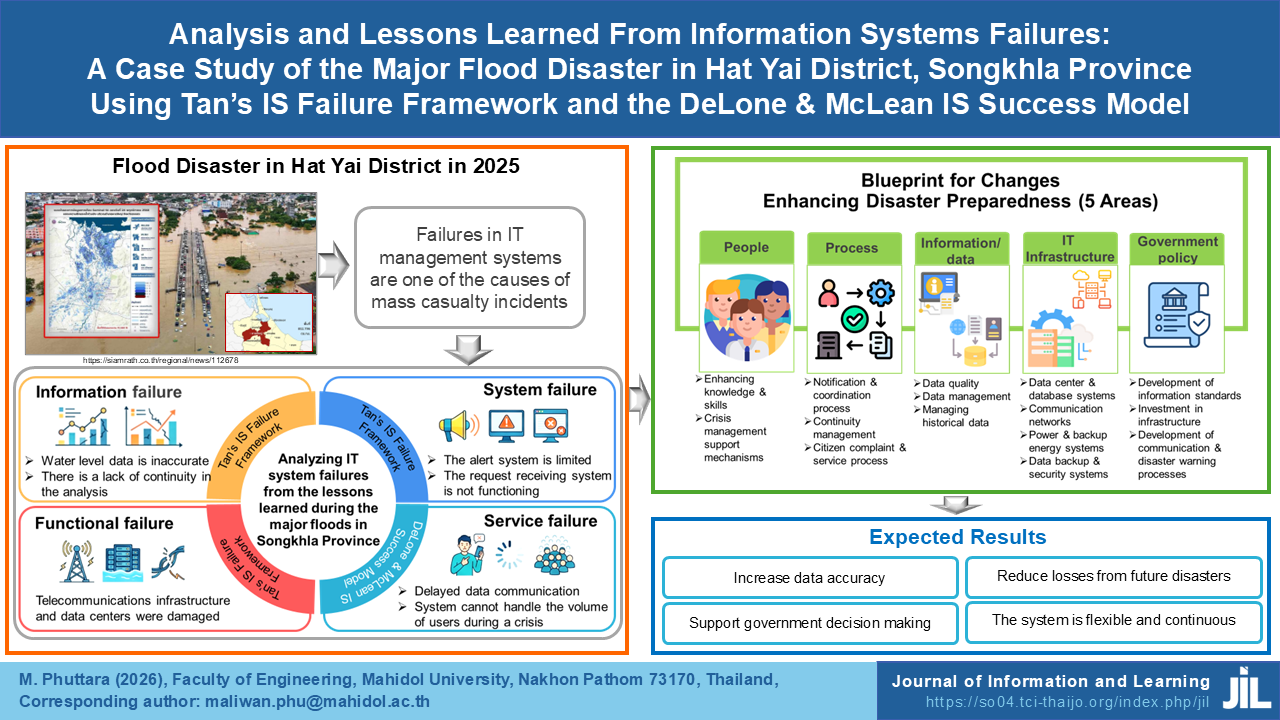
The major flood in Hat Yai District, Songkhla Province, in November 2025 caused severe impacts on communities, infrastructure, and public administration systems. One factor that constrained effective disaster management was the failure of information systems (IS), which play critical roles in communication, early warning dissemination, and decision support during emergency situations. This article aims to analyze and derive lessons learned from IS failures that occurred during the flood event. This study employs a conceptual analysis approach, applying Tan’s IS Failure Framework and the DeLone and McLean Information Systems Success Model to explain the characteristics and causes of IS failures in the context of disaster management. The findings indicate that these failures can be classified into four categories: 1) information failures, as evidenced by inaccurate and discontinuous water-level data; 2) functional failures, including limited performance of early warning systems and complaint-handling platforms; 3) system failures, notably damage to telecommunications infrastructure and data centers; and 4) service failures, including delayed communication, lack of backup channels, and limited system capacity during crisis periods. Based on these lessons, the study proposed a blueprint for change to enhance the preparedness of disaster information systems. This blueprint covers five dimensions: people, processes, information/data, technological infrastructure, and government policy. This framework serves as a guide for developing more accurate more accurate, resilient, and high-availability information systems to support public-sector decision-making and reduce disaster-related losses in the future.
References
Baraldo, M., & Di Franco, P. D. G. (2024). Place-centred emerging technologies for disaster management: A scoping review. International Journal of Disaster Risk Reduction, 112, Article 104782. https://doi.org/10.1016/j.ijdrr.2024.104782
Bingöl, E. S., Ünsal, Ö., & Aksak, P. (2025). Stakeholder participation in disaster risk management: The case of Provincial Disaster Risk Reduction Plan (IRAP) of Istanbul. International Journal of Disaster Risk Reduction, 125, Article 105570. https://doi.org/10.1016/j.ijdrr.2025.105570
Calle Müller, C., & ElZomor, M. (2025). The role of disruptive technologies in enhancing disaster response and resilience in low-income communities. International Journal of Disaster Resilience in the Built Environment, 16(5), 604–619. https://doi.org/10.1108/IJDRBE-12-2024-0136
DeLone, W. H., & McLean, E. R. (2003). The DeLone and McLean model of information systems success: A ten-year update. Journal of Management Information Systems, 19(4), 9–30. https://doi.org/10.1080/07421222.2003.11045748
Djoumessi, Y. F., & Mbongo, L. D. B. E. (2022). An analysis of information communication technologies for natural disaster management in Africa. International Journal of Disaster Risk Reduction, 68. Article 102722. https://doi.org/10.1016/j.ijdrr.2021.102722
Hao, J., Zou, X., Chen, Y., & Liu, Y. (2025). The influence of reference knowledge on the digital service quality and incentive mechanism. Journal of Innovation & Knowledge, 10(4), Article 100745. https://doi.org/10.1016/j.jik.2025.100745
Kamboj, S., Sharma, M., & Sarmah, B. (2022). Impact of mobile banking failure on bank customers' usage behaviour: The mediating role of user satisfaction. International Journal of Bank Marketing, 40(1), 128–153. https://doi.org/10.1108/IJBM-10-2020-0534
Khaosod. (2025, November 30). Nam thūam Songkhla sīachīwit lǣo 131 rāi sāhēt čhom nam Hat Yai nak sut phū prasop phai 2.43 sǣn khon [Songkhla floods: 131 deaths reported, drowning the main cause; Hat Yai hardest hit, 243,000 affected. https://www.khaosod.co.th/around-thailand/news_10040746
Lee, J., Song, M. S., Hwang, J., & Hong, S. B. (2025). Evaluating the disaster response capacity of the Korean citizen corps in rural areas: A system dynamics–GIS approach. iScience, 28(7), Article 112997. https://doi.org/10.1016/j.isci.2025.112997
Lu, Z., Yan, D., Jiang, H., Xue, H., & Xu, Z. -D. (2025). Cascading failures in urban infrastructure systems: A comprehensive review of disaster chain mechanisms. Journal of Infrastructure Intelligence and Resilience, 4(3), Article 100157. https://doi.org/10.1016/j.iintel.2025.100157
Lu, Y., Zhai, G., & Zhou, S. (2024). An integrated Bayesian networks and Geographic information system (BNs-GIS) approach for flood disaster risk assessment: A case study of Yinchuan, China. Ecological Indicators, 166, Article 112322. https://doi.org/10.1016/j.ecolind.2024.112322
Mustafa, S. Z., Kar, A. K., & Janssen, M. F. W. H. A. (2020). Understanding the impact of digital service failure on users: Integrating Tan’s failure and DeLone and McLean’s success model. International Journal of Information Management, 53, Article 102119. https://doi.org/10.1016/j.ijinfomgt.2020.102119
Nespeca, V., Comes, T., Meesters, K., & Brazier, F. (2020). Towards coordinated self-organization: An actor-centered framework for the design of disaster management information systems. International Journal of Disaster Risk Reduction, 51, Article 101887. https://doi.org/10.1016/j.ijdrr.2020.101887
Noomnon, T. (2025, November 28). Botrīan čhāk nam thūam Hat Yai thammai theknōlōyī yāng dīeo čhưng kū wikrit mai dai [Lessons from Hat Yai floods: Why technology alone cannot solve the crisis. Bangkok Biz News. https://www.bangkokbiznews.com/tech/ai/1209690
Rafi, M. M., Aziz, T., & Lodi, S. H. (2018). A comparative study of disaster management information systems. Online Information Review, 42(6), 971–988. https://doi.org/10.1108/OIR-06-2016-0168
Sausi, J. M., Kitali, E. J., & Mtebe, J. S. (2021). Evaluation of local government revenue collection information system success in Tanzania. Digital Policy, Regulation and Governance, 23(5), 437–455. https://doi.org/10.1108/DPRG-04-2021-0055
Shigeyasu, T., & Matsumoto, N. (2020). A new and effective disaster information sharing system gathering data locally and widely based on mobility of the mobile agent. Internet of Things, 11, Article 100226. https://doi.org/10.1016/j.iot.2020.100226
Siriwardhana, S. D., & Kulatunga, U. (2025). Digital information and coordination system for disaster preparedness in Sri Lanka. International Journal of Disaster Risk Reduction, 120, Article 105347. https://doi.org/10.1016/j.ijdrr.2025.105347
Sumrit, D., & Jongprasittiphol, O. (2025). Analyzing readiness factors for organizational disaster management in upstream automotive supply chains based on neutrosophic DEMATEL model. Results in Engineering, 28, Article 108254. https://doi.org/10.1016/j.rineng.2025.108254
Susanty, A., Puspitasari, N. B., Jie, F., Akhsan, F. A., & Jati, S. (2025). Consumer acceptance of halal food traceability systems: A novel integrated approach using modified UTAUT and DeLone & McLean models to promote sustainable food supply chain practices. Cleaner Logistics and Supply Chain, 15, Article 100226. https://doi.org/10.1016/j.clscn.2025.100226
Tan, C. W., Benbasat, I., & Cenfetelli, R. T. (2016). An exploratory study of the formation and impact of electronic service failures. MIS Quarterly, 40(1), 1–29. https://doi.org/10.25300/MISQ/2016/40.1.01
Trinh, T. T., & Jensen, O. (2025). Finding out about disaster risk: Global evidence on who seeks information, which sources they use, and whether it makes them better prepared. International Journal of Disaster Risk Reduction, 124, Article 105553. https://doi.org/10.1016/j.ijdrr.2025.105553
Wood, E. X. (2025). AI and big data in disaster response: Ethical and practical challenges. Journal of Dynamic Disasters, 1(4), Article 100041. https://doi.org/10.1016/j.jdd.2025.100041
Xiao, S., Gu, H., Shen, D., Niu, Z., Xiao, J., & Yu, F. (2025). A systematic review of social media-enabled flood disaster Informatics: Method, technology and application. International Journal of Applied Earth Observation and Geoinformation, 144, Article 104935. https://doi.org/10.1016/j.jag.2025.104935
Zheng, F., Wang, K., Wang, Q., Yu, T., Wang, L., Zhang, X., Wu, X., Zhou Q., & Tan, L. (2023). Factors influencing clinicians’ use of hospital information systems for infection prevention and control: Cross-sectional study based on the extended DeLone and McLean Model. Journal of Medical Internet Research, 25, Article e44900. https://doi.org/10.2196/44900
Downloads
Additional Files
Published
How to Cite
Issue
Section
Categories
License
Copyright (c) 2026 Journal of Information and Learning

This work is licensed under a Creative Commons Attribution-NonCommercial-NoDerivatives 4.0 International License.
Free access to published articles. Current licensing policy: CC BY-NC 4.0 from Volume 37, Issue 2 (2026). For earlier articles, consult the rights information on the individual article page. See our Open Access, Copyright and Licensing policy.


