
การวิเคราะห์และถอดบทเรียนความล้มเหลวของระบบเทคโนโลยีสารสนเทศ กรณีศึกษาเหตุการณ์อุทกภัยใหญ่ อำเภอหาดใหญ่ จังหวัดสงขลา โดยประยุกต์กรอบแนวคิด Tan’s IS Failure และ DeLone & McLean IS Success Model
คำสำคัญ:
การจัดการภัยพิบัติ, ถอดบทเรียน, เหตุการณ์อุทกภัย, ความล้มเหลวของระบบเทคโนโลยีสารสนเทศ, พิมพ์เขียวการเปลี่ยนแปลงบทคัดย่อ
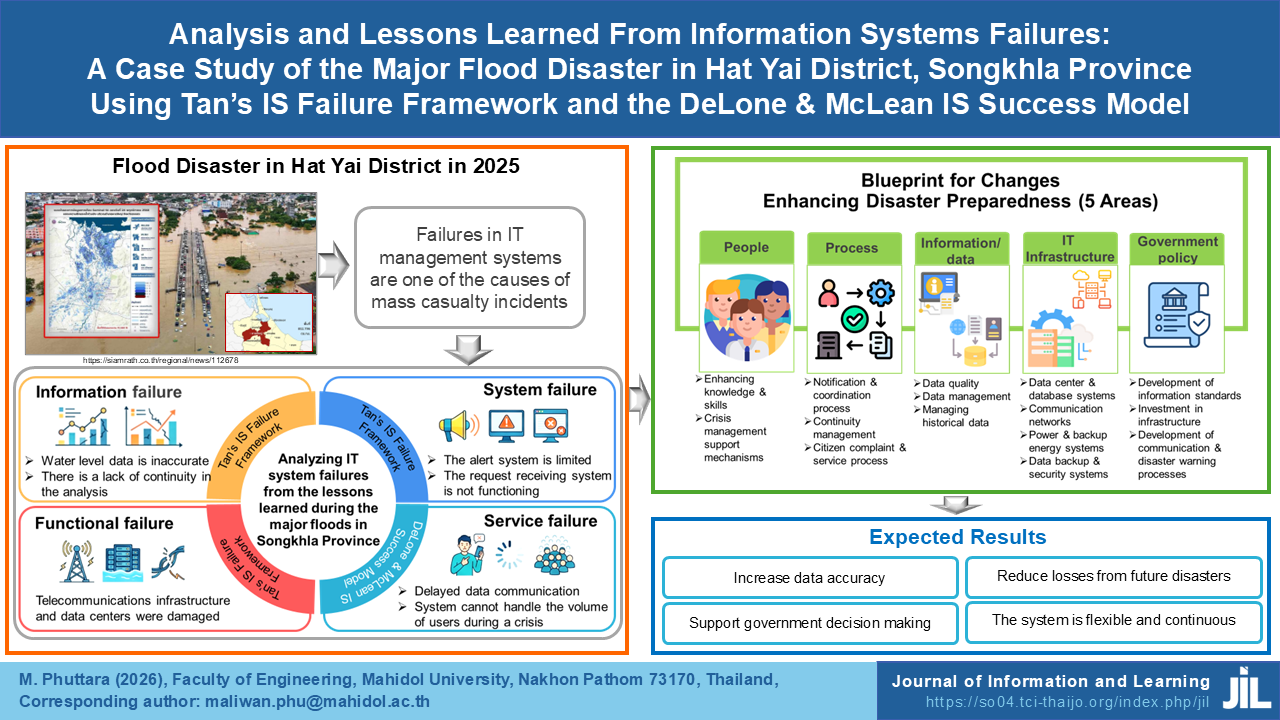
เหตุการณ์อุทกภัยใหญ่ในอำเภอหาดใหญ่ จังหวัดสงขลา เมื่อเดือนพฤศจิกายน พ.ศ. 2568 ส่งผลกระทบอย่างรุนแรงต่อประชาชน โครงสร้างพื้นฐานและระบบการบริหารจัดการของภาครัฐ โดยพบว่า ความล้มเหลวของระบบเทคโนโลยีสารสนเทศซึ่งเป็นกลไกสำคัญในการสื่อสาร การแจ้งเตือนภัย และการสนับสนุนการตัดสินใจในภาวะฉุกเฉิน เป็นปัจจัยหนึ่งที่ทำให้การจัดการภัยพิบัติมีข้อจำกัด ดังนั้น บทความนี้มีวัตถุประสงค์เพื่อวิเคราะห์และถอดบทเรียนความล้มเหลวของระบบเทคโนโลยีสารสนเทศที่เกิดขึ้นในช่วงเหตุการณ์อุทกภัยดังกล่าว การศึกษานี้ใช้การวิเคราะห์เชิงแนวคิดโดยประยุกต์กรอบแนวคิด Tan’s IS Failure Framework และ DeLone & McLean IS Success Model เพื่ออธิบายลักษณะและสาเหตุของความล้มเหลวของระบบเทคโนโลยีสารสนเทศในบริบทการจัดการภัยพิบัติ ผลการศึกษาพบว่า ความล้มเหลวของระบบสามารถจำแนกออกเป็น 4 ประเภท ได้แก่ 1) ความล้มเหลวด้านข้อมูลสารสนเทศ เช่น ข้อมูลระดับน้ำคลาดเคลื่อนและขาดความต่อเนื่อง 2) ความล้มเหลวด้านการทำงานของระบบ เช่น ระบบแจ้งเตือนภัยและระบบรับคำร้องทำงานได้จำกัด 3) ความล้มเหลวเชิงระบบ อาทิ โครงสร้างพื้นฐานโทรคมนาคมและศูนย์ข้อมูลได้รับความเสียหาย และ 4) ความล้มเหลวด้านการให้บริการ เช่น การสื่อสารข้อมูลล่าช้า ขาดช่องทางสำรอง และระบบไม่รองรับปริมาณผู้ใช้งานในช่วงวิกฤติ จากการถอดบทเรียน บทความนี้เสนอ พิมพ์เขียวการเปลี่ยนแปลง เพื่อยกระดับความพร้อมของระบบเทคโนโลยีสารสนเทศในการรับมือสาธารณภัย ครอบคลุม 5 มิติ ได้แก่ คน กระบวนการ ข้อมูล/สารสนเทศ โครงสร้างพื้นฐานเทคโนโลยี และนโยบายภาครัฐ แนวทางดังกล่าวสามารถใช้เป็นกรอบในการพัฒนาระบบเทคโนโลยีสารสนเทศด้านการจัดการภัยพิบัติ เพื่อเพิ่มความแม่นยำ ความยืดหยุ่น และความต่อเนื่องของระบบ ซึ่งจะช่วยสนับสนุนการตัดสินใจของหน่วยงานภาครัฐและลดความสูญเสียจากภัยพิบัติในอนาคต
เอกสารอ้างอิง
Baraldo, M., & Di Franco, P. D. G. (2024). Place-centred emerging technologies for disaster management: A scoping review. International Journal of Disaster Risk Reduction, 112, Article 104782. https://doi.org/10.1016/j.ijdrr.2024.104782
Bingöl, E. S., Ünsal, Ö., & Aksak, P. (2025). Stakeholder participation in disaster risk management: The case of Provincial Disaster Risk Reduction Plan (IRAP) of Istanbul. International Journal of Disaster Risk Reduction, 125, Article 105570. https://doi.org/10.1016/j.ijdrr.2025.105570
Calle Müller, C., & ElZomor, M. (2025). The role of disruptive technologies in enhancing disaster response and resilience in low-income communities. International Journal of Disaster Resilience in the Built Environment, 16(5), 604–619. https://doi.org/10.1108/IJDRBE-12-2024-0136
DeLone, W. H., & McLean, E. R. (2003). The DeLone and McLean model of information systems success: A ten-year update. Journal of Management Information Systems, 19(4), 9–30. https://doi.org/10.1080/07421222.2003.11045748
Djoumessi, Y. F., & Mbongo, L. D. B. E. (2022). An analysis of information communication technologies for natural disaster management in Africa. International Journal of Disaster Risk Reduction, 68. Article 102722. https://doi.org/10.1016/j.ijdrr.2021.102722
Hao, J., Zou, X., Chen, Y., & Liu, Y. (2025). The influence of reference knowledge on the digital service quality and incentive mechanism. Journal of Innovation & Knowledge, 10(4), Article 100745. https://doi.org/10.1016/j.jik.2025.100745
Kamboj, S., Sharma, M., & Sarmah, B. (2022). Impact of mobile banking failure on bank customers' usage behaviour: The mediating role of user satisfaction. International Journal of Bank Marketing, 40(1), 128–153. https://doi.org/10.1108/IJBM-10-2020-0534
Khaosod. (2025, November 30). Nam thūam Songkhla sīachīwit lǣo 131 rāi sāhēt čhom nam Hat Yai nak sut phū prasop phai 2.43 sǣn khon [Songkhla floods: 131 deaths reported, drowning the main cause; Hat Yai hardest hit, 243,000 affected. https://www.khaosod.co.th/around-thailand/news_10040746
Lee, J., Song, M. S., Hwang, J., & Hong, S. B. (2025). Evaluating the disaster response capacity of the Korean citizen corps in rural areas: A system dynamics–GIS approach. iScience, 28(7), Article 112997. https://doi.org/10.1016/j.isci.2025.112997
Lu, Z., Yan, D., Jiang, H., Xue, H., & Xu, Z. -D. (2025). Cascading failures in urban infrastructure systems: A comprehensive review of disaster chain mechanisms. Journal of Infrastructure Intelligence and Resilience, 4(3), Article 100157. https://doi.org/10.1016/j.iintel.2025.100157
Lu, Y., Zhai, G., & Zhou, S. (2024). An integrated Bayesian networks and Geographic information system (BNs-GIS) approach for flood disaster risk assessment: A case study of Yinchuan, China. Ecological Indicators, 166, Article 112322. https://doi.org/10.1016/j.ecolind.2024.112322
Mustafa, S. Z., Kar, A. K., & Janssen, M. F. W. H. A. (2020). Understanding the impact of digital service failure on users: Integrating Tan’s failure and DeLone and McLean’s success model. International Journal of Information Management, 53, Article 102119. https://doi.org/10.1016/j.ijinfomgt.2020.102119
Nespeca, V., Comes, T., Meesters, K., & Brazier, F. (2020). Towards coordinated self-organization: An actor-centered framework for the design of disaster management information systems. International Journal of Disaster Risk Reduction, 51, Article 101887. https://doi.org/10.1016/j.ijdrr.2020.101887
Noomnon, T. (2025, November 28). Botrīan čhāk nam thūam Hat Yai thammai theknōlōyī yāng dīeo čhưng kū wikrit mai dai [Lessons from Hat Yai floods: Why technology alone cannot solve the crisis. Bangkok Biz News. https://www.bangkokbiznews.com/tech/ai/1209690
Rafi, M. M., Aziz, T., & Lodi, S. H. (2018). A comparative study of disaster management information systems. Online Information Review, 42(6), 971–988. https://doi.org/10.1108/OIR-06-2016-0168
Sausi, J. M., Kitali, E. J., & Mtebe, J. S. (2021). Evaluation of local government revenue collection information system success in Tanzania. Digital Policy, Regulation and Governance, 23(5), 437–455. https://doi.org/10.1108/DPRG-04-2021-0055
Shigeyasu, T., & Matsumoto, N. (2020). A new and effective disaster information sharing system gathering data locally and widely based on mobility of the mobile agent. Internet of Things, 11, Article 100226. https://doi.org/10.1016/j.iot.2020.100226
Siriwardhana, S. D., & Kulatunga, U. (2025). Digital information and coordination system for disaster preparedness in Sri Lanka. International Journal of Disaster Risk Reduction, 120, Article 105347. https://doi.org/10.1016/j.ijdrr.2025.105347
Sumrit, D., & Jongprasittiphol, O. (2025). Analyzing readiness factors for organizational disaster management in upstream automotive supply chains based on neutrosophic DEMATEL model. Results in Engineering, 28, Article 108254. https://doi.org/10.1016/j.rineng.2025.108254
Susanty, A., Puspitasari, N. B., Jie, F., Akhsan, F. A., & Jati, S. (2025). Consumer acceptance of halal food traceability systems: A novel integrated approach using modified UTAUT and DeLone & McLean models to promote sustainable food supply chain practices. Cleaner Logistics and Supply Chain, 15, Article 100226. https://doi.org/10.1016/j.clscn.2025.100226
Tan, C. W., Benbasat, I., & Cenfetelli, R. T. (2016). An exploratory study of the formation and impact of electronic service failures. MIS Quarterly, 40(1), 1–29. https://doi.org/10.25300/MISQ/2016/40.1.01
Trinh, T. T., & Jensen, O. (2025). Finding out about disaster risk: Global evidence on who seeks information, which sources they use, and whether it makes them better prepared. International Journal of Disaster Risk Reduction, 124, Article 105553. https://doi.org/10.1016/j.ijdrr.2025.105553
Wood, E. X. (2025). AI and big data in disaster response: Ethical and practical challenges. Journal of Dynamic Disasters, 1(4), Article 100041. https://doi.org/10.1016/j.jdd.2025.100041
Xiao, S., Gu, H., Shen, D., Niu, Z., Xiao, J., & Yu, F. (2025). A systematic review of social media-enabled flood disaster Informatics: Method, technology and application. International Journal of Applied Earth Observation and Geoinformation, 144, Article 104935. https://doi.org/10.1016/j.jag.2025.104935
Zheng, F., Wang, K., Wang, Q., Yu, T., Wang, L., Zhang, X., Wu, X., Zhou Q., & Tan, L. (2023). Factors influencing clinicians’ use of hospital information systems for infection prevention and control: Cross-sectional study based on the extended DeLone and McLean Model. Journal of Medical Internet Research, 25, Article e44900. https://doi.org/10.2196/44900
ดาวน์โหลด
ไฟล์ประกอบ
เผยแพร่แล้ว
รูปแบบการอ้างอิง
ฉบับ
ประเภทบทความ
หมวดหมู่
สัญญาอนุญาต
ลิขสิทธิ์ (c) 2026 Journal of Information and Learning

อนุญาตภายใต้เงื่อนไข Creative Commons Attribution-NonCommercial-NoDerivatives 4.0 International License.
Journal of Information and Learning ดำเนินการโดยสำนักวิทยบริการ มหาวิทยาลัยสงขลานครินทร์ วิทยาเขตปัตตานี บทความที่ได้รับการตีพิมพ์ในวารสารได้รับความคุ้มครองตามกฎหมายลิขสิทธิ์ โดยเจ้าของลิขสิทธิ์จะมีสิทธิในการทำซ้ำ ดัดแปลง และเผยแพร่งานบทความ ทั้งรูปแบบอิเล็กทรอนิกส์ การทำฉบับสำเนา การแปล และการผลิตซ้ำในรูปแบบต่างๆ ลิขสิทธิ์บทความเป็นของผู้เขียนและสำนักวิทยบริการ มหาวิทยาลัยสงขลานครินทร์ วิทยาเขตปัตตานี วารสารฯ ขอสงวนสิทธิ์ในการพิจารณาตีพิมพ์ตามความเหมาะสม รวมทั้งการตรวจทานแก้ไข การปรับข้อความ หรือขัดเกลาภาษาให้ถูกต้องตามเกณฑ์ที่กำหนด สำหรับผลการวิจัยและความคิดเห็นที่ปรากฏในบทความถือเป็นความคิดเห็นและอยู่ในความรับผิดชอบของผู้เขียน


