
Development of a Board Game to Enhance Learning Achievement in Quality Store Systems for Retail Store Management
คำสำคัญ:
board game, learning achievement, quality store systems, retail store managementบทคัดย่อ
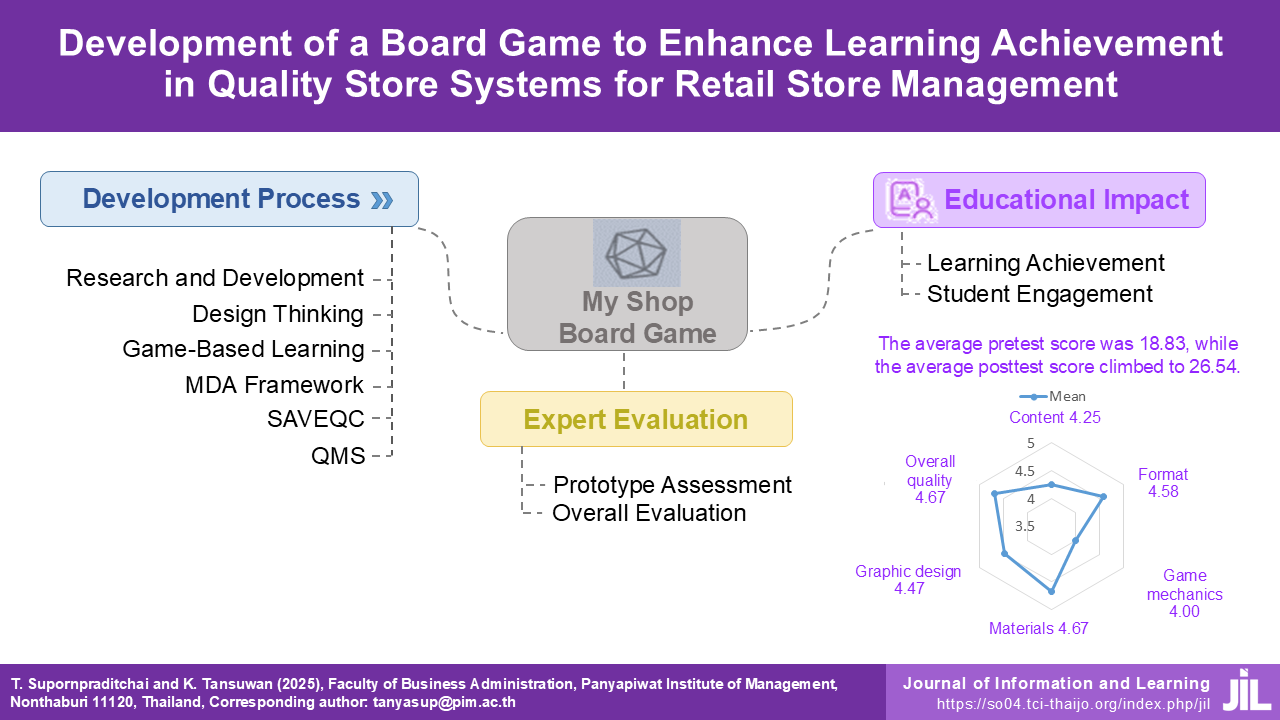
The objectives of this study were to 1) create a board game to improve learning achievement in the quality store system (QSS) for retail store management, and 2) measure students' learning outcomes after playing the game. The study used a research and development (R&D) strategy, including design thinking, game-based learning (GBL), and the mechanics-dynamics-aesthetics (MDA) framework to create "MyShop," a board game that simulates product selection, staffing decisions, and quality store systems. Purposive sampling was used to identify 30 key informants working for a major convenience store chain, including 10 QSS executives, 10 operational workers, and 10 store managers who were chosen based on their knowledge, position in QSS implementation, and participation willingness. In addition, three specialists in instructional game design and retail management analyzed and improved the board game prototype. The sample group consisted of 278 first-year students from the Modern Trade Business Management Program chosen at random using cluster sampling. The research instruments comprised 1) in-depth interviews and focus group questions examined using content analysis, 2) the "MyShop" board game prototype with cards (Situation, Product, Customer, Event, and QSS), tokens, and boards, and 3) a 35-item multiple-choice pretest and posttest. To assess changes in learning achievement, data from student assessments were evaluated with paired t-tests. The game is considered "very appropriate" by specialists, demonstrating its high quality and suitability for instructional usage. QSS knowledge improved significantly, with exam scores improving from 18.83 to 26.54 (p < .05). The game improved students' comprehension of QSS principles, including service, assortment, and value, while also encouraging interactive and practical learning. These findings show that combining GBL with MDA can result in immersive, effective educational tools. The "MyShop" board game is a unique way for students to learn retail management that encourages critical thinking, collaboration, and real-world application, making it useful for both academic and professional development.
เอกสารอ้างอิง
Alessa, A. I., & Hussein, S. (2023). Using traditional and modern teaching methods on the teaching process from teachers’ own perspective. Educational & Social Science Journal, 10(2), 65–92. https://www.ressjournal.com/Makaleler/1261510042_4.pdf
Alipova, A., Turganbayeva, A., Alimzhanova, L., Savelyeva, V., & Malybayev, R. (2024). Evaluating the effectiveness of gaming practices in enhancing computer science terminology learning among primary school students. International Journal of Information and Education Technology, 14(6), 865–875. https://www.ijiet.org/vol14/IJIET-V14N6-2112.pdf
Bayeck, R. Y. (2020). Examining board gameplay and learning: A multidisciplinary review of recent research. Simulation & Gaming, 51(4), 411–431. https://doi.org/10.1177/1046878119901286
Chew, K. S., Wong, S. S., Tarazi, I. S., Koh, J. W., Ridzuan, N. A. A., & Wan Allam, S. A. S. (2023). Tutorless board game as an alternative to tabletop exercise for disaster response training: Perception of interaction engagement and behavioral intention. BMC Medical Education, 23, Article 432. https://doi.org/10.1186/s12909-023-04356-4
CP All Public Company Limited. (2021). 2021 Annual report. https://www.cpall.co.th/wp-content/uploads/2022/04/CPALL-OR2021-TH_Hires.pdf
CP All Public Company Limited. (2008). 2008 Annual Report. https://www.cpall.co.th/wp-content/uploads/2020/03/Annual_Report_2008_TH.pdf
Freeman, S., Eddy, S. L., McDonough, M., Smith, M. K., Okoroafor, N., Jordt, H., & Wenderoth, M. P. (2014). Active learning increases student performance in science, engineering, and mathematics. Psychological and Cognitive Science, 111(23), 8410–8415. https://www.pnas.org/doi/epdf/10.1073/pnas.1319030111
Gkogkidis, V., & Dacre, N. (2020). Co-creating educational project management board games to enhance student engagement. European Conference on Game-Based Learning, Brighton, UK. https://doi.org/10.2139/ssrn.3812772
Guest, G., Bunce, A., & Johnson, L. (2006). How many interviews are enough? An experiment with data saturation and variability. Field Methods, 18(1), 59–82. https://doi.org/10.1177/1525822X05279903
Hunicke, R., Leblanc, M., & Zubek, R. (2004). MDA: A formal approach to game design and game research. https://users.cs.northwestern.edu/~hunicke/MDA.pdf
Kırikkaya, E. B., İşeri, Ş., & Vurkaya, G. (2010). Board game about space and solar system for primary school students. The Turkish Online Journal of Educational Technology, 9(2), 1–10. https://www.researchgate.net/publication/215464350_A_board_game_about_space_and_solar_system_for_primary_school_students
Krungsri Research Center. (2021). Nǣonōm thurakit/ʻutsāhakam pī 2564-2566: Thurakit rānkhā plīk samai mai [Business/industry trends 2021-2023: Modern trade business]. https://www.krungsri.com/th/research/industry/industry-outlook/wholesale-retail/modern-trade/io/io-modern-trade-21
Moonpreneur. (2002, November 30). Top 10 business board games for kids entrepreneurs in 2023. https://mp.moonpreneur.com/blog/top-business-board-games-kid-entrepreneur
Nganlasom, P. (2021). Development of a board game to enhance learning achievement and attitude toward Thai literature of seventh grade students. Journal of Political Science Mahamakut Buddhist University, 1(1), 24-40. https://so02.tci-thaijo.org/index.php/jpsmbu/article/view/253778
O’Neill, D. K., & Holems, P. E. (2022). The power of board games for multidomain learning in young children. American Journal of Play, 14(1), 58-98. https://files.eric.ed.gov/fulltext/EJ1357958.pdf
Panyapiwat Institute of Management. (2024). Bachelor of Business Administration Program in Modern Trade Business Management. Faculty of Business Administration. https://ba.pim.ac.th/wp/mtm
Plass, J. L., Homer, B. D., & Kinzer, C. K. (2015). Foundation of game-based learning. Educational Psychologist, 50(4), 258–283. https://files.eric.ed.gov/fulltext/EJ1090277.pdf
Pope, L. C. (2021). Board games as educational tools leading to climate change action: A literature review. The Journal of Sustainability Education, 25, 1–26. https://www.susted.com/wordpress/wp-content/uploads/2021/05/Pope-JSE-PDF.pdf
Shana, Z., & Abulibdeh, E. S. (2020). Science practical work and its impact on students’ science achievement. Journal of Technology and Science Education, 10(2), 199–215. https://files.eric.ed.gov/fulltext/EJ1272657.pdf
Thammabut, T., Chueakun, P., Kaewthon, R., & Wonganu, P. (2022). The development of a board game to enhance computational thinking skill and motivation in computer programming course for undergraduate students. Journal of Information and Learning, 33(3), 34–45. https://so04.tci-thaijo.org/index.php/jil/article/view/256803
Treher, E. N. (2011). Learning with board games: Tools for learning and retention. The Learning Key. https://www.thelearningkey.com/pdf/Board_Games_TLKWhitePaper_May16_2011.pdf
Vita-Barrull, N., Estrada-Plana, V., March-Llanes, J., Guzmán, N., Fernández-Muñoz, C., Ayesa, R., & Moya-Higueras, J. (2023). Board game-based intervention to improve executive functions and academic skills in rural schools: A randomized controlled trial. Trends in Neuroscience and Education, 33, Article 100216. https://doi.org/10.1016/j.tine.2023.100216
Shen, C., Wang, H., & Ritterfeld, U. (2009). Serious games and seriously fun games: Can they be one and the same? In U. Ritterfeld, M. Cody, & P. Vorderer (Eds.), Serious games (pp. 70–84). Routledge.
Yusof, S. A. M., Radzi, S. H. M., Syed Din, S. N., & Khalid, N. (2016). A study on the effectiveness of a board game as a training tool for project management. Journal of Telecommunication, Electronic and Computer Engineering, 8(8), 171–176. https://www.researchgate.net/publication/316104479_A_Study_on_the_Effectiveness_of_a_Board_Game_as_a_Training_Tool_for_Project_Management
ดาวน์โหลด
ไฟล์ประกอบ
เผยแพร่แล้ว
รูปแบบการอ้างอิง
ฉบับ
ประเภทบทความ
หมวดหมู่
สัญญาอนุญาต
ลิขสิทธิ์ (c) 2025 Journal of Information and Learning [JIL]

อนุญาตภายใต้เงื่อนไข Creative Commons Attribution-NonCommercial-NoDerivatives 4.0 International License.
Journal of Information and Learning ดำเนินการโดยสำนักวิทยบริการ มหาวิทยาลัยสงขลานครินทร์ วิทยาเขตปัตตานี บทความที่ได้รับการตีพิมพ์ในวารสารได้รับความคุ้มครองตามกฎหมายลิขสิทธิ์ โดยเจ้าของลิขสิทธิ์จะมีสิทธิในการทำซ้ำ ดัดแปลง และเผยแพร่งานบทความ ทั้งรูปแบบอิเล็กทรอนิกส์ การทำฉบับสำเนา การแปล และการผลิตซ้ำในรูปแบบต่างๆ ลิขสิทธิ์บทความเป็นของผู้เขียนและสำนักวิทยบริการ มหาวิทยาลัยสงขลานครินทร์ วิทยาเขตปัตตานี วารสารฯ ขอสงวนสิทธิ์ในการพิจารณาตีพิมพ์ตามความเหมาะสม รวมทั้งการตรวจทานแก้ไข การปรับข้อความ หรือขัดเกลาภาษาให้ถูกต้องตามเกณฑ์ที่กำหนด สำหรับผลการวิจัยและความคิดเห็นที่ปรากฏในบทความถือเป็นความคิดเห็นและอยู่ในความรับผิดชอบของผู้เขียน


